

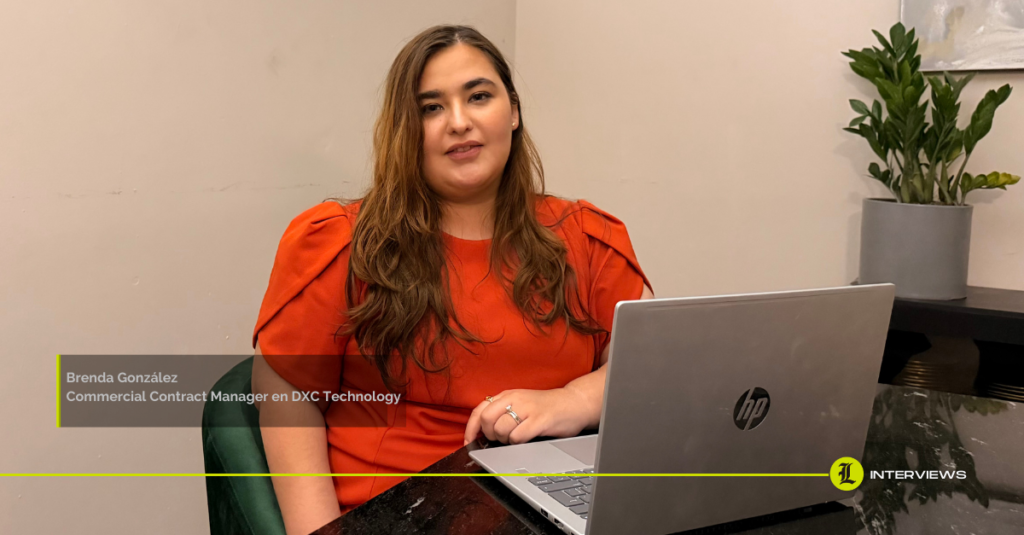
In an environment in which digital regulation is advancing faster than organisations, and artificial intelligence is redefining legal practice, Brenda González has developed an approach far removed from formalism. In her role as Commercial Contract Manager at DXC Technology, she has learned that the legal function cannot be confined to control; it must anticipate, translate and enable decision-making.
In this conversation for the special report Voices of Law: Dialogue with Partners and General Counsel from Latin America, she reflects on leadership, international negotiation and a fundamental question she considers key to the future of the sector: are we training lawyers to protect structures, or to build strategy?

Beyond the position: translating complexity into decisions
Looking back on her career, Brenda González is not defined by her title, but by the role she has chosen to assume within global organizations.
“Today I am a professional who understands that the legal role is not only about interpreting contracts and regulations, but also about enabling decisions. Beyond my position, I am someone who translates complexity into clarity and risk into strategy.”
Her evolution stems from specific decisions that shaped her approach. The first was choosing to be part of the conversation from the very beginning. “I decided to get involved in business conversations from the design phase, not just the final review.” This early involvement transformed her impact and her understanding of the business.
The second was assuming regional responsibilities in environments where regulation and culture don’t always easily align. “Working in contexts where norms and practices clash forced me to develop a peripheral vision. To understand not only the legal aspects, but also the cultural ones.”
And perhaps the most demanding was defending the technical criteria when the simple answer was to say yes. “The sustainability of an organization depends on consistency. Defending the legal criteria is not always popular, but it is structural.”
From technical lawyer to strategic business partner
There is a clear turning point in his story: the moment he realized that the contract was not the end, but the means.
“The change happened when I internalized that the contract is not the end goal, but a tool to make the business work.”
From that point on, their risk management ceased to be reactive. It was no longer solely about regulatory compliance, but also about financial impact, speed of closing, scalability of the model, and competitive positioning.
“Today I am not looking to avoid all risk, but to identify which strategy to adopt to gain competitiveness.”
The distinction is profound. In their view, the legal department’s role is not to hinder, but to calibrate. Not to eliminate uncertainty—something impossible—but to manage it judiciously and align it with the overall strategy.
Latin America: Flexibility without sacrificing ethics
Working in Latin America, he says, has given him a mastery of flexibility that is difficult to acquire in more predictable markets.
“The practical interpretation of the rule often carries more weight than the literal wording. And decision-making is deeply relational: trust is the true driving force behind agreements.”
But that flexibility has very clear limits. “I have learned to navigate the informality of the environment without ever compromising ethics or compliance.”
In short, the region demands a solid yet adaptable mindset. Rigor and flexibility. Norms and context. This combination has strengthened its judgment and its capacity for international negotiation.
Strategic anticipation: the true value of the legal area
In a global technology company, risk control is just the starting point.
“Risk control is the minimum requirement; strategic foresight is the real value.”
For González, the legal area adds real value when it detects regulatory changes – in privacy, artificial intelligence or digital governance – before they impact the product or the business model.
“The modern lawyer must be at the table where decisions are designed, not where they are corrected.”
That shift – from proofreader to architect – defines his way of understanding the legal function in technological environments.
From writer to systems architect
Artificial intelligence and contract automation haven’t diminished her role; they’ve transformed it. “My role is evolving from legal drafter to legal systems architect.”
Automation allows for the standardization of processes and frees up time, but it also demands greater technical sophistication. “Today we cannot have an opinion on data or AI without a deep understanding of how the tools work.”
Technology, when used properly, returns the lawyer to the area he considers truly different: human judgment.
“Technology gives us back the time to exercise judgment. And that is where our true value lies.”
Leading without physical presence
For Brenda, managing teams distributed across different countries has meant unlearning traditional assumptions. “I’ve had to unlearn the idea that physical presence equates to commitment or productivity.”
Remote leadership, he explains, is based on trust, absolute clarity of expectations, and cultural sensitivity. Consistency is not imposed by physical proximity, but by shared values and consistent communication that transcends borders.
What do you really expect from a law firm?
From his in-house perspective, the difference between a strategic and a purely technical firm is clear. “A strategic firm understands my business model, anticipates questions I haven’t yet asked, and doesn’t write to protect itself, but to solve my problem.”
It’s not just about legal excellence, but also about business acumen and a practical vision. The true legal partner, he argues, is one who feels like a natural extension of their own team.
The conversation he wants to open in Monterrey
At the Monterrey 2026 Legal Management Forum, organized by Gericó Associates, González is not looking to repeat predictable diagnoses. His interest lies in fostering a substantive conversation about the true role of the legal department within organizations.
“It is urgent to discuss how to measure the true value of the legal area and how to integrate AI without compromising governance.”
But there is one question he considers structural for the future of the profession: “Are we training lawyers to protect or to build?”
The issue is not rhetorical. It involves reviewing the educational model, the type of leadership that is fostered, and the role that lawyers should play in contexts of regulatory uncertainty and technological transformation.
“We have to ask ourselves if we are preparing future leaders to be merely technicians or to be human strategists capable of guiding organizations.”
Brenda González doesn’t see law as a system of containment, but as a design tool. Her professional journey reveals a clear conviction: the lawyer who only protects structures risks remaining on the periphery; the one who learns to build strategy becomes part of the decision-making core.
In a market where regulation is accelerating and technology is redefining roles, their message is clear: the value of the legal field is not in systematically saying no, but in knowing how – and when – to say yes with sound judgment.