

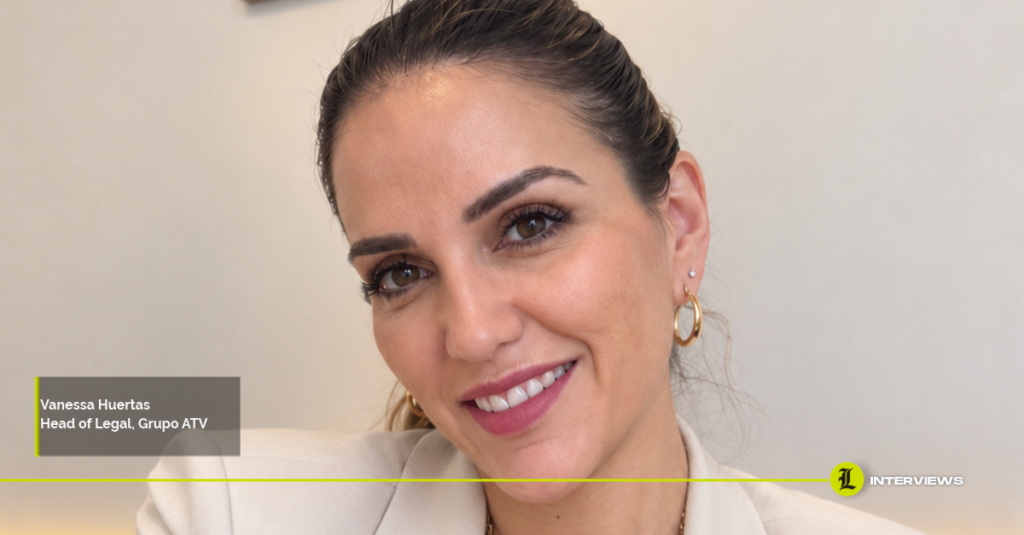
In a television network, many decisions are made against the clock, and a single mistake can compromise the media outlet’s credibility. Vanessa Huertas, Head of Legal at Grupo ATV, one of Peru’s leading television groups, responds to this pressure with a leadership style based on setting clear priorities and empowering the team to identify risks. She works daily with the news teams to balance the public’s right to be informed with the rights of the people being reported on. This principle also guides her approach to content circulating across television, streaming platforms, and social media, and to generative artificial intelligence, which necessitates reviewing talent authorizations and rigorously verifying news. Looking ahead to the Foro Gerencias Legales Lima 2026, she adds a personal goal: to make her voice heard and pave the way for more women in leadership positions. Regarding her team, she explains: “I want each member to feel confident saying, ‘I see a risk here,’ even when everyone is in a hurry.”
What stage of your career prepared you to lead the legal department of a media group?
The stage that prepared me the most was when I started participating directly in business decisions and seeing how our recommendations worked in practice. That’s when I understood that what we propose from Legal has consequences for people, teams, and projects.
I learned to listen to different departments, to negotiate, and to stand my ground when the risk demanded it. I also learned to look for alternatives: when a proposal wasn’t viable, I had to help find a solution that would allow us to move forward.
That learning has been key to managing the legal department of a media group, where many decisions are made against the clock. You have to have sound judgment, explain things clearly, and take responsibility for your recommendations.
Personally, I also learned to trust my experience and make my voice heard. As a woman, taking on a leadership position meant recognizing that I was prepared to occupy that role and that I had something valuable to contribute.
What have you learned about leadership leading a legal team in an industry that works against the clock?
I’ve learned that when everything is urgent, a leader’s first responsibility is to bring order. The team needs clear priorities; if we simply shift the pressure onto them, it’s easy to lose sight of what truly requires attention.
In television, time is very short and you have to respond quickly, but you also have to recognize when a decision deserves a few more minutes of review. That’s why I value my team asking questions, raising concerns, and proposing alternatives. I want each member to feel confident saying, “I see a risk here,” even when everyone is under pressure.
I’ve also learned that the way we communicate can either facilitate or complicate a decision. Our recommendation must be clear and helpful for whoever has to put it into practice.
And something I consider essential: urgency can’t take over everything. We must find space to teach, delegate, and recognize the team’s contributions. Seeing someone gain judgment and confidence to take on new challenges is one of the greatest satisfactions of a leader.
In a television group, how do you balance freedom of expression with legal risk management?
It is one of the most delicate responsibilities of the position, because every decision involves the right of citizens to be informed and the rights of the people about whom information is being provided.
I firmly believe we need media outlets that can investigate, question, and scrutinize independently. At Legal, we support this work by helping to ensure that information is published rigorously and with supporting evidence.
Often, our contribution begins with very specific questions: What evidence do we have? Are we distinguishing between an allegation and a proven fact? Is it necessary to identify the person? Have we sought their side of the story? To provide good guidance, it’s also essential to understand the journalistic context and the timelines of a newsroom.
A complaint does not automatically mean a publication is incorrect, and the public interest demands care in how we report the news. My responsibility is to evaluate each case independently, warn of the risks, and propose alternatives that allow us to maintain the informational value of the story.
That balance is built through daily work with journalistic teams. When there is trust and we can communicate effectively, we contribute to protecting freedom of expression and the credibility of the media outlet.
Audiences are increasingly consuming content on digital platforms. What challenges does this change pose for the protection of content rights?
The main challenge is that content can have many lives. A program airs on television, is published on a platform, and is then broken down into snippets for social media. Therefore, from the moment we produce or commission it, we must consider where we want to distribute it and what uses we want to give it.
We need to be clear about our rights to each element: images, music, performances, and third-party material. This clarity allows us to use the content safely and anticipate when we need additional authorization.
But there’s an equally important challenge: ensuring that this information reaches those who publish. A well-drafted contract is of little use if its terms don’t translate into clear guidelines for the teams. This is where coordination between Legal, Production, Sales, and Digital departments is crucial.
We must also be prepared to act when our content circulates without authorization, asserting our rights and assessing the appropriate response. Protecting our content means safeguarding the work of many people and the investment that allows us to continue creating new productions and supporting talent.
Looking ahead to 2027, what legal challenges does generative artificial intelligence pose for the audiovisual industry?
I think one of the biggest challenges will be understanding what we’re agreeing to when we use these tools. Sometimes we get excited about the results and postpone asking important questions: What happens to the material we upload? Can we use what it generates? Are we using the voice or image of someone who hasn’t authorized that use?
In a television company, these questions are very specific. There’s talent, contracts, and content that hasn’t even premiered yet. We need to review whether the authorizations we already have cover these uses and discuss their scope with the people involved.
In news, what worries me most is how easily an image or audio recording can appear real. Before sharing them, their origin and context must be verified. A mistake can affect a person and also the credibility that the media outlet has built up over years.
Looking ahead to 2027, I want to ensure that teams know how to use these tools and when to consult them. The rules need to be applicable to their daily work. From a legal perspective, we need to understand the technology, listen to those who use it, and address any questions promptly.
You are participating in the Foro Gerencias Legales Lima 2026,. Which topic on this edition’s agenda do you consider most relevant for the media industry?
I’m particularly interested in the panel on artificial intelligence, data, and cybersecurity. In the media, we work with a lot of information and content, and every tool we incorporate raises questions about how to protect it and what responsibilities we’re assuming.
For me, it’s important that we in the Legal department understand how these tools are used on a daily basis. This dialogue with the teams allows us to anticipate problems and provide recommendations that are truly helpful.
I also value the opportunity to listen to colleagues from other industries. We sometimes face similar difficulties, and learning how they have overcome them helps us to look at our own challenges in a different light.
Personally, participating in these spaces also means making my voice heard and sharing what I’ve learned. I would like to see more women encouraged to do so, to trust their experience, and to envision themselves in leadership positions. Those of us already in these roles can contribute by giving visibility to their work and opening up opportunities.