

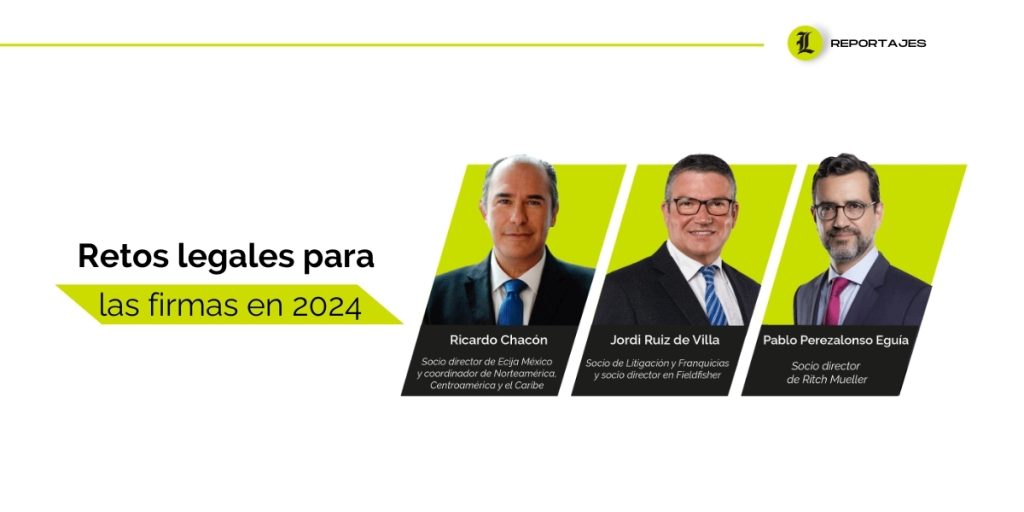
Given the climate of global uncertainty expected to continue in 2024, the debate has arisen about how law firms will navigate it. In this second installment, we consulted Ricardo Chacón, coordinator for North America, Central America, and the Caribbean and managing partner of Ecija Mexico; Jordi Ruiz de Villa, Litigation and Franchising partner and managing partner at Fieldfisher Spain; and Pablo Perezalonso Eguía, managing partner of Ritch Mueller Mexico, about the legal challenges of this new year.
The expansion of the Middle East conflict, the war in Ukraine, presidential elections in some Latin American countries, and inflation will largely determine how legal services are delivered. Other challenges in 2024, already present in the daily operations of law firms, include the implementation of technological tools, the adoption of internal ESG policies, organic growth, and attracting and retaining talent.
We invite you to read the first part: The Spanish legal profession faces 2024 with a focus on inflation, competitiveness, and talent acquisition.
Volatile environment that forces law firms to transform
For Ricardo Chacón, managing partner of Ecija México, navigating economic and geopolitical uncertainty will continue to be one of the challenges for the legal sector, as will the advancement of technology and its implications in our daily lives, the attraction and retention of talent in a tremendously competitive sector, and differentiation in the provision of professional services.
“The global landscape is characterized by constant change, and law firms must be able to adapt quickly to economic fluctuations, regulatory and technological changes, as well as market transformations. Law firms will need to continue developing proactive and flexible strategies to manage these risks and capitalize on the opportunities that arise from this dynamism. The ability to anticipate clients’ needs and offer timely, specialized advice will be essential to maintaining relevance in a volatile environment.”
To the above, Jordi Ruiz de Villa, managing partner at Fieldfisher Spain, added that “while it is true that we are in an environment of great uncertainty, it is also a time of great opportunity. The economic indicators we are monitoring point to a soft landing for the economy, but there are some risks (the expansion of the Middle East conflict, the war in Ukraine, and the real estate crisis in the Chinese economy) that could lead to a more severe adjustment. These risks require us to manage a VUCA environment, closely monitoring business development and having alternative strategies ready that we can implement quickly if necessary.”
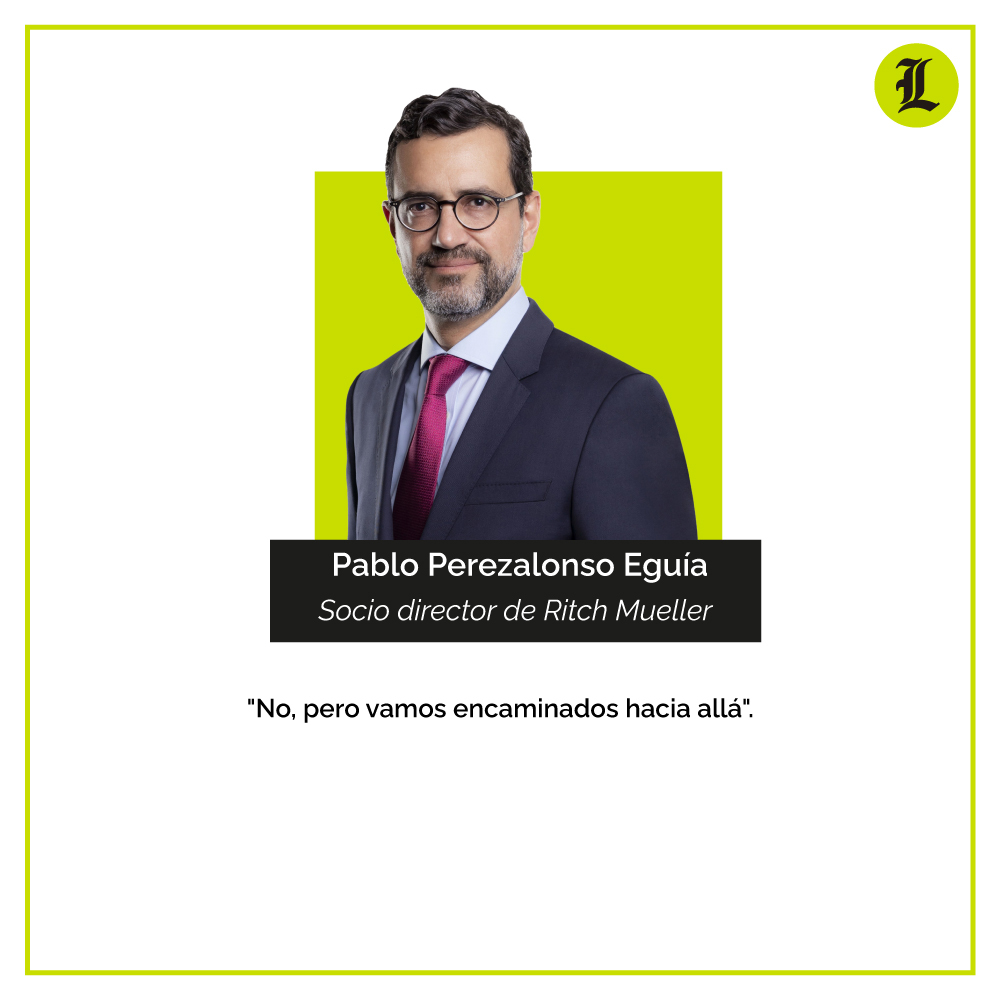
Pablo Perezalonso Eguía, managing partner of Ritch Mueller, added that “it is not foreseeable in the short term that this uncertainty will be resolved. Furthermore, Mexico will have presidential elections, which will create an atmosphere of anticipation for the first six months without many decisions being made, and the second half of the year will be for understanding the new government.”
Inflation will be a determining factor in the demand for legal services
Ricardo Chacón, managing partner of Ecija México, explained that inflation can undoubtedly influence the demand for legal services in various ways. “In an inflationary environment, companies often seek to optimize their operations and cost structures, which can increase the need for legal advice in areas such as corporate restructuring, tax optimization, and renegotiating contracts to include price adjustment clauses or terms indexed to inflation. It is also common to see more breaches of contract, making preventative advice from a dispute resolution perspective even more crucial.”
Inflation can also accelerate certain business transactions, such as mergers and acquisitions, as organizations seek synergies to mitigate the effects of rising costs. This, in turn, can increase the demand for legal services in commercial and corporate law. On the other hand, price fluctuations can generate litigation related to contractual disputes. Therefore, inflation can act as a catalyst for certain areas of legal practice where we are experiencing growth.
Jordi Ruiz de Villa, managing partner at Fieldfisher Spain, agreed that inflation “is accompanied by high interest rates, which affects the purchasing power of companies, while also generating impoverishment and a decrease in consumption in relative terms. Therefore, inflation affects the demand for legal services and puts pressure on their price.”
Contrary to what his peers commented, Pablo Perezalonso Eguía, managing partner of Ritch Mueller, believes that inflation will not be a determining factor in the demand for legal services.
Investment in technology, consolidation of new practice areas and strengthening of their teams, among the priorities of firms in 2024
Ricardo Chacón responded that his strategy for 2024 involves continuing the path laid out a few years ago: “to be a leading full-service firm in Digital Economics and Law where the firm has an absolute presence and reference in the Latin American market.
We have made a significant effort in recent years on both fronts, strengthening key areas globally such as privacy and data protection, intellectual property, TMT, among others, opening offices in new territories in Iberia and Latin America, where we already have a presence in 17 countries through 35 offices.
At Ecija we are more than 200 partners and 1000 professionals and we have positioned ourselves as the Ibero-American firm with the greatest presence in Latin America and a reference in Europe in TMT, strengthened by our strategic alliance with Taylor Wessing .
Finally, the firm still has a way to go in terms of sustainability and diversity. This is an area we are emphasizing both locally and globally.
Currently, 55% of professionals globally are women. However, we have a 30% female presence in executive positions, a figure that is above the industry average. (In Spain, we are the Spanish firm with the highest percentage of female partners. However, this is no consolation. Together with ECIJA by Women, an affinity group created by professionals at the firm, we work voluntarily on training, visibility, and action activities to achieve an environment that facilitates real equality between women and men at the firm, with the goal of reaching a higher percentage.)
Meanwhile, Jordi Ruiz de Villa said that among his priorities are “to continue growing with services that consolidate our position as an international firm and that allow us to offer increasingly sophisticated services to the growing number of international clients, without forgetting our traditional clientele.
Continue working on the engagement of our teams and continue investing in technology (including artificial intelligence) to improve our internal processes and achieve greater efficiency ratios.”
For Pablo Perezalonso Eguía, the important thing is “to continue positioning ourselves as market leaders, consolidate the newest practice areas and increase profits.”
The law must adapt to complex scenarios marked by new technologies
“The legal sector is undergoing a significant transformation, driven by three fundamental pillars: the integration of advanced technologies and their everyday impact, the attraction and retention of talent in a highly competitive environment, and the need to differentiate itself in the provision of professional services,” said Ricardo Chacón, who continued, noting that “technological progress, with developments such as Artificial Intelligence and blockchain, is fostering an unprecedented change in the industry. These innovations not only expand the horizon of possibilities for improving legal services, but also place the legal sector at a crucial turning point.”
Despite the rapid technological evolution that is widely discussed in the media, the reality is that legal practice is still in the initial stages of its digitization and transformation into true digital legal service entities.
The law faces the challenge of adapting to complex scenarios presented by technologies and the speed of societal evolution, artificial intelligence, the Internet of Things, blockchain, machine learning, and big data analytics. We are at a point where the legal sector must embrace, and above all, support, this evolution and the opportunities it brings.
According to Jordi Ruiz de Villa, “the main challenge will continue to be talent retention in an adverse demographic environment and with newgenerations that revolve around very different values from the generations that preceded them.”
Pablo Perezalonso followed, adding that among the firm’s major challenges are “political instability and uncertainty, the economic environment, adaptation to artificial intelligence and nearshoring.”
Business opportunities will focus on M&A , compliance , labor, energy, litigation, and AI
Ricardo Chacón clarified that there is no universal pattern and the potential growth of different areas depends largely on the specific nature of each country. However, he points out that the TMT area remains a fundamental pillar in every region where Ecija has a presence.
He added that “the Corporate, M&A, Litigation, and Labor areas are growing exponentially. We also see high potential for expansion in the Energy, Sustainability, and ESG practice. Regulations surrounding climate change and the energy transition are opening up opportunities in renewable energy projects, regulatory compliance, and corporate sustainability advice.”
Equally important, and with much development ahead, is the protection of personal data. Technological advances inevitably impact privacy issues, making it a constantly evolving area.
Of course, all of the above depends on proper regulatory compliance and the implementation of good corporate practices, which is why the practice known as “compliance” also becomes relevant.”
Jordi Ruiz de Villa predicts that by sector, “tax litigation and claims related to the recovery of damages (due to cartels, regulatory changes or derived from commercial relationships between individuals) may experience a strong expansion thanks to litigation funding funds.
Mergers and acquisitions (M&A) will continue to have a place, both through special transactions and within franchise networks. We also expect an improvement in refinancing, restructuring, and insolvency activity, and a surge in compliance and labor law as a result of the implementation of the whistleblower channel.
Finally, sectors such as tech data (in artificial intelligence projects), energy or pharma will continue to be important pillars of Fieldfisher.
Although there may be some slowdown in real estate investment in this latter part of the year, we are confident that from March of this year onwards there could be a solid recovery in this area.”
Pablo Perezalonso believes that the main sectors that will generate the most business opportunities will be banking and finance, real estate and M&A.
Talent is at the heart of law firm strategy
“Regarding talent, at Ecija, we place extraordinary emphasis on the individual, on values, and on providing a space for growth without limitations,” said Ricardo Chacón. “Our vision transcends the idea of a hierarchical institution with predetermined ‘levels’ that must be reached. Instead, we promote an environment where each person can advance according to their own enthusiasm, talent, initiative, and innovation. Our goal is for each team member to develop their full potential without feeling constrained by rigid structures.”
In addition, we implement training and mentoring programs that not only enhance their technical and legal skills but also guide them on their performance within the firm. We understand that motivation and commitment increase when employees feel valued and see a clear path for career advancement. These elements, combined with our corporate culture of teamwork and innovation, and our commitment to diversity and inclusion, contribute to making Ecija a place where lawyers,Regardless of their level of experience, they will find an environment conducive to their professional development, personal growth, and achievement of their goals.
We believe that sustainability and the environment will be an outstanding task for all companies in the immediate future.There is currently a societal demand. Our professionals are looking for highly responsible companies in which to develop their careers, and our clients are increasingly demanding to become highly efficient and profitable companies while integrating sustainability into their daily operations and business.
Therefore, in Ecija we developed our “ECIJA x Planet” campaign, which has several ESG components and activities that have been recognized by The Lawyer European Awards 2023 and Legal 500.
Jordi Ruiz de Villa told us that his motto is “a firm built around people,” so talent is at the heart of the firm’s strategy. “It’s not just about promoting flexibility and a good work environment, but about recognizing talent, providing expectations and recognition, for which continuous evaluation and a commitment to career development are essential.”
Furthermore, we promote values such as sustainability, equality and diversity through committees made up of people from all categories who help us with our continuous improvement processes.
Finally – and no less importantly – we coordinate with the rest of the Fieldfisher offices actions for charitable purposes that have allowed us to raise a record £250,000 in 2023, to give just one example.”
Pablo Perezalonso said that they will continue “looking for the best talent, adapting to the concerns of the new generations, but without neglecting quality and customer response.”
Technology and AI will set the standard in 2024
“To go from being a local firm to an international firm, we saw it as important to have an innovative mindset, not to be afraid to do things differently and to be the first to do something new, as well as to embrace diversity and adapt to local markets.Our model is a business model based on a service-oriented business structure that goes beyond the traditional partnership model. We understood that to grow, we needed to define an innovative and disruptive approach. Ecija’s model is probably unique in the Ibero-American market and is characterized by a polycentric spirit.
Therefore, in 2024 we will focus not only on continuing to grow internationally through our expansion strategy, but also on connecting, fostering know-how between offices and, of course, continuing to innovate through greater implementation of technology,” Ricardo Chacón pointed out.
For Jordi Ruiz de Villa, the key points that will be reinforced in 2024 and that will be important for their business model will be “technology and artificial intelligence applied both to sales processes and to work methodologies.”
Pablo Perezalonso responded that it will be about “getting closer to our clients to be their partners and not just service providers, investing in technology, including security and AI, improving hiring processes and following up with future partners.
In retrospect, are they where they want to be?