



The Mexico Plan, launched by President Claudia Sheinbaum in 2025 after a six-year term with the lowest accumulated GDP growth in the country’s recent history (4.9%), combines the promotion of nearshoring and administrative simplification with a declared objective of “energy and industrial sovereignty” that fully impacts the mining sector.
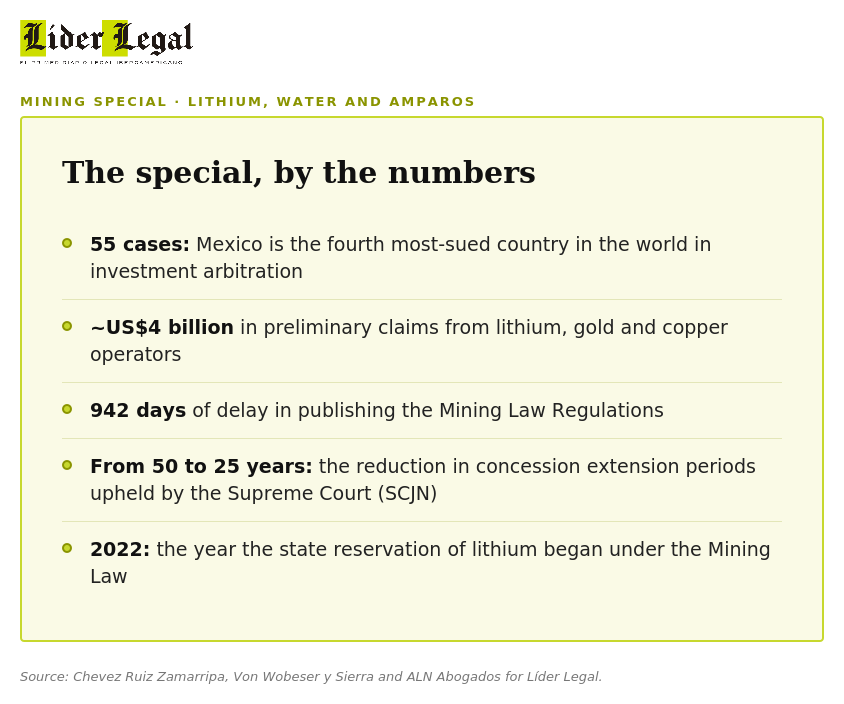
In this sector, the Plan coexists with two reforms that have redefined the landscape: the Mining Reform of May 8, 2023, which tightened the grounds for canceling concessions and left the regulations that were supposed to develop its central elements pending for more than 900 days; and the 2025 Water Reform, which introduced real-time telemetry measurement and a new type of criminal offense. The result is a parallel arbitration battle: with 55 active cases, Mexico is the fourth most sued country in the world in investment arbitrations, and claims from lithium, gold, and copper operators already total preliminary claims of nearly $4 billion.
Mexico 2030 Plan: Regulatory Certainty or Uncertainty?
Chevez Ruiz Zamarripa – César De la Parra (partner) and Ernesto Silva (associate)

Andrés Manuel López Obrador’s six-year term was one of the slowest in Mexico’s modern economic history, with a cumulative GDP growth of only 4.9% despite a growing public debt. One of the criticisms leveled against the former president was his lack of a long-term economic strategy with clear and well-defined objectives.
Considering this context, the new mayor, Claudia Sheinbaum, launched Plan México in 2025 as part of a strategy to boost economic growth and development, fostering investment primarily through the promotion of nearshoring, the implementation of infrastructure projects, and the simplification of administrative procedures. Plan México, however, has not neglected the social aspects that characterize the current administration, such as the continuous increase in the minimum wage, the expansion of social welfare programs, and the implementation of policies aimed at guaranteeing the country’s energy and industrial sovereignty—the latter being of particular importance to the mining sector.
In the mining sector, the Mexico Plan has been implemented alongside a series of reforms published in 2023 that entail significant regulatory changes directly impacting mining companies. These changes redefine the regulatory and administrative burdens on companies, and non-compliance can lead to the cancellation of mining concessions and severe administrative and even criminal penalties.
One of the most significant changes is the so-called water reform, which imposes new obligations regarding water management. The mining sector, by its very nature, can use significant quantities of water, which can have a considerable impact on regions where water is scarce (arid or semi-arid regions).
In 2025, the National Water Law was reformed, establishing strict obligations to measure the total volume of water extracted, used, or appropriated from basins and aquifers, as well as water from mining operations or other services. This measurement must be carried out using telemetry devices capable of transmitting data to the authorities in real time, allowing them to measure surface and groundwater intakes.
This reform has been accompanied by the implementation of a new crime punishable by imprisonment and significant fines. This crime is triggered when there is environmental damage caused by the discharge of untreated wastewater, and also in cases of corruption and collusion with public officials in the water sector. The inclusion of this crime means that mining companies must exercise particular care in complying with policies and best practices to avoid causing environmental damage that could be classified as a criminal offense by the authorities.
Also related to environmental conservation is the recent regulation issued regarding forest sustainability. The General Law of Ecological Balance and Environmental Protection requires companies to submit a Mine Restoration, Closure, and Post-Closure Program that establishes the actions for environmental repair, restoration, rehabilitation, and remediation. Mining companies must contribute to ecosystem restoration instead of simply compensating for the damage caused through financial resources.
The new obligations applicable to mining companies are significant considering that compliance with these obligations is now required to obtain extensions on mining concessions. Furthermore, in certain serious cases, such as lacking a water concession for industrial mining use, failing to submit a mine closure plan, or if there is a risk of ecological imbalance or damage to natural resources, the authority may cancel the mining concession, in addition to imposing other administrative sanctions such as fines and the aforementioned new criminal offense.
The change in mining regulations does not, in itself, significantly increase legal certainty for mining companies, as most of the obligations are clearly defined. What has generated uncertainty for the sector within the context of Plan Mexico is the recent ruling issued by the then First Chamber of the Supreme Court of Justice of the Nation in amparo appeal 391/2024, which establishes that the general regulatory framework applicable to mining concessions can be unilaterally modified by the State in the public interest.
According to the Supreme Court, mining companies do not have any vested rights beyond those strictly contractual matters related to a mining concession, such as the concession’s duration, the authorized material, and the purpose of the exploitation. Any regulatory issue in force at a given time constitutes merely an expectation of a right and cannot be invoked if it is modified.
The precedent set by the First Chamber implies that holders of mining concessions cannot count on economic and legal certainty, since their obligations can be modified by the Mexican government without prior notice or consultation, even when these modifications lead to an unviability in their operations.
Having said that, we recognize that the reforms implemented under the Mexico Plan pursue legitimate objectives of social interest. The protection of national waters, the restoration of forest ecosystems, and the guarantee of responsible mining are goals that respond to real needs. In a country where mining activity has sometimes generated environmental impacts that have had to be remediated, it is reasonable for the State to seek to update the regulatory framework to balance economic development with environmental sustainability and the well-being of affected populations.
However, to preserve the essential legal certainty that mining companies require to operate and invest in Mexico, it is crucial that these reforms be implemented proportionally, gradually, and with full respect for due process. The possibility of unilaterally modifying the regulatory framework without any limitations, as suggested by the precedent set by the First Chamber, could discourage investment in the sector and jeopardize the economic viability of mining projects that require long-term planning.
In this regard, the Mexican government must ensure that the regulatory burdens imposed are reasonably related to the objectives pursued, establishing adequate transition periods, prior consultation mechanisms with stakeholders in the sector, and objective criteria that allow companies to anticipate and adapt to regulatory changes.
Von Wobeser and Sierra – Edmond Grieger (partner) and Stefania Lopardo (associate)

While we believe that the Mexico 2030 Plan does not reduce legal certainty for mining investment, if the Plan is understood within the framework of the Mining Reform of May 8, 2023 (the “Reform”), it does generate some uncertainty regarding environmental sustainability, water management, and social license. This is because current mining regulations in Mexico are incomplete and uncertain for three main reasons:
1) Pending litigation: The Supreme Court has revoked -in the use of its power of attraction- injunctions against specific articles of the Reform; however, actions of unconstitutionality and the resumption of multiple injunction trials -even in the review stage- that have been paralyzed (for more than two years), and others already resolved but in contradictory senses, which has generated, at the same time, dispersed jurisprudential criteria and lack of clarity on controversial points.
2) Legal regulation deficit: Within the framework of the Mexico 2030 Plan, the certainty of new projects will depend on clear secondary regulations—such as the Regulations of the Mining Law, whose publication is 942 days late—that should develop the bases, forms, and processes of the figures and obligations established by the Reform (for example, the “financial vehicle” that must be obtained prior to the granting of the title); and
3) Subjection to the authority’s discretion: In the absence of secondary legislation, and given that the certainty factor in the new Mining Law is no longer limited to mere geological availability but also includes the ability to overcome ex-ante filters and additional obligations, there is currently a margin of discretion. This is because the post-Reform Mining Law provides for public tenders as a replacement for “open land,” as well as social impact assessments, prior consultations, and grounds for revocation with interpretable application parameters. An example of this regulatory gap is the management plans for water, waste, and mine closure, for which there are still no defined schedules, thresholds, metrics, or compliance pathways.
In short, the Plan constitutes a programmatic ordering that, by itself, does not generate certainty or more uncertainty; rather, such a dilemma will be defined to the extent that the corresponding regulatory framework is effectively and clearly regulated and executed.
ALN Lawyers -Joel González (managing partner)

The State has the full right to redefine public policy applicable to the mining sector. The problem is not the regulation itself, but the predictability with which it is implemented. Investment can adapt to more demanding environmental, social, or governance standards, provided that the rules are clear, consistent, and applied uniformly.
The line between legitimate regulation and legal uncertainty emerges when regulatory changes substantially alter the expectations under which long-term investments were made, without adequate transition mechanisms or administrative certainty. In mining, where projects require significant time to develop, regulatory stability is essential for decision-making. Therefore, we have emphasized the concept of social and regulatory resilience in projects, which refers to the capacity of mining companies to adapt to new regulations and the evolving expectations of authorities and project stakeholders.
El frente arbitral
Chevez Ruiz Zamarripa – César De la Parra (partner) and Ernesto Silva (associate)
As mentioned, failure to comply with some of the new administrative requirements can result in the unilateral cancellation of a mining concession by the Mexican government. The authorities are aware of this, to the point that there have been cases in which mining companies are pressured to take certain actions that often fall outside the purely regulatory sphere, such as, for example, paying taxes that the Tax Administration Service deems owed.
In addition, the “nationalization” of lithium in Mexico constitutes a problematic case of state intervention in the extraction of this mineral. This process began in 2022 with modifications to the Mining Law establishing that the exploration, exploitation, processing, and use of lithium were reserved for the benefit of the Mexican people. This reform did not initially affect existing mining concessions but applied only to future activities, creating a dual legal framework. However, the Mexican government subsequently began canceling lithium mining concessions, prompting some foreign operators to initiate or threaten to initiate international legal proceedings to protect their investments.
For U.S. companies, Chapter 11 of NAFTA (for investments made during the treaty’s term), Chapter 14 of the USMCA, and, specifically for Canada, the CPTPP, offer investment protection mechanisms against actions taken by the governments of the participating countries. Under these treaties, the countries must ensure a minimum standard of treatment for investors, which includes fair and equitable treatment, protection of the principle of legal certainty, and a prohibition on expropriation without compensation, subject to certain considerations.
The actions of the Mexican government have led foreign mining groups to file claims in arbitration tribunals alleging direct and indirect expropriation without compensation and violations of the minimum treatment principle stipulated in international treaties. Specific cases such as those of Ganfeng Lithium/Bacanora Lithium, Odyssey Marine Exploration (deep-sea mining), Almaden Minerals, and Silver Bull Resources, involving the cancellation of mining concessions, have compelled Mexico to defend its position in arbitration tribunals.
The above cases are just some of the most high-profile cases in which Mexico has been accused of taking actions that violate rights protected in international treaties; however, there are many others, since with 55 cases, Mexico is currently the fourth most sued country in the world in investment arbitrations, which represents a very important economic contingency for the Mexican government.
Von Wobeser and Sierra – Edmond Grieger (partner) and Stefania Lopardo (associate)
The activation or threat of activation of Chapter 14 of the USMCA looms over two already accomplished facts: (i) the administrative cancellation of mining concessions – currently viable without a robust sanctioning procedure, given the regulatory gap – and (ii) the state reserve of lithium introduced in 2022 and enshrined in the Mining Law.
From the perspective of foreign investors, both measures exhibit the classic elements of indirect expropriation: substantial deprivation of economic value, lack of compensation, and, in several cases, retroactive application to existing titles. If we add to this the regulatory volatility—public tenders still lacking technical rules, indefinite social impact assessments, and imprescriptible powers of annulment—the minimum standard of fair and equitable treatment (FET) of Article 14.6 is compromised by a lack of transparency, an abrupt change in legitimate expectations, and potentially discriminatory treatment compared to the direct allocation to the state-owned company Litio para México. The State, of course, could invoke Article 14.16 (Right to Regulate) and the public policy clause of Annex 14-B, arguing that mining and lithium are strategic resources whose reservation and protection serve legitimate public policy, environmental, and even national security objectives; But NAFTA/T-MEC jurisprudence demonstrates that invoking sovereignty is not enough when the measure lacks proportionality or a clear and non-discriminatory process.
In terms of defensive capabilities, Mexico has a consolidated State Defense Office following the initial defeats of NAFTA and a recent track record of mostly favorable rulings (e.g., Eco Oro, Watkins); however, the current regulatory asymmetry increases the risk of arbitration liabilities. Claims announced by lithium, gold, and copper operators already total preliminary claims of nearly $4 billion, a figure that—although still contingent—exceeds the total amount paid by Mexico during the NAFTA era. The true turning point will be the acceptance or rejection of the defense of “non-discriminatory fiscal and environmental measure” and proof that the cancellations followed due process. Currently, that proof is weak: there are no regulations defining the parameters for revocation, nor has proportionality been demonstrated in relation to the lost investment. Thus, the Mexican State does have arguments to uphold its regulatory margin, but procedural weaknesses and regulatory ambiguity make these defenses uncertain gambles. Until the regulatory deficit is addressed and clear avenues for compensation or coexistence are established, the latent arbitration liability will continue to grow and the “country risk” perceived by the mining industry will remain above what is officially recognized.
ALN Lawyers – Joel González (managing partner)
Mexico has legal arguments to defend the exercise of its regulatory powers, particularly when the measures pursue objectives of public interest. However, in international arbitration, it is not enough to demonstrate regulatory authority; it must also be shown that its exercise respected international standards for the treatment of investment.
Another very important factor to consider is that operators who intend to activate these arbitration procedures have the obligation to exhaust all domestic procedures available in the jurisdiction in which they operate prior to the activation of Chapter 14 of the USMCA, and in this sense it is essential to have specialized advice to comply with this requirement.
Each dispute will depend on its specific circumstances. There will be cases where the State’s position is strong and others where the financial exposure could be significant. It is premature to quantify potential arbitration liabilities, but it is clear that the decisions adopted in recent years increase the risk of international litigation, which will require close monitoring.
Injunctions without a single rule
Chevez Ruiz Zamarripa – César De la Parra (partner) and Ernesto Silva (associate)

The amparo proceeding is a constitutional protection mechanism that, in the Mexican legal system, allows individuals to protect themselves from acts of authority that violate their fundamental rights. These proceedings are ordinarily resolved by District Courts and Circuit Courts of Appeals, which must follow the guidelines established by the Supreme Court of Justice of the Nation (SCJN) through jurisprudence.
Regarding the cancellation of concessions and expropriations, the SCJN has recently established, as we have mentioned, that the regulatory framework that a mining company has when obtaining its concession does not imply an acquired right that assures it of the type of obligations that it must fulfill during the validity of its concession.
Conversely, this criterion establishes that the government can unilaterally modify the obligations that the concessionaire must fulfill in order to maintain its concession. Thus, if a cancellation stems from an actual breach of this type, we could observe that the corresponding act would not, in principle, be unconstitutional, and therefore a constitutional challenge would be unlikely to succeed.
The Supreme Court of Justice of the Nation (SCJN) has also ruled on the reform to the then-called Mining Law that reduced the extension periods of a mining concession, resolving that said change is not unconstitutional.
This means that a company that acquired a mine under the previous law made its investment assuming it could later obtain a 50-year extension. However, the change to the extension period, reducing it to 25 years, is not a matter that mining companies can challenge. This is because, according to the Supreme Court of Justice of the Nation (SCJN), the initial possibility of obtaining a 50-year extension was not an acquired right for mining companies but merely an expectation of a right. Therefore, it is irrelevant that the investment was made assuming a 50-year extension that ultimately cannot be obtained. Consequently, injunctions against this type of modification would not succeed in our federal courts.
Thus, it is considered that an amparo trial would have elements to succeed when it involves mining concessions that have been illegally cancelled by the authorities, when there is evident compliance with the regulatory provisions, or when there is an expropriation without adequate compensation.
It should also be noted that apart from the amparo trial, some mining companies (depending on their origin) can apply the protections provided for in the international trade treaties that Mexico has signed and that contain protections for investments made in our country.
Von Wobeser and Sierra – Edmond Grieger (partner) and Stefania Lopardo (associate)
We believe that the universe of injunctions likely to succeed cannot be measured by counts, but rather by “groups” of cases. We consider that those who demonstrate a consolidated legal position and a specific act of application that directly affects their title or its extension, with relevant procedural or substantive defects, have reasonable expectations: cancellations or denials based on open clauses without technical parameters (risk to the population, water availability), absence of operational regulations, lack of justification and proportionality, or sanctioning procedures lacking essential formalities. Injunctions against measures that disregard express acquired rights stated in the titles themselves, or that retroactively apply new grounds, are also defensible. In contrast, the State usually “wins from the outset” when the complainant only had pending applications at the time of the reform—a mere expectation, not an acquired right—when the aim is to invalidate the bidding process or the abstract lithium reserve through an individual injunction, or when the grievance is diffuse and no direct personal impact is demonstrated. In such cases, the impropriety due to lack of legal interest or for seeking abstract control of norms is the rule, and, even going into the substance, the regulatory margin of the State prevails if the measure is justified in legitimate purposes, is applied in a non-discriminatory manner and passes a test of reasonableness.
The Supreme Court’s decision-making threshold is being defined around three well-known guidelines. First, the strict distinction between acquired rights and mere expectations: faced with pending requests or unconsolidated interests, the Court has denied amparo (constitutional protection) and upheld transitional provisions that dismiss unresolved proceedings. Second, the procedural framework: the Court requires an act of application that is subject to challenge, respect for the principle of finality except for self-executing norms, and procedures with guarantees when the sanction is extinctive (cancellation or revocation). Third, substantive constitutionality: the right to regulate prevails if the restrictions are clear, proportionate, and non-discriminatory; however, when the authority relies on indeterminate clauses, lacks technical support, or omits sufficient justification, avenues for review are opened. Added to this picture is an operational fact that increases the probability of success in well-presented cases: the lack of secondary regulations for more than nine hundred days, which increases indeterminacy and discretion, and weakens the defense of strict legality in cancellations or refusals issued without regulated standards.
ALN Lawyers – Joel González (managing partner)
There is no single answer. Amparo proceedings will not be resolved by general categories, but rather based on the specific circumstances of each case.
Cases with the highest probability of success are those where violations of due process, retroactivity, lack of legal basis, or disproportionate infringement of previously acquired rights can be proven. Conversely, when the authority acted within the existing legal framework and respected procedural guarantees, the State’s defense will be considerably stronger.
The Supreme Court has favored a case-by-case analysis, weighing principles such as legal certainty, legality, legitimate expectation and proportionality, avoiding establishing absolute rules applicable to all procedures.
It is equally important in order to determine the expectation of success of each particular company to have a detailed, well-founded opinion of the particular case of each challenge procedure.
Criminal risk related to water
Chevez Ruiz Zamarripa – César De la Parra (partner) and Ernesto Silva (associate)
One of the most significant changes is the so-called water reform, which imposes new obligations regarding water management. The mining sector, by its very nature, can use significant quantities of water, which can have a considerable impact on regions where water is scarce (arid or semi-arid regions).
In 2025, the National Water Law was reformed, establishing strict obligations to measure the total volume of water extracted, used, or appropriated from basins and aquifers, as well as water from mining operations or other services. This measurement must be carried out using telemetry devices capable of transmitting data to the authorities in real time, allowing them to measure surface and groundwater intakes.
This reform has been accompanied by the implementation of a new crime punishable by imprisonment and significant fines. This crime is triggered when there is environmental damage caused by the discharge of untreated wastewater, and also in cases of corruption and collusion with public officials in the water sector. The inclusion of this crime means that mining companies must exercise particular care in complying with policies and best practices to avoid causing environmental damage that could be classified as a criminal offense by the authorities.
Von Wobeser and Sierra – Edmond Grieger (partner) and Stefania Lopardo (associate)

With the enactment of the General Water Law and the corresponding reforms to the National Water Law, the “criminal threat” ceased to be merely rhetorical and moved to a mixed system, with specific water-related offenses and a more severe sanctions regime. Today, the criminal risk is direct in cases such as extraction without a permit, alteration of watercourses, manipulation or fraud in water meters, and acts of corruption related to permitting procedures; however, the outright omission of measuring volumes or paying fees for “agricultural water”—isolated from other factors—continues to be primarily considered an administrative and fiscal infraction subject to closure, reduction of volumes, revocation, and substantial fines.
[ALN Abogados – Joel González]ALN Lawyers – Joel Gonzalez[/ALN Abogados – Joel González
The regulatory trend is clear: environmental compliance, and specifically water compliance in light of the aforementioned reform, has ceased to be merely an administrative matter and has become a central component of corporate risk management.
However, criminal law should remain a last resort. In practice, its application will depend on the existence of intentional misconduct or serious and repeated breaches, rather than isolated administrative errors.
For companies, the message is clear: strengthening compliance, traceability, and water management systems is no longer a good practice, but a necessity to reduce legal, operational, and reputational risks.
As we have pointed out previously, it will not be unusual, in the short term, to find more frequently companies adopting specific areas or departments for the management and administration of their water resources.
The concession is no longer enough
Chevez Ruiz Zamarripa – César De la Parra (partner) and Ernesto Silva (associate)
Due to reforms to the Mining Law, the grounds for canceling mining concessions have been significantly expanded to include various administrative infractions. This has led to an increase in cancellation proceedings by Mexican authorities.
Issues such as not paying the contributions applicable to the mining sector for two consecutive years have led to the fact that now, determinations made by the Tax Administration Service regarding income and deductions that previously only affected the federal tax sphere (such as income tax), can now affect the validity of a concession, since these differences determined in income and deductions can have effects on the calculation of the mining rights provided for in the Federal Law of Rights.
The audit programs carried out by the Tax Administration Service on large companies, including mining companies, have increased in recent years, which has led to a matter such as federal taxation having increasing relevance in the mining sector.
Other obligations that, due to their complexity, may cause the cancellation of concessions, are having a valid water concession for industrial use in the mine, for which a series of requirements and administrative obligations must be met, including keeping a control and measurements on the amount of water used.
Compliance with environmental obligations, such as the Mine Closure Plan, has also become particularly relevant, as have the imminent risks of ecological imbalance, irreversible damage or deterioration to natural resources, and cases of contamination with dangerous repercussions for ecosystems, surface or groundwater hydrological systems, or public health. These factors can generate some uncertainty for concession holders due to the inherent subjectivity in assessing the potential risk.
Von Wobeser and Sierra – Edmond Grieger (partner) and Stefania Lopardo (associate)
Yes. We have handled cases where mining concession titles were in compliance with applicable regulations—current, up-to-date on tax, regulatory, and environmental obligations, and with a sound technical design—and yet the project still proved unfeasible. The clearest pattern is the trend of denying extension requests: since the reform of May 8, 2023, and with regulations pending, the administrative decision relies on open-ended clauses—risk to the population, water availability, location within protected natural areas, and the seventh transitional provision that prohibits extensions in those areas—without a public methodology, verifiable thresholds, or an explicit proportionality test.
ALN Lawyers – Joel González (managing partner)
Today, a concession represents only one component of the project. Legal viability depends on a much broader set of regulatory, environmental, social, territorial, and governance authorizations.
Our experience shows that the greatest challenges are usually concentrated in obtaining and maintaining environmental permits, the legal availability of water, the relationship with communities, and coordination between authorities at different levels of government.
Modern mining demands a comprehensive vision from a holistic point of view in which companies understand that participation and communication between all their areas, from those in charge of operation, exploration, to environment, water, communities and legal, given the implications that the interaction of all these departments of the mining company has.
The success of a project no longer depends exclusively on the mining title, but on the ability to proactively manage all the regulatory risks that accompany its development, as well as close communication between authorities, communities and actors within its area of influence.
What the debate leaves behind
Beyond the nuances, the three firms agree on a common diagnosis: the problem is not that the State regulates the mining sector—it has the power to do so—but rather the lack of secondary regulations and objective criteria for exercising that power. Chevez Ruiz Zamarripa locates this in the precedent set by the First Chamber regarding amparo appeal 391/2024; Von Wobeser and Sierra quantify it in the 942-day delay in the Regulations of the Mining Law; ALN summarizes it as a problem of predictability rather than regulation itself. All three analyses arrive at the same conclusion: without clear operating rules, administrative discretion will continue to be the norm.
On the arbitration front, the difference lies in the emphasis: Chevez Ruiz stresses the volume of litigation (55 cases, making it the fourth most sued country in the world), Von Wobeser focuses on the economic magnitude (nearly $4 billion in preliminary claims), and ALN emphasizes the often-overlooked procedural requirement of exhausting domestic remedies before resorting to arbitration. Regarding injunctions, there is complete consensus: there is no general rule, and the truly important criterion is the distinction between acquired rights and mere expectations, as the Supreme Court of Justice of the Nation (SCJN) has been defining it on a case-by-case basis.
On water-related criminal matters, Von Wobeser and ALN are almost in complete agreement: the criminal offense exists and is real, but its practical application is reserved for intentional misconduct or serious and repeated breaches, not for isolated administrative errors—which does not exempt companies from strengthening their measurement and traceability systems immediately. And on the point that should most concern legal and compliance departments, all three firms are unanimous: a mining concession is no longer, in itself, synonymous with viability. The real risk factor today lies in water permits, environmental management, community relations, and constitutional litigation, all coordinated as a single front.