

By 2026, Brazil’s big law firms will no longer be debating whether to adopt artificial intelligence, but rather how to integrate it securely, strategically and in a way that genuinely generates value. Growing pressure for efficiency, predictability and closer client relationships has raised market standards and shifted the focus away from the tool itself towards people, processes and institutional knowledge.
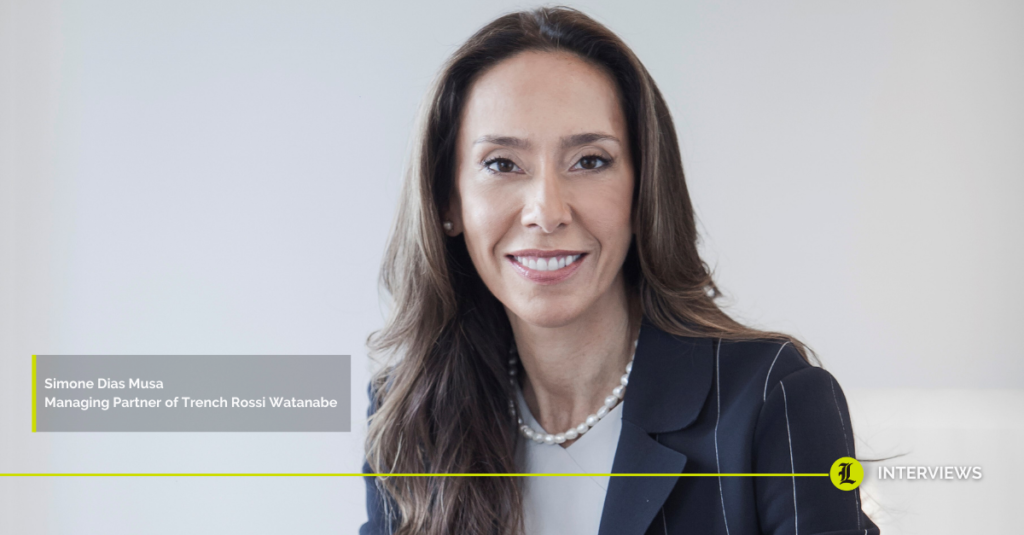
This conversation with Simone Dias Musa, managing partner of Trench Rossi Watanabe, forms part of our special report “Brazil in 2026 and the new market logic: the ‘big law’ perspective”. Her view rests on a clear premise: competitive advantage will no longer stem from adopting technology per se, but from the ability to apply it judiciously, anchored in the firm’s own knowledge base.
Artificial intelligence: from widespread access to intelligent use
One of the firm’s main strategic priorities for 2026 is the deeper integration of artificial intelligence across all areas of its practice. Trench Rossi Watanabe already uses tools such as Copilot across all practice groups and has launched pilot projects with more specialised solutions, including Legora. AI adoption also extends to key administrative functions, such as finance, billing and collections.
The objective is to enhance productivity and quality, both at an individual and collective level, without compromising agility or excellence in service delivery. Musa, however, draws an important distinction:
“The difference between law firms will not be the AI tool they use, but the talent of their people and their ability to apply that technology, with quality and security, to their own databases”.
Accordingly, the firm has embarked on a deep restructuring of its knowledge-management systems, fully aware that poorly organised data not only limits AI’s effectiveness but also introduces material risk.
Mandatory training and a review of the economic model
AI integration is not merely a technological decision; it is an organisational one. As a direct consequence, the firm will introduce mandatory training for all lawyers, across all practice areas, through programmes in Brazil and abroad focused on the practical application of these tools. The rollout will take place in stages starting in 2026.
This transformation also challenges traditional economic assumptions.
“Greater AI integration requires a restructuring of fee models and a review of compensation systems and performance metrics”.
Technological efficiency places increasing pressure on billable-hour-based structures and opens the door to alternative pricing formats more closely aligned with the value delivered to clients.
Transactional expansion and physical proximity to clients
Another strategic priority for 2026 is the continued expansion of the firm’s transactional practice, a process initiated more than a decade ago. The addition of new partners and the creation of specialised teams in finance, capital markets and M&A have driven sustained double-digit growth.
This momentum is also reflected in physical infrastructure decisions. The firm will expand its presence to Avenida Faria Lima, in the Salma Tower, while simultaneously modernising its longstanding headquarters on Avenida Chucri Zaidan, where it has operated for 27 years.
“Maintaining both spaces allows us to be closer to our strategic clients and to respond to a renewed demand for physical proximity in the post-pandemic environment”.

The alliance with Baker McKenzie and the value of global reach
Against a backdrop of growing geopolitical volatility, Trench Rossi Watanabe’s nearly 70-year alliance with Baker McKenzie has taken on renewed strategic relevance. According to Dias Musa, in a context of heightened international uncertainty, Baker McKenzie’s global footprint and accumulated institutional knowledge enable the firm to support multinational clients with agility and depth. “In a scenario of geopolitical turbulence, Baker McKenzie’s extensive global presence allows us to address challenges related to foreign trade, to review and protect business models against emerging geopolitical risks, and to navigate tax trends and reforms both in Brazil and internationally”.
“The firm’s ability to advise on increasingly complex cross-border transactions, she adds, remains a core strategic priority”.
A more informed and value-driven client
Today’s corporate client is more sophisticated, better informed and significantly more demanding. According to Dias Musa, clients now “expect cost predictability, operational efficiency, including the intensive use of AI, clear communication, and a deep understanding of their business and strategic objectives”.
The centre of gravity has shifted decisively towards perceived value: impact, opportunity and transparency.
“It is essential to generate value at the right moment, and to communicate it with the level of clarity clients expect”.
This shift is accelerating the transition away from hourly billing towards value-based fee structures. To support this evolution, the firm has established a dedicated pricing department and built specialised teams in Legal Operations, Project Management and Knowledge Management, providing data-driven decision-making, process discipline and greater predictability.
Rainmakers: from individual business generation to sustained impact
The role of the rainmaker remains critical, but no longer functions in isolation. In Dias Musa’s view, the rainmaker of 2026 creates sustainable value by translating a client’s strategic priorities into integrated legal solutions.
“Clients increasingly value trust-based relationships and long-term partnerships”.
Beyond networking skills, the modern rainmaker must demonstrate strategic vision, collaborative leadership, empathy and the ability to coordinate multidisciplinary teams within complex organisations.
Areas of opportunity in an increasingly complex market
“We continue to invest in strengthening and positioning our transactional practices, which have seen significant growth and which we expect to expand further. We anticipate an increase in corporate reorganisations and strategic transactions aimed at optimising results and generating value. We also foresee intense activity in the funds sector, as well as in debt and restructuring”.
Dias Musa adds that the firm is also closely monitoring International Trade, in response to shifts in global markets and evolving tariff regimes. Artificial intelligence, intellectual property, data protection and cybersecurity are expected to gain further relevance -both in litigation and in response to legislative developments in Brazil. Labour law is likely to follow a similar trajectory.
Energy, infrastructure, ESG, carbon credits and nature-based solutions are set to attract growing demand, alongside a tax agenda shaped by Brazil’s Tax Reform and the application of transfer pricing rules.
Talent, leadership and culture as competitive differentiators
For Trench Rossi Watanabe, talent development and retention are central pillars of its long-term strategy. Preparing future leaders depends on structured development programmes, a continuous feedback culture and diversified career paths.
Among these initiatives, RISE stands out – an exclusive programme for senior associates focused on developing strategic thinking, business acumen and management capabilities, while strengthening the leadership pipeline and increasing female representation. At a more advanced stage, LIFT, aimed at high-potential female associates, accelerates leadership development and reinforces a sustainable and diverse succession plan.
“We firmly believe that diverse teams make better decisions, foster innovation and more accurately reflect both society and our clients”.
From this perspective, leadership plays a decisive role in balancing high performance, innovation and individual well-being. Leading by example, fostering open dialogue and ensuring that growth does not come at the expense of burnout are non-delegable responsibilities.
“Culture is not imposed; it is built day by day through coherent decisions”.
In Brazil’s big law landscape of 2026, technology will be a shared starting point rather than a differentiator. The firms that stand out will be those capable of integrating talent, data, leadership and culture into a coherent, long-term institutional project. As Simone Dias Musa’s perspective makes clear, the issue is not access to more technology, but the ability to use it better -without losing sight of the people who ultimately sustain the firm.
It is in this combination of judgement, coherence and culture that the true differentiation of today’s legal market lies.