


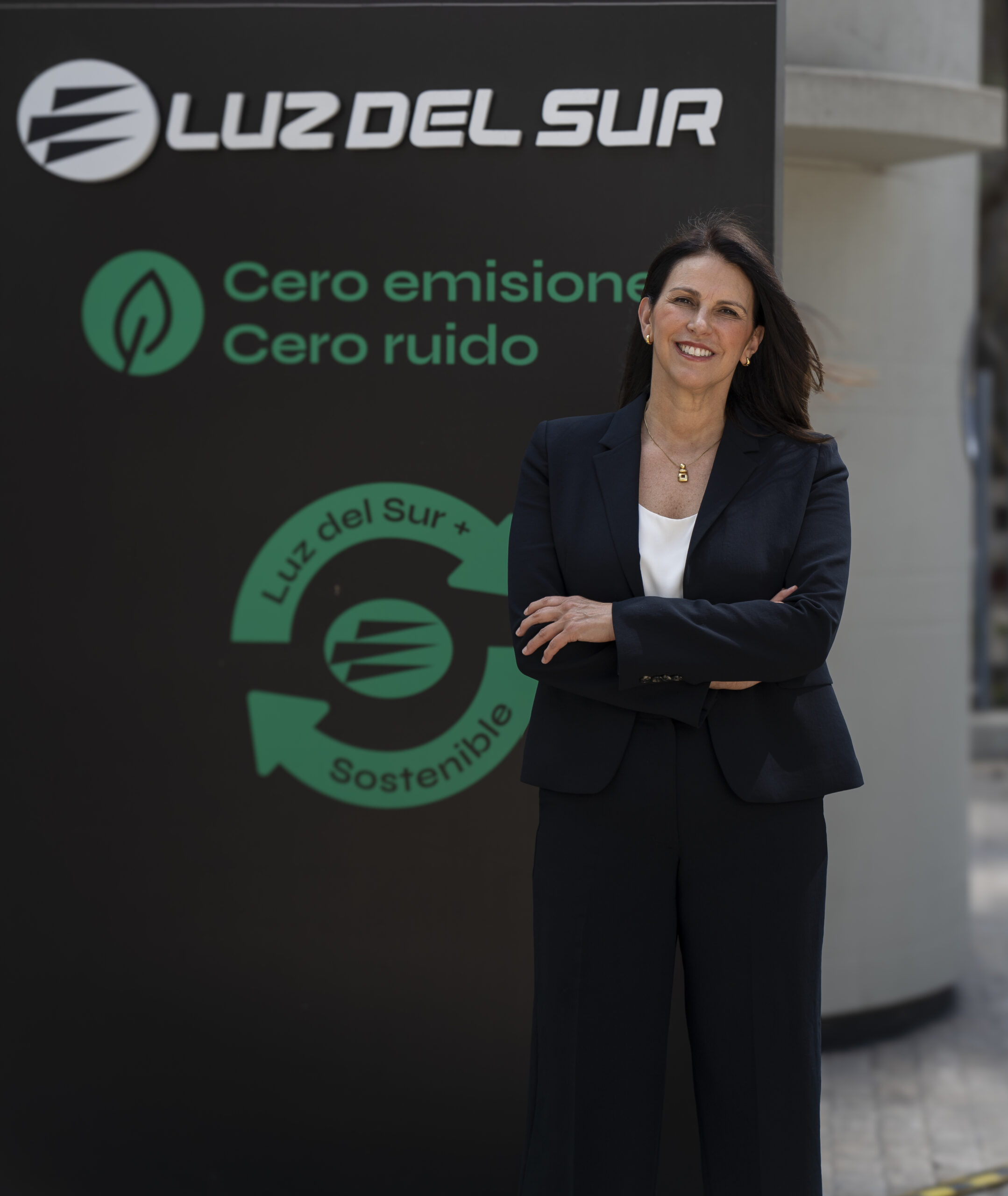
Gillian Paredes, legal manager at Luz del Sur, works in a sector that, in her words, operates at the intersection of regulation, critical infrastructure, and public service. In this arena, legal analysis incorporates continuity, quality, and security of supply as variables in every decision. With this perspective, honed since leaving private practice in 2019, she leads her team, acts as a bridge between China Three Gorges and the Peruvian regulatory landscape, and anticipates the legal agenda for the energy transition: smart metering, data management, cybersecurity, and stable rules for investing in networks. “From the legal perspective, our role is not only to manage risks but also to help the company make sound decisions,” she states.
Luz del Sur provides an essential public service in Lima. How does this responsibility affect the decisions of the legal department?
The public service nature of electricity distribution definitely influences what we do. One of the things that struck me most when I joined Luz del Sur was the scale of our responsibility: behind every business decision are millions of people, homes, health centers, schools, and companies that depend on the continuity and security of the electricity supply.
Therefore, each issue must be analyzed from a broader perspective than a strictly legal one. It is not enough to determine what is legally permissible; it is also necessary to evaluate the most responsible and sustainable decision, considering its impact on the continuity, quality, and safety of the service, as well as on the various stakeholders involved, including users, authorities, and communities.
This requires a constant balance between protecting the company’s interests, fulfilling our obligations, and contributing to solutions that are compatible with the public interest inherent in our business. From a legal perspective, our role is not only to manage risks but also to help the company make sound decisions that reflect the importance of the service it provides.
What career decision was decisive in leading you to head the legal department of a public utility company?
Without a doubt, the most decisive decision was to leave the private practice of the profession to assume an executive position within a company.
I spent virtually my entire career in law firms and thoroughly enjoyed that role. However, in 2019 I made a difficult decision: to leave external legal counsel and become the Legal Manager of a company in the hydrocarbons sector. It meant stepping out of a comfort zone where I felt very secure to take on a completely different responsibility, one that involved not only providing legal opinions but also directly participating in business decision-making.
That experience changed my professional perspective. It allowed me to understand firsthand the challenges of business management and the value a legal department can bring when it actively participates in business decision-making. Afterward came new professional challenges and opportunities, until the possibility arose of joining Luz del Sur, a company I had always followed with particular interest. Its history was familiar to me, as its creation was part of the privatization process of the Peruvian electricity sector in the 1990s, an experience in which I participated at the beginning of my career. Therefore, joining the company also had personal significance.
Looking back, I now clearly see that the decision I made in 2019 to leave private practice to take on a corporate role was the one that truly shaped the course of my career and ultimately led me to where I am today.
How has your leadership style evolved as you have taken on greater responsibilities?
At the beginning of my career, I primarily associated professional growth with developing legal expertise. I trained in law firms where a professional’s value is built on the quality of their analysis, judgment, and ability to help clients resolve complex issues. For many years, I focused my professional development on honing those skills and becoming a trusted advisor to my clients.
Over time, I’ve come to understand that leadership is much less about having all the answers and much more about asking the right questions, building trust, and helping others develop their own judgment. I’ve shifted from focusing primarily on my individual contribution to focusing on building teams where each person’s talent can flourish and generate the greatest possible value.
Today, I dedicate a large part of my time to listening, aligning the team with business objectives, and creating an environment where people feel valued, take on responsibilities, and can grow professionally. I’ve also learned that approachability, empathy, and the ability to understand different perspectives are just as important as technical rigor.
If there’s one thing I’ve learned over the years, it’s that the best results are rarely the product of individual effort. They emerge from committed teams that understand the purpose of what they do, trust each other, and feel ownership of the decisions. For me, that’s the true measure of leadership.
Since 2020, Luz del Sur has been part of the China Three Gorges group. What has changed in the work of the legal department with the arrival of an international shareholder?
Luz del Sur has historically had the experience of being part of international business groups, so the main change has not been the presence of a foreign shareholder itself, but the opportunity to integrate into an organization with a different history, culture and vision, such as China Three Gorges.
For the legal department, this has meant developing closer collaboration with teams based in China and strengthening our ability to operate in multicultural environments. It has been a very enriching experience, allowing us to learn new ways of approaching corporate governance, compliance, and risk management issues, incorporating perspectives that complement our local expertise.
Personally, one of the aspects I value most is having seen that, beyond cultural differences, we share a common vision regarding the importance of building a solid company committed to providing an essential service to millions of people. This ongoing exchange has enriched how we analyze legal and corporate challenges.
At the same time, the legal department plays a vital role as a bridge between the group’s standards and expectations and the regulatory, social, and operational realities of Peru. I believe that this combination of global experience and local knowledge has strengthened our ability to add value to the business and support the company’s growth.
In short, our experience with China Three Gorges has shown us that diverse perspectives are a strength. The best solutions often emerge when international best practices are combined with a deep understanding of the local context and a shared long-term purpose.
Looking ahead to 2027, what legal challenges does the energy transition pose for electricity distribution companies in Peru?
The energy transition presents significant regulatory and contractual challenges for distribution companies. The gradual integration of distributed energy resources, the electrification of new consumption, the development of electric mobility, and the digitalization of networks will require increasingly modern and flexible regulatory frameworks.
In the case of electricity distribution, one of the most significant challenges will be supporting the technological modernization of the networks. The expansion of smart metering, the management of large volumes of data, the automation of operations, and the increasingly active interaction of users with the system will pose new challenges in terms of regulation, data protection, cybersecurity, contracting, and the allocation of responsibilities.
It will also be essential to generate regulatory signals that facilitate infrastructure investment and ensure the reliability, resilience, and quality of service. The energy transition requires significant long-term investments and stable regulations that allow these initiatives to be developed predictably.
From a legal perspective, the challenge is to support this transformation by ensuring legal certainty, promoting innovation, and contributing to regulatory changes that allow for an orderly, sustainable, and user-centered energy transition, without compromising the continuity of a service essential to the country’s development.

You will participate in the Foro Gerencias Legales Lima 2026, which brings together legal managers from different sectors. What do you hope to contribute to this dialogue based on your experience in the electricity sector?
I hope to offer the perspective of an industry that operates at the intersection of regulation, critical infrastructure, and public service. In the electricity sector, legal decisions rarely have a purely corporate impact; they frequently affect the continuity of services upon which millions of people depend.
This reality compels us to develop a strategic perspective that combines compliance, risk management, and business understanding. I believe the experience of the electricity sector can offer valuable insights into how legal departments can generate value beyond contingency management by actively participating in decision-making and building sustainable solutions for organizations.
Personally, I’m interested in exchanging experiences with colleagues from other sectors because many of the current challenges are shared: digital transformation, strengthening compliance cultures, reputation management, and the need for legal departments to act as true strategic business partners. This dialogue is always enriching and helps us find better ways to face the challenges ahead.