

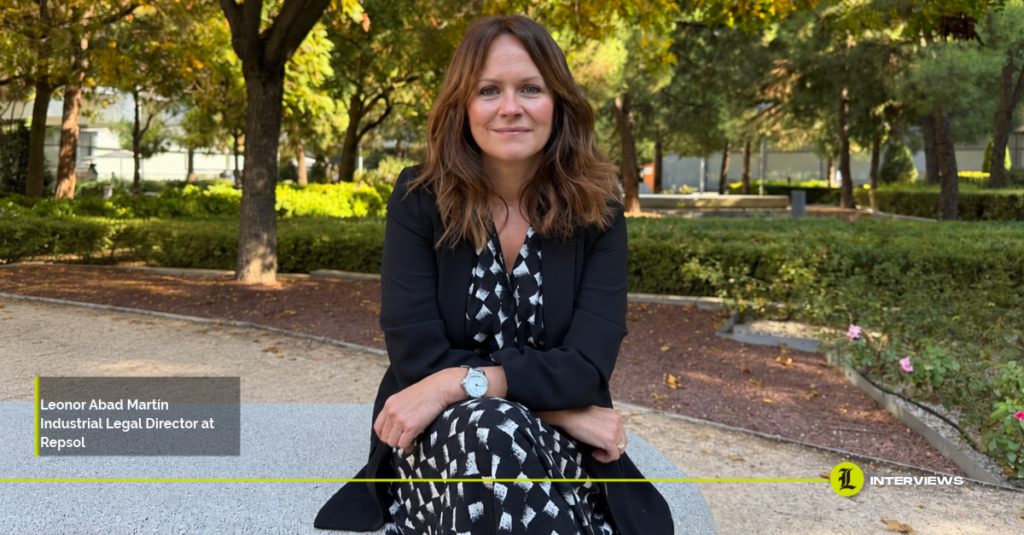
Leonor Abad Martín, Industrial Legal Director at Repsol, has been with the company for 25 years and leads the legal department of an area that combines refining, chemicals, trading, and gas with renewable fuel, hydrogen, and circular economy projects—areas where precedent and regulation are not always present. For her, in-house counsel must have a deep understanding of the business and help solve problems, going beyond simply identifying risks. This same logic guides her management style: high standards, close collaboration, and a team with autonomy and its own judgment. Artificial intelligence, which she considers a capabilities multiplier, reinforces this vision: it elevates the role of leadership within the in-house legal department and leads to a rethinking of how the work of law firms is valued, with less emphasis on hours worked and more on the value they bring to the client. “Having access to a lot of information is one thing, but knowing what to do with it is quite another,” he warns.
The energy transition is transforming the industrial activity of the sector. What does this process demand of someone who leads the legal function of an industrial business?
It demands adaptability and a willingness to learn constantly. And that, personally, I love. We’re working on projects that were hard to imagine a few years ago, with new technologies, different business models, and collaborative structures between companies that present very interesting legal challenges.
In our case, industrial transformation and renewable fuel and circular economy projects have often forced us to move beyond traditional approaches. This is where the legal function must combine rigor, an open-minded perspective, and the ability to find solutions.
Repsol is undergoing a transformation, and we’ve moved from working with fossil fuels to incorporating fuels derived from waste. I’m thinking, for example, of the C43 plant in Cartagena, the first facility on the Iberian Peninsula dedicated exclusively to producing renewable fuels from waste such as used cooking oil. Or the Ecoplant in Tarragona, which will be the first in Europe to transform municipal waste into renewable and circular methanol. Also, the large renewable hydrogen electrolyzers we’re developing in Cartagena and at Petronor, and the synthetic fuels plant in the port of Bilbao, which will manufacture them from renewable hydrogen and captured CO₂. Each of these projects has presented a different legal challenge.
There isn’t always a precedent, a regulation that resolves all doubts, or a contractual structure you can simply replicate from another transaction. You have to understand the project, work with specialists from other disciplines, analyze the alternatives, and find solutions. Our role is to help that innovation develop on a solid legal foundation.
Alongside this business transformation, we’re experiencing another revolution that I find fascinating: the integration of artificial intelligence into our work. For me, AI has been a game-changer. I don’t see it simply as a tool to speed up what we already do, but as a multiplier of our capabilities.
And what’s truly interesting isn’t just the time we save. It’s what we can do with that time and those new capabilities. We can delve deeper, explore alternatives, anticipate problems, and dedicate more attention to the issues that truly require our expertise. Ultimately, we improve the quality and scope of what we contribute to the business.
However, AI does not replace knowledge or experience. To use it effectively, you need to know what questions to ask, understand the answers, and, above all, be able to recognize when it makes a mistake. Legal judgment and responsibility for the outcome remain with us.
I believe we are facing a tremendous opportunity for the legal profession. AI doesn’t mean we need less talent. It allows the talent we have to go much further. And this brings me back to leadership: with AI, leadership skills will make more of a difference than ever before. AI may surpass our capabilities in many tasks, but guiding teams, building trust, and making sense of that change will still depend on us.
You are a member of the jury for the Legal Marcom Awards, which recognize excellence in marketing, communication, and business development within the legal sector. What trends do you see in the way the legal sector communicates today?
Being part of this jury has allowed me to see firsthand how much law firms have evolved in their relationships and communication. There is a growing interest in getting to know the client, understanding their business, and explaining the value they can bring beyond strictly legal expertise. Communication is more focused on the client’s needs and the concrete contribution of the advice. And I believe that’s the right path.
From my position as a corporate lawyer, there is something I particularly value about law firms that I believe is sometimes not highlighted enough: the experience they accumulate working with a multitude of clients, sectors, and different operations.
We know our business very well and have excellent professionals and highly specialized legal knowledge. But inevitably, our experience is more closely tied to the reality of our own company. Law firms have the opportunity to participate in a wide variety of transactions, learn about other ways of approaching problems, and contribute perspectives that we don’t always have. That experience complements ours and can add significant value to the decisions we have to make.
And there’s another factor that’s changing the game: artificial intelligence. In our in-house legal departments, we’re making a significant effort to incorporate these tools. And I think it’s reasonable to expect law firms to move in that direction as well.
Because AI not only changes how we do things, it also forces us to rethink how we value and treat legal services. If technology allows us to solve certain tasks in much less time, perhaps we should start placing less emphasis on the hours spent and more on the true value of the advice. The question isn’t just how much time a job requires, but what it brings to the client.
And precisely in this new scenario, I believe that critical thinking, experience, and sound professional judgment will increasingly make the difference. Because having access to a lot of information is one thing, but knowing what to do with it is quite another.
That’s why I believe the great challenge for law firms, also from a communication point of view, is knowing how to convey that value: not so much how much they know, but how their experience helps clients to make better decisions.
You head a specific area within a larger legal affairs department. What does leading in that position entail?
Above all, know the business very well. For me, that’s absolutely fundamental.
At Repsol’s industrial division, we work with a wide range of businesses, from refining and chemicals to trading, gas, and new projects related to the circular economy and industrial transformation. These are complex activities that involve significant investments, and legal decisions have major economic and operational consequences.
You can’t provide good advice if you don’t understand how the business works, what it aims to achieve, and what challenges it faces. Legal rigor must be accompanied by a genuine understanding of the business’s priorities. And to do that, you have to sit down with the teams, listen to them, ask questions, and often learn things that have nothing to do with law.
I’ve always liked to be involved in projects from the very beginning. To understand what we want to achieve and find the best way to do it. I believe that corporate lawyers must be, above all, problem solvers. Of course, we have to identify risks and ensure that operations are conducted within legal boundaries and company standards. But our work doesn’t end there.
Saying something can’t be done can be relatively easy. The difficult part, and what truly adds value, is finding an alternative that allows the business to achieve its goal without taking unacceptable risks.
And when you’re part of a large legal department, it’s essential to work in a coordinated manner, share knowledge, and leverage the capabilities of the entire organization. We’re fortunate to have excellent specialists in many disciplines. Integrating that knowledge allows us to provide a more comprehensive and robust response to the business.
Leading a legal team also involves developing the people who make it up. How do you foster the professional development of your team?
I believe that developing people is one of the main responsibilities we have as team leaders. And, what’s more, it’s one of the parts of my job I enjoy most.
We all have strengths and areas for improvement. I like to get to know the people I work with well, to understand what they’re particularly good at, what motivates them, and where they can contribute the most. And from there, I give them opportunities and responsibilities that allow them to develop their potential.
I’m demanding, quite demanding, starting with myself. But I don’t think being demanding means constantly pointing out what someone is doing wrong. Of course, you have to give feedback and address what isn’t working, but you also have to acknowledge what’s done well and build trust. Demanding things makes sense when it helps improve and is accompanied by support.
I like my team to have autonomy, their own judgment, and to disagree with me when they think I’m wrong. I don’t want them constantly thinking about what I would do in every situation. I want them to think, propose ideas, and make decisions.
And there’s something I consider important: when someone on your team grows professionally, even if it means they end up taking on other responsibilities outside the team, you should be happy for them. Because it means you’ve contributed to their development and, also, to the company’s.
Throughout your career at Repsol, what role models have influenced your leadership style?
I’ve been very fortunate with the people I’ve worked with over these 25 years at Repsol. I’ve learned something from each of them that has greatly influenced my understanding of leadership.
I’m quite observant and have always been motivated to learn from others. I’ve certainly learned from everyone: my managers, my colleagues on the legal team, my team members, and my colleagues in the business areas. One of the advantages of working at a company like Repsol is that you’re surrounded by extraordinary professionals who help you broaden your perspective and continue growing every day.
But if I have to talk about role models, the first ones, without a doubt, have been my parents. From them I learned the value of hard work and treating people well, and that’s something I try to apply every day.
I don’t have a very sophisticated theory about leadership. I believe you have to work hard, be consistent, lead by example, and treat your team members well. For me, credibility is built that way, day by day. I like people who know a lot but don’t need to constantly prove it, who listen, and who are able to recognize that someone else might have a better idea.
Closeness is essential. I don’t believe you need to create distance to lead a team. You can be very demanding and, at the same time, maintain a close, trusting, and respectful relationship.
I’ve always believed that companies are, fundamentally, the people who work in them. And, honestly, if after all this time I’m still “hooked” on Repsol, it’s largely because of that. Because of the incredible people I’ve met and with whom I’m lucky enough to continue working.
Many lawyers aspire to lead a legal function. What advice would you give them to prepare for that role?
They shouldn’t get “locked up” in the law. It seems like a contradiction, but I think one of the best pieces of advice you can give a corporate lawyer is to dedicate time to understanding things that aren’t legal.
They should take an interest in how the business operates, what concerns its managers, how investment decisions are made, or what consequences a particular contractual clause has on daily operations. This perspective is what allows legal knowledge to be connected to the company’s decisions.
I’ve learned a great deal working with engineers, finance professionals, salespeople, and professionals from other disciplines. And I believe that curiosity is essential.
I would also advise them to get training in people management. Because being a good lawyer doesn’t automatically make you a good manager. They are different responsibilities and require different skills, and you have to be prepared for both.
When you lead a team, your job is no longer just about handling the issues that come your way. You have to create the conditions for others to solve problems, make decisions, set priorities, and manage situations that aren’t always easy. Your responsibility also includes setting a clear direction and helping the team move forward with autonomy and confidence.
And finally, never lose your desire to learn. I’ve been with Repsol for 25 years and I’m still learning every day. In fact, with the rise of artificial intelligence, I feel like we’re entering a completely new professional era. And I find that very exciting.
Leonor Abad Martín’s advice to those aspiring to lead a legal department stems from her own experience at Repsol. She suggests stepping outside the legal field to understand how decisions are made within the company, learning from engineers, finance professionals, and sales staff, and developing skills in people management, because “being a good lawyer doesn’t automatically make you a good director.” To this preparation, she adds her perspective on the current situation: after 25 years with the company, she believes the emergence of artificial intelligence opens a completely new professional chapter, one she finds very stimulating and which requires future legal directors to maintain their desire to learn.