
In 2026, the Brazilian legal market operates under a new logic: increasingly sophisticated clients, mounting pressure for efficiency and predictability, technology fully embedded in daily practice, and intensifying competition among large firms. This is the context for the special feature in our report, Brazil in 2026 and the New Market Logic: the ‘Big Law’ Perspective, which examines how leading firms are responding to this shifting landscape.
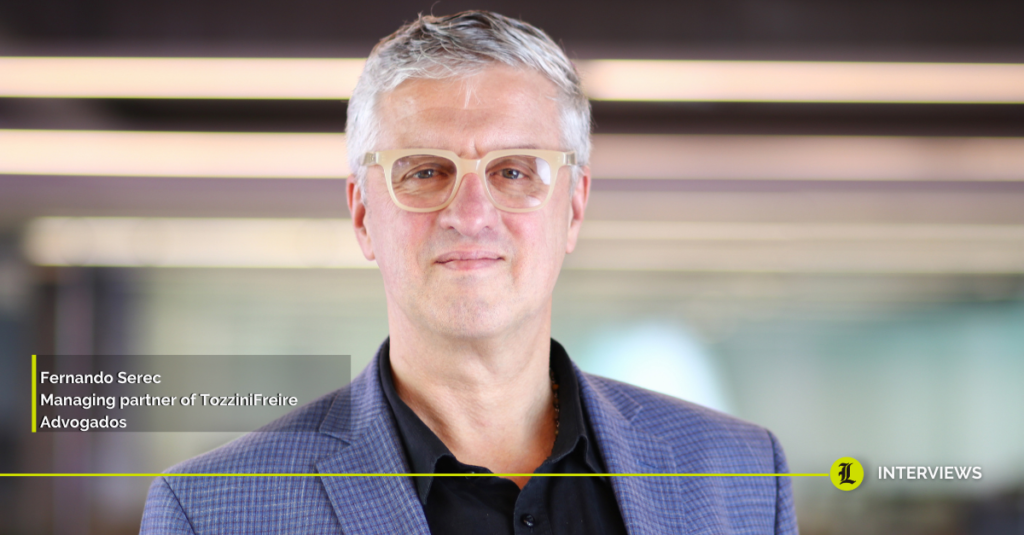
Against this backdrop, TozziniFreire Advogados reaches a singular milestone: its 50th anniversary. Rather than treating the occasion as a retrospective celebration, the firm has turned it into a strategic inflection point, an opportunity to reassess its positioning and project its next phase of growth. We spoke with Fernando Serec, the firm’s managing partner, to understand how an institution with half a century of history reconciles ambition, consistency and the cultivation of lasting relationships in a market that no longer rewards reputation alone, but also the capacity to evolve with sound judgement.
From the outset of the conversation, Serec advances an idea that underpins his broader vision: in big law, longevity only has meaning when it translates into concrete, forward-looking decisions.
Fifty years as a starting point, not a destination
The path to the 50th anniversary began well before the date itself. Throughout 2025, TozziniFreire Advogados undertook a series of structural transformations that anticipated the firm’s new cycle. These included the opening of a new chapter in its transactional practice, reinforced by the addition of high-impact partners; the relocation of its São Paulo headquarters to Avenida Faria Lima, one of the country’s principal business districts; and the expansion of its Rio de Janeiro office, with the arrival of a new partner and a more modern space closer to clients.
These moves, Serec stresses, were neither isolated nor cosmetic.
“All these transformations have reinforced our purpose of building strong and lasting relationships.”
For the managing partner, the anniversary serves as a catalyst, one that compels a reassessment of how the firm intends to grow and of the nature of the relationships it seeks to sustain with clients, its professionals and the wider market.
Innovation and internationalisation as elements of identity
Beyond these more visible changes, TozziniFreire Advogados continues to advance initiatives that are integral to its institutional identity. Its international strategy programme, TFGlobal, extends the firm’s global reach, reduces cultural barriers and deepens its expertise across multiple jurisdictions.
At the same time, ThinkFuture, the firm’s structured innovation programme, marked its seventh anniversary in 2025 and has consolidated TozziniFreire’s position as a reference point in the Brazilian market for legal innovation. TFInclusión, which brings together all diversity, inclusion and pro bono initiatives, reinforces a conception of growth that extends beyond purely financial metrics.
These initiatives are embedded within a coherent strategic framework that aligns institutional functions and legal teams around a shared objective: sustainable growth and long-term relevance.
Artificial intelligence: from technological edge to strategic tool
Artificial intelligence is now firmly embedded in the daily operations of Brazilian big law, but TozziniFreire Advogados has pursued a distinct path. Automation and data-analysis tools have streamlined processes such as contract review, due diligence and legal research, allowing lawyers to focus on higher-value, strategic work.
The pivotal step, however, was the development of AILA, the firm’s proprietary artificial intelligence platform. Built on OpenAI technology and integrated into its internal digital ecosystem, AILA operates under stringent security and data-protection standards.
“By integrating artificial intelligence into our work, we are able to anticipate client demands and deliver solutions that are more closely aligned with their strategic needs”.
Alongside this, the firm is expanding its use of tools such as Copilot and Harvey, while maintaining active partnerships within the technology sector. This transformation, Serec explains, brings the firm closer to the centre of clients’ strategic decision-making and demands sustained investment in new digital capabilities and management skills.

A client who demands predictability and business acumen
The profile of the corporate client has become markedly more demanding. Today’s clients expect cost predictability, high standards of efficiency and agility in execution. In this context, Serec argues, law firms must move beyond a purely reactive or technical legal response.
The challenge lies in designing solutions that are aligned with clients’ strategic business planning and long-term growth objectives. Achieving this requires sustained investment in technology, rigorous team training and the structuring of consistent production processes-conditions that enable transparent fee models aligned with the value delivered.
Rainmakers: technique, business and negotiation
In an increasingly competitive market, TozziniFreire Advogados has deliberately cultivated complementary partner profiles: lawyers with strong business-development capabilities alongside others with exceptional technical depth and market recognition.
For Serec, this balance is critical. While outstanding technical expertise remains a non-negotiable requirement in the partner promotion process, commercial judgement, negotiation skills and a deep understanding of clients’ businesses are playing an ever more central role. The rainmaker of 2026 is, above all, a connector -someone capable of integrating technical excellence, business insight and long-term relationships.
Strategic sectors and the recovery of transactional work
Agribusiness, technology, energy, infrastructure, and life sciences and healthcare are among the sectors expected to continue generating significant opportunities for the firm. Throughout 2025, TozziniFreire Advogados strengthened its presence among clients in these segments, with tangible effects anticipated in 2026.
The firm is also cautiously optimistic about a recovery in the transactional market in 2026 and 2027. Recent partner additions, including Carlos Mello, Mirella Mie Abe, Daniel Laudisio and Fernanda Montorfano, together with further planned appointments, form part of a structured strategy to reinforce key practices and accelerate growth.
“These were not isolated moves, but part of a broader strategy”.
Talent, leadership and female representation
Talent development and retention remain central strategic priorities. Serec stresses the importance of training lawyers who combine technical excellence with business awareness and a genuine capacity for dialogue with clients.
The growing presence of women in leadership roles has, he notes, been an organic process within the firm, with a clear commitment to expanding it consistently in the years ahead.
“Developing new leaders and strengthening female representation are integral to our vision for the future”.
Leading through integration: business, innovation and well-being
For Fernando Serec, leadership is about direction as much as engagement. While firm management is necessarily collective, it also requires clarity of purpose and coherence in execution.
Business development, innovation, technology, physical and mental health, diversity and well-being are not peripheral concerns. When integrated consistently into management, they become drivers of growth and sources of competitive differentiation.
As it approaches its 50th anniversary, TozziniFreire Advogados looks towards 2026 with a clear premise: history alone offers no guarantees. For Serec, reaching this milestone is not a point of arrival, but an added responsibility, to continue building lasting relationships, investing in talent, innovating with sound judgement and maintaining strategic consistency in an increasingly demanding market.
It is a reflection that bridges past and future. In big law, longevity is only justified when it is translated into a genuine capacity for adaptation and sustained leadership.