

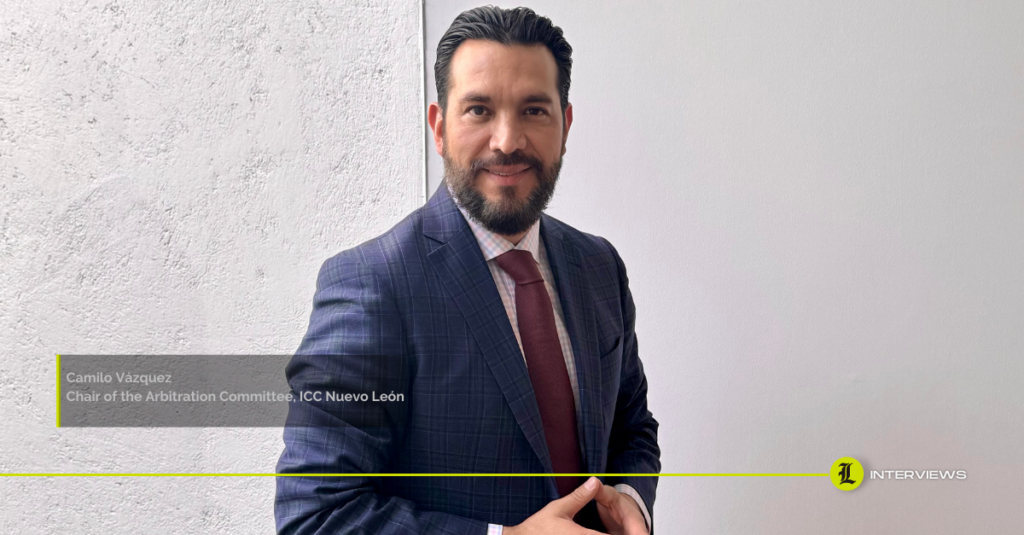
Arbitration has ceased to be a boilerplate closing clause and has become an integral element of business architecture. This shift has shaped—and consolidated—the outlook of Camilo Vázquez, a lawyer specialising in complex disputes and current President of the Arbitration Committee of ICC Nuevo León, Mexico.
His perspective extends beyond procedure. He speaks of contractual design, predictability, procedural culture and professional responsibility. For him, conflict is not an isolated event; it is a business decision that must be managed with technical rigour and a long-term view. In a fragmented and increasingly regulated geopolitical landscape, international arbitration—when properly conducted—becomes a stabilising force.
This conversation, part of Voices of Law: Dialogues with Partners and General Counsel from Latin America, reveals not only the trajectory of his career, but also his understanding of the present and future of the arbitration system.

Beyond the position: managing conflict with a business vision
When he looks at his professional career in perspective, Vázquez is not defined by his institutional position.
“Today I see myself as a lawyer who understands conflict not as an end in itself, but as a critical moment that must be managed with technique, judgment and business acumen.”
His training in complex litigation was crucial. He advised companies in asset disputes that affected entire structures—investors, shareholders, ongoing projects. This experience allowed him to understand that every dispute involves a strategic decision with long-term impact.
This awareness led him to adopt a pro-arbitration stance early on, when the mechanism did not yet enjoy its current recognition. It was a decision based on conviction and institutional development.
In his role as arbitrator, that perspective deepened. “Attending to every detail of the procedure and the decision is essential, because not only the legal soundness but also the enforceability of the award depends on it.” In arbitration, technique is a guarantee of international effectiveness.
From midnight clause to strategic tool
There was a time when arbitrage was a “midnight clause”. Today it is part of the structural risk analysis from the very conception of the operations.
“Arbitration has gone from being a ‘midnight clause’ to becoming a strategic tool for managing business risk.”
In Mexico, the 2008 constitutional reform, which granted recognition to Alternative Dispute Resolution Mechanisms, reinforced that legitimacy. The system ceased to be a marginal option and became an institutionally consolidated alternative.
In infrastructure, construction, or M&A projects, arbitration is now an integral part of the legal design of the business: a neutral forum, clear rules, and international enforceability. For companies, this means predictability.
Referee and institution: the pillars of trust
The evolution of the system also transformed their understanding of the referee’s role.
“The referee is a key figure in the procedure: the soundness and enforceability of the decision depend on their judgment, independence, and rigor.”
The role is not merely technical; it is structural. The referee not only makes decisions, but also guarantees trust.
In parallel, institutions—and particularly the ICC—play an essential role. Clear rules, scrutiny of awards, and quality standards strengthen the system’s credibility. Trust is not just rhetoric: it is built through oversight and institutional consistency.
From the Presidency of the Arbitration Committee of the ICC Nuevo León, his work focuses precisely on that: strengthening standards, promoting practical training and maintaining a constant dialogue with the judiciary, without sacrificing independence.
Arbitration in times of fragmentation
In a fragmented geopolitical context with increasing regulatory tensions, international arbitration takes on a stabilizing function.
“In fragmented geopolitical contexts, arbitration offers neutrality and predictable rules.”
For the company, this means anticipating how a conflict will be resolved and having an internationally enforceable decision. Technical expertise, institutional framework, and enforceability become factors of legal stability in global trade.
Modernization: Beyond the Rules
Criticisms of arbitration—costs, duration, accessibility—have forced the system to evolve. Updates to the ICC Rules incorporate expedited procedures, greater clarity in consolidation and disclosure of funding, and tools aimed at strengthening efficiency and transparency.
But Vázquez insists that true transformation is not limited to the rules. “Efficiency depends not only on the regulations, but also on the professionalism of the referees and the responsibility with which the parties manage the proceedings.”
Procedural culture is as important as the written rule. And here he issues a clear warning: “Arbitration should not become litigation by another name.”
If it loses agility and strategic focus, it loses its essence.
Digitization and artificial intelligence: responsible integration
Digitization is now a structural part of arbitration practice. Electronic files, reasonable virtual hearings, and technological tools for document organization have proven to increase efficiency. “These changes are here to stay.”
Regarding artificial intelligence, it distinguishes between support tools, document analysis, precedents, information organization, and generative artificial intelligence, the use of which poses new challenges.
The duty to disclose its use, the systems employed, and the parameters applied is being debated. This is not a minor debate; it is both institutional and ethical.
Therefore, ICC Mexico has promoted an Artificial Intelligence Committee to analyze its impact on MASCs and define responsible criteria.
“The challenge is not to stop technology, but to integrate it with clear rules, robust confidentiality standards, and well-defined ethical parameters.”

The debate he seeks to advance: efficiency from the outset
Camilo Vázquez will take part in the Monterrey Legal Forum 2026, organised by Gericó Associates, a platform where the present and future of legal leadership in the region will be examined this Thursday. If there is one issue he considers urgent to place on the agenda, it is efficiency.
“Companies require arbitrations that combine time and cost control with technical sophistication and operational efficiency.”
Yet his reflection extends beyond procedure. The challenge—and the solution—does not begin when a dispute arises.
“The efficiency of arbitration does not begin with the request, but with the arbitration clause.”
A carefully drafted clause, strategically designed at the contractual stage, can reduce friction, avoid unnecessary procedural obstacles and contain future costs. Arbitration should not be improvised once conflict emerges; it should be embedded from the outset of the legal relationship.
Camilo Vázquez’s trajectory reflects a coherent professional evolution: a litigator who came to understand conflict as a business decision; an arbitrator conscious of the weight carried by every word in an award; and an institutional leader committed to strengthening standards and professional culture.
In an increasingly uncertain global landscape, arbitration will remain a space of neutrality and predictability only if it preserves its technical rigour and ethical integrity.
Conflict may be inevitable. Improvisation should not be.