
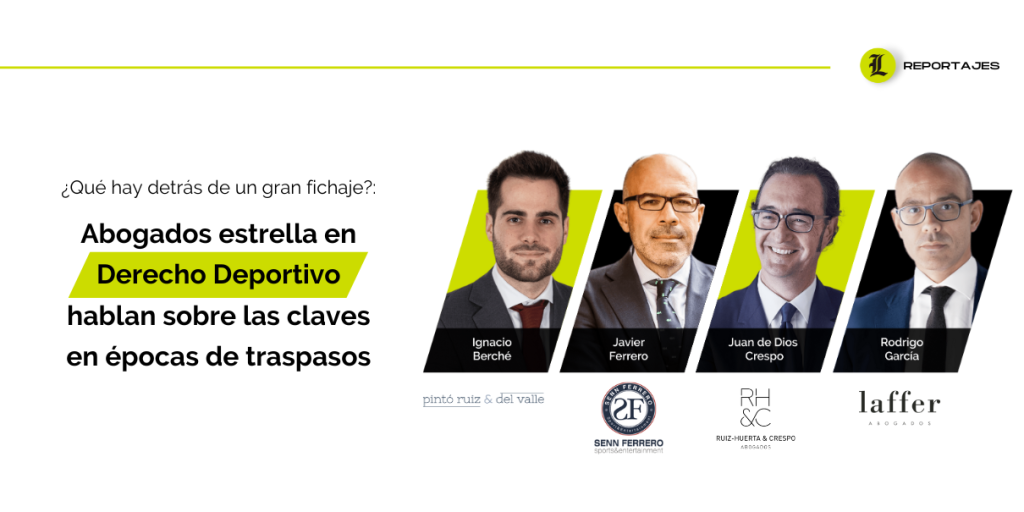
The practice of Sports Law in Spain has “evolved in an exciting and exponential way”, according to Rodrigo García, Sports Law partner at Laffer Abogados; Ignacio Berché, lawyer at Pintó Ruiz del Valle; and Juan de Dios Crespo Pérez, CEO of Ruiz-Huerta & Crespo Sports Lawyers. and Javier Ferrero, managing partner of Senn, Ferrero, Asociados.
For Rodrigo García of Laffer Abogados, the evolution of this practice has been “fascinating.” “From an educational standpoint, the academic offerings, nonexistent 15 years ago, are now a cornerstone that continues to grow. From a legal practice perspective, the various stakeholders in the world of football (clubs, players, and agents) have realized, over the last 10 years, the need for and importance of having high-quality legal and tax advice in transactions.”
They have been helped by negative events such as the tax problems arising from image rights payments and payments to intermediaries, but also by positive ones such as the implementation of a real legal framework by FIFA and the national federations.”
Ignacio Berché, from Pintó Ruiz del Valle, agreed that the practice of Sports Law has grown exponentially in Spain for several reasons: “The first is that in recent years the volume of transfers in the transfer market has increased significantly, making the role of a lawyer specializing in this area of law increasingly necessary. Furthermore, contracts are becoming more professional and contain more complex clauses and issues that only an expert in this field can understand and handle effectively. As a result, the creation of new law firms and research centers specializing in Sports Law has increased exponentially, which is quite logical since it undoubtedly represents a great business opportunity given the current climate.”
Secondly, this growth is also due to investment from other countries such as the United States, through MLS (Major League Soccer), and Saudi Arabia, through the Saudi Professional League, which have joined the major leagues and developed a very strong transfer policy. Therefore, it is clear that, year after year, the market continues to grow exponentially without any limitations, despite having suffered a severe pandemic, which we all expected would lower and rebalance transfer fees and salaries. From our point of view, it is true that we are facing one of the strongest markets there has ever been, but we would like to add that if spending by clubs is not regulated (as is happening in Spain), we could find ourselves in the not too distant future with the bankruptcy of many football clubs, since this model is clearly unsustainable.”

For his part, Juan de Dios Crespo Pérez, of Ruiz-Huerta & Crespo Sports Lawyers, told us that he started in this field in 1981, when he was still a student at law school. “I saw the potential, but the growth that has taken place in Spain is extraordinary. We have, first of all, the best Master’s programs in Sports Law, both in Spanish and English, because we were among the first to see the importance of education in training future lawyers in this area.”
And, with that, we have also positioned ourselves as one of the countries with the highest number of lawyers in the sector. It is not unusual to see an English club playing against a French one where both lawyers or firms are Spanish. That is the level we have reached, and therefore we can affirm that the practice in Spain has not only increased exponentially, but has done so with a quality recognized worldwide.”
Meanwhile, Javier Ferrero, of Senn, Ferrero, Asociados, said that they have been operating in this sector since 2000 and “the evolution has been spectacular in every way. There has clearly been a professionalization of the sector in all its areas, and this inevitably entails the need for more professionals, and specifically, lawyers specializing in this area. The truth is that you increasingly find more professionals, and very well-trained ones, especially the younger lawyers.”
With the specialists we reviewed the risks and challenges that football clubs face in this summer market, Rodrigo García, from Laffer Abogados, pointed out “that this is a special transfer window because it is the last one in which intermediaries will not be fully subject to the new FIFA agent regulations, which, among other restrictions, establishes a cap on the commissions to be charged to players and clubs.
This makes this window particularly active, but on the other hand, the number of players who could potentially be involved in a transaction is greater, leading to a devaluation of their salaries that could harm them.”
Ignacio Berché, from Pintó Ruiz del Valle, continued, stating that “clubs face the challenge of navigating an increasingly competitive market, under the threat of the substantial capital enjoyed by certain leagues and sports institutions. This makes it difficult for many clubs to sign world-class players and diminishes their persuasive power. A clear example of this is the emergence of the Saudi league, which has adopted an unprecedented transfer policy in football history, particularly with lucrative and irresistible offers to world-renowned players as well as promising young talents from European academies. Therefore, this new Saudi trend of attracting top-level players could create problems for European clubs regarding the exodus of great football talents due to the stratospheric multi-million dollar offers they are willing to pay.”
LaLiga establishes greater controls over team budgets, meaning it controls spending in relation to income. If teams do not comply with the “financial fair play” policy, they cannot spend on transfers above the allowed amount, making it very difficult to retain talent and even enter the transfer market competing with other entities that do not have these restrictions.
Therefore, the major challenge is to remain competitive in the various competitions they participate in throughout the season, given the difficulty of signing or retaining top players. The solution, in any case, is to persuade players with factors other than financial ones, such as the sporting project and the confidence they inspire. Finally, historic clubs like Real Madrid CF, FC Barcelona, and Atlético de Madrid compete for and attract top players not by paying astronomical sums, but thanks to their history, viability, and sporting project.
Juan de Dios Crespo Pérez, of Ruiz-Huerta & Crespo Sports Lawyers, believes that the first challenge “is money and how to obtain it and then invest it in signings. Increasingly, except for the most prominent clubs, the vast majority of clubs are trying to sign players at no cost, meaning those whose contracts are expiring, or through loans or player exchanges.”
Then, within that same framework, it is necessary to comply with local financial fair play regulations and, in cases of participation in European competitions, with UEFA regulations.”
For Javier Ferrero of Senn, Ferrero, Asociados, the main challenges are the usual ones that clubs face at this time of year, namely “building squads that fit their budgets and the financial fair play requirements established by LaLiga and international institutions. Much progress has been made in this area, and costs are increasingly aligned with the financial realities of clubs. One difficulty here is competing with markets in other countries where these rules are not as strict and where players are being paid exorbitant salaries. Another challenge is adapting to the multitude of legislative changes that football is undergoing internationally, which obviously requires…” Expanding on my previous answer, it’s about having professionals who know this industry perfectly.”
Dynamism and capacity for action, among the greatest difficulties in transfer season
Rodrigo García, of Laffer Abogados, pointed out that, firstly, the “timing of transactions is very fast and requires absolute availability for the client and a capacity for reaction and response that is not common in other areas of law. This can result in poorer legal advice, and lawyers must be aware of the difficulty of providing real-time advice in the transfer market.”
It is also very important to have a team of lawyers in other jurisdictions who share the criteria of availability and dedication that we lawyers in Spain generally have.”

According to Ignacio Berché of Pintó Ruiz del Valle, “one of the biggest difficulties we have identified in recent transfer windows is the lack of uniformity in transfer periods worldwide, and specifically at the European level, as is the case with the Premier League (England). In the English market, the transfer window closes much earlier than in the rest of the European leagues. This forces agencies to work on different schedules to account for globalization, meaning that an English client might need assistance at one time, while a German client might need advice at a very different time, with the domestic leagues already underway.”
That said, a recurring problem during these periods, related to the one mentioned earlier, is the workload at specific times, such as finalizing a transfer on the last day of the transfer window. Another difficulty faced by law firms specializing in sports law is the time constraints and constant pressure to successfully conclude negotiations between players and clubs. The pressure is immense for law firms and player agents as they work against the clock to avoid abandoning their clients at such a crucial moment.
Juan de Dios Crespo Pérez, of Ruiz-Huerta & Crespo Sports Lawyers, agreed that the urgency and need for quick answers remains because the market moves so rapidly. “Availability is essential because a Sunday could be the moment a transfer happens, and you can’t afford to be offline. Then there are the requests from clubs regarding legal aspects: Can a player leave because there’s a conflict in a certain area? Can a minor leave upon reaching the age of majority, even with a contract signed by their parents? And so on.”
For his part, Javier Ferrero, of Senn, Ferrero, Asociados, added that the greatest difficulty “is knowing how to combine rigorous advice with market timing. There are transactions that are very technically complex, in that there are many aspects to review and cover, and where different regulations are intertwined and must be carried out in a very short time, which requires greater attention, dynamism, and knowledge on the part of the professional involved, especially at a time when perhaps other sectors are taking a break.”
Since Cristiano Ronaldo’s signing for Al-Nassr, Saudi Arabia seems to be all the rage. Numerous top-level footballers are rumored to be making the leap to the Saudi Professional League. We’re not talking about players nearing retirement—like Benzema (Real Madrid) or Kanté (Chelsea)—but rather players in their prime—like Rúben Neves (Wolverhampton) and many others who are being mentioned. How are these kinds of deals being handled since they were signed, and what are your predictions for the league’s development in the coming years?
Rodrigo García, of Laffer Abogados, responded that it remains to be seen whether this is a passing fad like the one China experienced a few years ago, or a new competitor with a powerful structure and significant, and above all, sustained economic capacity. It seems we are facing the latter scenario.
In my opinion, in Spain we must take careful note of the ever-increasing competition we have in other leagues. We run the risk of becoming a league where, apart from the big clubs, the rest are simply development clubs and an export league like Brazil.”
To the above, Ignacio Berché, from Pintó Ruiz del Valle, added that it is true that since CR7’s arrival in Saudi Arabia, a completely unknown league and culture, it has opened the doors for both world-class and average players to come, a similarity to what happened in the United States with the arrival of David Beckham, to the MLS, which meant a commercial and competitive explosion for the American league. In a relatively short period of time (6 months), Saudi Arabia has become a footballing hotspot for many players, such as Karim Benzema, N’Golo Kanté, Roberto Firmino, and others. Furthermore, in recent weeks there have been other signings of players who are at important stages in their professional careers (of maturity and established status) and who demonstrate that they are capable of playing football for several more years. In other words, the chances of retiring from professional football for certain players seem remote, such as Édouard Mendy, Ziyech (not confirmed) or Koulibaly, Brozović and Rúben Neves (already mentioned).
The arrival of the 2022 Qatar World Cup in the Persian Gulf has led to the emergence of a new and attractive destination for veteran elite football players: Saudi Arabia. In the first two decades of the 21st century, the United States, specifically Major League Soccer (MLS), was the preferred destination for veteran European players in the final years of their professional careers. However, this trend has completely reversed, and now Saudi Arabia is the preferred destination for many world-class players.
Saudi Arabia’s objective is to attract elite football players to the Persian Gulf in order to grow exponentially and become a major future market for players from other countries, primarily European, regardless of the transfer fee or the players’ age. This model is one of several recent examples in football history, such as China. In the second decade of the 21st century, China adopted an unprecedented policy of commercially attracting football players, investing heavily to create a high-profile league that ultimately failed and had to be discontinued. However, the Chinese case differs from that of Saudi Arabia. The format and transfer policy being developed in Saudi Arabia is more attractive and compelling for players due to the lucrative contracts and the amenities that Saudi clubs offer to players and their families.
Juan de Dios Crespo Pérez, of Ruiz-Huerta & Crespo Sports Lawyers, continued, clarifying that the issue here involves both a sporting and a political dimension. “We must understand that Saudi Arabia lost the sporting race to Qatar, which hosted the World Championships in handball, swimming, athletics, and, most famously, football in 2022. The Saudi kingdom found itself ahead, and in its attempt to secure the 2030 World Cup (they have now given up and are going for 2034), several moves were set in motion.
The first objective was to attract renowned, high-quality footballers, putting the country on the map and raising the level of its football. It’s important to remember that Qatar doesn’t have a huge football following, and its population is small, unlike Saudi Arabia, where the population is approaching 50 million and there’s an enormous passion for the sport, filling stadiums to capacity.
The second is to reach agreements with other countries, such as Spain or Italy, with their super cups or with the African Football Confederation, with financial aid for their football, in order to obtain a better political-sporting position that allows them to obtain votes for the FIFA World Cup (initially 2030 and now 2034).
And finally, with the legal entry of real funds into the clubs, the aim is to control the common mismanagement that existed in most organizations. Now, it seems, there will be clearer financial compliance with players, coaches, and foreign clubs, and that will also improve their image.In short, a socio-political-economic-sporting movement that is very well orchestrated.”
Javier Ferrero, of Senn, Ferrero, Associates, has stated that “the evolution of the figure of the athlete at an international level and, in particular, of the footballer, has been exponential, in terms of the generation of income and new content for the marketing of assets that goes beyond its strictly sporting aspect, to which is added the channeling, through football and sport, of promotional interests, even as we have seen with Qatar or Saudi Arabia, a country interest, with the aim of making itself better known to the world and perhaps softening its international image.
It’s difficult to compete against this in the short term, given the economic differences between countries. What remains to be seen is whether these markets are stable, long-lasting, and secure—from a legal standpoint, regarding the contracts that are signed. However, something that cannot be ignored, and which our firm certainly sees as such, is that these are markets where a great deal of money is being invested in sports. And that, in itself, is not a bad thing, since we firmly believe that sport is one of the main hallmarks of a country’s identity, and we have seen this, particularly in Spain, which has undoubtedly been the best ambassador for the “Marca España” (Brand Spain) we have ever had.
What tax advantages and differences can a footballer who plays in LaLiga against Saudi Arabia benefit from today, from the perspective of their salary and image rights?

Rodrigo García, of Laffer Abogados, responded that “now that personal income tax is zero, the comparison is meaningless. Spain is a tax hell for athletes. It has one of the highest income tax brackets, players have suffered clearly abusive tax and criminal prosecution, leading most players to leave due to tax and legal uncertainty, and, moreover, the short duration of careers is not taken into account from a tax perspective. Finally, a country where a football player cannot deduct the expenses of their agent and third parties (nutritionists, lawyers, etc.) is simply a country where football is not considered an industry.”
Ignacio Berché, from Pintó Ruiz del Valle, stated that “the tax advantages a football player can have in the Saudi league compared to the Spanish league are frankly significant. In Spain, players typically pay between 45% and 50% of their salary in personal income tax (IRPF), provided it exceeds three hundred thousand euros annually. The rate can vary depending on the autonomous community where they reside, but as we can see, it remains high (almost half of their income is reduced). The regulations and tax policy in Saudi Arabia are quite different, as players do not pay federal income tax on their earnings, whether they are foreign or national. Therefore, it is quite logical that players would reconsider going to that league, primarily because they will earn more money.” And secondly, because even though they earn a higher amount, the state doesn’t withhold any taxes. It’s true that big European clubs pay their players net, but they still have to cover the tax burden, which means they can’t compete with Saudi clubs when it comes to paying salaries.
Let’s take an example: Real Madrid CF, to pay Eden Hazard 20 million euros net, actually spends 40 million euros, half of which is paid to the Spanish tax authorities. Meanwhile, a Saudi club pays those 40 million euros directly to a player without having to pay anything to the Saudi tax authorities.
Furthermore, let’s consider that most of the footballers being transferred to Saudi Arabia are big-name players in world football, but they are veterans. As veterans, European clubs typically offer them contracts of a maximum of two years and with a lower salary than they were previously earning. In Saudi Arabia, they are not only offered longer contracts, but the amount they receive is significantly higher.
Meanwhile, Juan de Dios Crespo Pérez, of Ruiz-Huerta & Crespo Sports Lawyers, explained that “income tax, as we know it, doesn’t exist in Saudi Arabia, so the advantages are clear. Social security contributions are paid by the clubs, and regarding image rights, if the company is Saudi, the law requires a 20% tax on the profit earned, but I don’t think footballers have their companies there; they probably have them abroad, with even better tax situations.”
Javier Ferrero, of Senn, Ferrero, Associates, reaffirmed what his colleagues had stated: “The main advantages are clear, given that in certain countries no taxes are paid, in contrast to the very high tax burdens in other countries, particularly in European countries. However, I believe athletes should be careful, as they may change countries to play in these competitions, such as Saudi Arabia, attracted by the money offered and the low or nonexistent taxes. But that doesn’t mean they are tax residents in those countries, and then, if they don’t have good advice and comply with the regulatory requirements in this area and with international taxation, which are not easy, they will be in for a surprise during and/or after their time in those countries.”
Macro-operations, what to expect in the coming months

Rodrigo García, of Laffer Abogados, stated that, to date, “the largest transfers are abroad. In Spain, yet another summer—and there have been many—we will have to settle, in most cases, for loan deals with purchase options and the arrival of players in their later years.” Regarding whether any “macro-deals” will materialize, the expert said that “it doesn’t seem like the most likely scenario.”
However, Ignacio Berché, from Pintó Ruiz del Valle, was less reserved and indicated that in relation to LaLiga, a large number of signings are expected. So far, Real Madrid has managed to close several deals, the most notable being that of Jude Bellingham, with the transfer fee around 130 million euros, taking into account the transfer fee plus the corresponding commissions. Other signings completed so far include Joselu and Fran. García[/Fran García], Brahim Díaz and Arda Güler. On the part of FC Barcelona it has been possible to close the incorporation of [Pintó Ruiz del Valle0]İlkay Gündoğan[/Pintó Ruiz del Valle0] and [Pintó Ruiz del Valle1]Iñigo Martínez[/Pintó Ruiz del Valle1]. Lastly, [Pintó Ruiz del Valle2]Atlético de Madrid CF[/Pintó Ruiz del Valle2] has managed to incorporate [Pintó Ruiz del Valle3]César Azpilicueta, Çağlar Söyüncü[/Pintó Ruiz del Valle3] and [Pintó Ruiz del Valle4]Javi Galán[/Pintó Ruiz del Valle4].
It should be noted that we are at the beginning of the transfer window and more signings are expected in LaLiga over the following months. The most talked-about of these is that of Kylian Mbappé, from Real Madrid CF. As is well known, the player signed with the Parisian club until 2025, but this renewal had a catch. The player and his agent stipulated in the contract that the footballer himself could decide whether to leave for free in 2024 or renew and receive the renewal bonus until 2025. In any case, Paris Saint-Germain CF obliges him to inform Mbappé within two weeks of his decision on whether to renew or ultimately leave the club. Nasser Al-Khelaïfi does not want the player to become a free agent. no concept, for this reason he prefers to transfer him in this summer market before he can leave for free in the summer of 2024. If the operation were to finally materialize, it would be around 200 million euros (minimum starting price).”
Berché explained that macro-operations such as these could be considered, due to their scale, “previous operations like Lewandowski and Erling Haaland, and currently, players like Kane, Mbappé, Bernardo Silva, Victor Osimhen and Gvardiol. Since they are fundamental and established players in their respective teams and, in addition, require a transaction cost (money received by the originating club plus the corresponding commissions for agents, family, etc.). Thus, the The cost of these operations will be astronomical, taking into account commissions, signing bonuses, salaries and payment to the original club.
There are many possibilities for the transfers we’ve mentioned to happen. Keep in mind that teams need to sign top players to be competitive in their respective competitions. Furthermore, if even one of these transfers goes through, it could trigger a domino effect, setting off a chain reaction of other transfers. For example, if Real Madrid CF were to sign Mbappé, the Parisian club could use the money from that transfer to sign striker Victor Osimhen from Napoli CF for around €130 million. Therefore, although we haven’t yet seen a major operation of this magnitude, there’s still a large part of the transfer market ahead, and above all, we must remember that these types of operations usually take time to complete since they require the mutual agreement of many parties and, above all, extensive negotiation.”
Juan de Dios Crespo Pérez, of Ruiz-Huerta & Crespo Sports Lawyers, responded that “this is a hypothetical sports question and I wouldn’t dare give a figure, but there is and will be a lot of activity. It’s difficult to predict, but if it were to happen, there would be a domino effect afterward, since that type of operation has many consequences.”
Meanwhile, Javier Ferrero, of Senn, Ferrero, Associates, seemed somewhat reflective and said that he honestly doesn’t know, “surely many, although my personal feeling is that a very active market was expected and the truth is that the start has been slower than expected, although there is still a lot of market left.”
Regarding the possibility of any “macro-deals” materializing, Ferrero said, “If not in this market, it will certainly be in the next. However, the domino effect is at work here, and if one major piece makes a move, the rest start to fall. There will be deals, and obviously some significant ones.”