


Arbitration in Latin America has shown remarkable growth in recent years; its level of maturity is so significant that the International Centre for Settlement of Investment Disputes (ICSID), for the fiscal year 2023, registered 45 new cases, of which 22% involved States from Central America and the Caribbean, and 13% involved States from South America.
In terms of international arbitration, a 2023 report by the Transnational Institute revealed that Latin America and the Caribbean are the regions with the most claims in the world, and that 86.8% of these originate from investors in the United States, Canada, and Europe… This situation reflects the need for countries in the region to strengthen their regulatory frameworks and investment policies to mitigate conflicts and promote a safer and more predictable environment for foreign investors.
In this regard, Latin America has seen a significant increase in the number of cases, rising from 6 cases in 1996 to more than 1,190 in 2024. Countries such as Honduras, Argentina, Colombia, Venezuela, Mexico, Peru, and Ecuador account for the majority of the lawsuits, reflecting the challenges these countries face in terms of regulatory stability and investment protection.
To learn about the current state of arbitration in Latin America, we spoke with María Arias Navarro, Councilor of the Spanish Court of Arbitration (CEA) and the Madrid International Arbitration Center (CIAM-CIAR) and Legal Director of the Spanish Mediation Center (CEM); Cecilia O’Neill, arbitrator in Lima and Madrid; Benito Zelaya, managing partner of Lexincorp Honduras; and Mario Reggiardo, partner at Payet, Rey, Cauvi, Pérez Abogados, who all agreed on the current positive state and growth potential of arbitration in the region.

The experts conducted a comprehensive analysis of the current landscape regarding the countries facing the most claims before the International Centre for Settlement of Investment Disputes (ICSID), as well as the sectors with the highest number of arbitrations, both commercial and investment-related. The role of arbitration in attracting investment between Latin America and Spain was also addressed. Furthermore, the progress made by Latin America in modernizing its legal frameworks for arbitration, particularly in terms of regulations, was discussed.
This approach allows for a better understanding of how arbitration has become a crucial mechanism for resolving disputes and fostering a favorable environment for foreign investment in the region.
Arbitration is growing in Latin America
María Arias Navarro, counsel of the Spanish Court of Arbitration (CEA) and the Madrid International Arbitration Center (CIAM-CIAR) and Legal Director of the Spanish Mediation Center (CEM), said that “in the last decade and with the opening to international trade, the Ibero-American economy has been marked by the reception of numerous foreign investment.
Latin America has experienced a growth in the number of investment arbitration cases in recent years, and many countries in the region have signed Bilateral Investment Treaties (BITs) or Agreements for the Promotion and Reciprocal Protection of Investments (APPRIs) to strengthen the legal security required by economic and commercial relations.
In 2023, Central America and the Caribbean and South America accounted for 35% of ICSID proceedings. This trend continued during the first half of 2024, with over 30% of new cases registered originating from Ibero-American states.
But we can’t only talk about arbitration and Latin America when we talk about investment arbitration. The growth in the volume of international arbitrations in recent years has been significant, and in the area of commercial arbitration, Latin America continues to play a major role. Looking at the data, almost 20% of the cases registered at the Madrid International Arbitration Centre – Ibero-American Arbitration Centre (CIAM-CIAR) during 2023 had or have a Latin American component. At the ICC, the figure dropped to 14% in the last fiscal year, but there have been years in which the percentage exceeded 30%, with Spanish, Mexican, and Brazilian nationalities being the most frequently represented. Latin America has also made a strong showing at the ICDR-AAA, even though the majority of its cases are between US parties.
In this context, on March 8, 2024, a strategic alliance was signed between the Madrid International Arbitration Center (CIAM) and the Ibero-American Arbitration Center (CIAR). The main objective of this alliance is to promote equality and unify, through a single voice, international arbitration in Spanish and Portuguese between Ibero-American parties, given their shared roots, language, culture, and legal tradition, and to consolidate both institutions as the leading arbitration center in Ibero-America. This strategic partnership not only leverages the historical, cultural, and legal similarities within Ibero-America, but also positions CIAM-CIAR as a key player on the global arbitration stage. With its centralized operations, prestigious headquarters, and distinguished leadership, CIAM-CIAR is well-positioned to handle a growing caseload while advancing the quality and accessibility of arbitration services throughout the region, marking a significant milestone in the evolution of international arbitration within the Ibero-American region.

For her part, Cecilia O’Neill, an arbitrator in Lima and Madrid, added that “arbitration in Latin America has reached an advanced stage of maturity in recent years, standing out for its growing institutionalization and recognition both domestically and internationally. Legislative reforms in many countries have aligned their practices with international standards, and there has been an increase in the use of arbitration to resolve commercial and investment disputes. Despite these advances, arbitration still faces challenges related to the effectiveness and uniformity in the application of its rules and practices throughout the region.”
Benito Zelaya, managing partner of Lexincorp Honduras, agreed that “arbitration in Latin America has shown remarkable growth in recent years, reflected in the statistics of the International Centre for Settlement of Investment Disputes (ICSID) for the 2023 fiscal year. According to the ICSID annual report, during this period, 45 new cases were registered, of which 22% involved States of Central America and the Caribbean, and 13% involved States of South America.
In terms of total caseload, ICSID administered 329 cases in fiscal year 2023, representing 35% of all cases it has handled historically. This increase in arbitration activity in the region underscores the growing importance of arbitration as a dispute resolution mechanism in Latin America. Furthermore, Brazil, for example, has established itself as one of the top five countries selected as venues for arbitrations, alongside nations such as France and the United Kingdom in recent years.
Additionally, the most represented sectors in these cases include oil, gas and mining (27%), and the electricity and energy sector (15%), which highlights the relevance of arbitrage in key industries in the region.
These data indicate that arbitration in Latin America is not only growing, but is also reaching a significant level of maturity, with a notable presence in the resolution of international disputes, especially in strategic sectors.
Overall, there has been a growing appetite for arbitration as an alternative dispute resolution mechanism, driven by the need for a more efficient and attractive system for resolving disputes for foreign investment.
Although challenges remain, such as a lack of uniformity in legislation and cultural resistance to alternative methods, significant efforts are being made to strengthen the regulatory framework and promote specialized training in arbitration.”
Meanwhile, Mario Reggiardo, a partner at Payet, Rey, Cauvi, Pérez Abogados, pointed out that “countries with complex operations and greater foreign investment, and therefore with a higher number of arbitration clauses in their contracts, have a sophisticated arbitration practice. However, those who handle this level of practice are still very few lawyers compared to the number of litigants, especially in Latin America.”
The Peruvian case is unique. The legal requirement that all government purchases be subject to arbitration, in place for the past 20 years, has led to an unusual increase in the number of arbitrations. Distrust in the judiciary has also meant that arbitration agreements are included in virtually every large transaction and many medium-sized ones. Many lawyers—not only litigators, but also corporate and administrative lawyers—are involved in arbitration in some way, although in this sphere it is mostly practiced with standards far removed from those of international arbitration. A smaller percentage of lawyers have a more sophisticated arbitration practice, although that number continues to grow every year.
As for the trend, it will continue to increase because the number of governments in the region that do not respect investors’ rights is growing, or, without necessarily intending to violate them, adopt policies that ultimately lead to such violations. The increase in incompetent, ideologically biased, or corrupt public officials is also contributing to the violation of rights enshrined in investment treaties.
Latin America and the Caribbean are the regions with the highest demand in the world due to the complexity and dynamism of their economies
Most cases are handled by the International Centre for Settlement of Investment Disputes (ICSID), which belongs to the World Bank Group. María Arias Navarro said that the cases registered with this organization during 2023 show that Honduras, Mexico, and Peru have been the countries most frequently sued.
Cecilia O’Neill added that, in Latin America, states account for approximately 22% of ICSID cases and have recently been sued in several disputes. “The Ibero-American countries that currently have the highest number of claims before ICSID are Peru (21), Mexico (20), Spain (20), Honduras (15), Venezuela (15), Colombia (11), Panama (9), and Argentina (7), among others.”
Benito Zelaya added Brazil to the list of countries with the most claims in international arbitration, stating that “this is partly due to its role as a key destination for foreign investment and the complexity of its economy, which generates contractual disputes. Brazil, in particular, has seen an increase in the use of arbitration, especially in the construction and infrastructure sector, while Mexico and Argentina face litigation related to energy and natural resource contracts.”
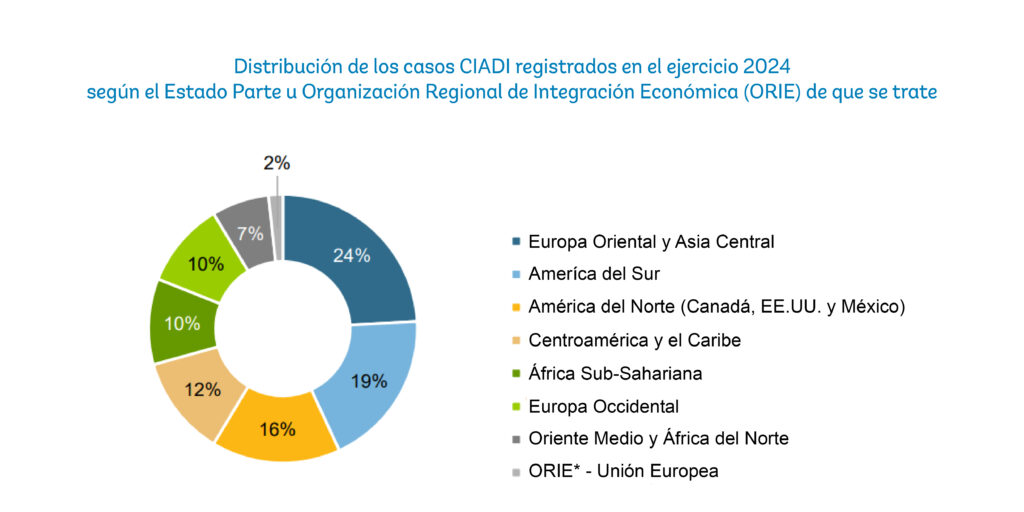
For Mario Reggiardo, obtaining information on commercial arbitrations is complex because most of these cases are confidential. “Regarding investment arbitrations, the International Centre for Settlement of Investment Disputes (ICSID) has published statistics on cases initiated and pending. As of June 30, 2024, approximately 47% of the registered cases corresponded to Latin America:
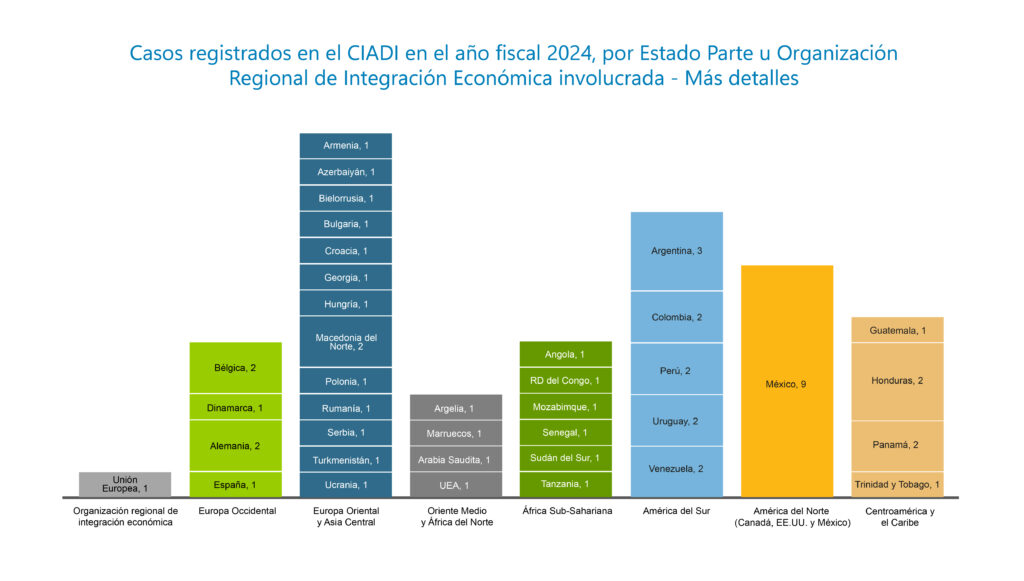
The countries with the highest demand were Mexico (9 cases), Honduras (3 cases) and Argentina (3 cases):
Arbitrages are growing in the energy, mining, oil and gas sectors
María Arias Navarro pointed out that, from a general perspective, energy and construction continue to be the sectors with the highest demand for arbitration, both commercial and investment. “The gradual but steady growth of corporate arbitration is also evident. This sector, along with professional services, pharmaceuticals, food, and healthcare, has had a greater impact on CIAM-CIAR cases in 2023.”
From a general perspective of international arbitration, we could say that the following sectors continue to consolidate their position as those with the highest demand:
- Conflicts in the renewable energy sector, both in the pre-contractual and contract negotiation phase, as well as in project construction and operation.
- Oil & gas supply contracts, particularly when it is necessary to adjust price variables.
- And the development of large infrastructures in various parts of the world (particularly in Latin America).
We also expect investment arbitration to consolidate its expansion into less traditional areas such as disputes arising from tax measures or related to international sanctions regimes.
Cecilia O’Neill agreed that the sectors that have dominated the matters subject to arbitration in Latin America include the energy sector, “particularly around disputes related to the exploitation of natural resources, and the infrastructure sector, including construction contracts and concessions.
Arbitration encompasses several key sectors, reflecting both local needs and the dynamics of international trade. For example, in Spain, arbitrations have focused on trade, construction, energy, telecommunications, and, to a lesser extent, mergers. In Latin America, arbitrations have predominated in energy and infrastructure. Countries like Brazil and Peru have had a high volume of cases, especially in concession contracts, with an increase in disputes related to large infrastructure projects.

Benito Zelaya agreed with the above, stating that in 2024 the sectors most affected by arbitration in Latin America continue to be energy, mining, and oil and gas. He noted that these sectors have been the focus of numerous conflicts due to regulatory changes, contractual disputes, and environmental policies.
In the energy and mining sectors, the transition to renewable energy and the implementation of environmental policies have generated disputes. Changes in contracts and regulatory reforms are the main causes of conflict. In oil and gas, fluctuations in oil prices and changes in government policies continue to be sources of arbitration. Countries like Mexico and Brazil have seen an increase in disputes related to the reintegration of state-owned enterprises into the energy market. In construction, infrastructure projects, especially those related to the construction of power plants and mining operations, have also been the subject of disputes.
According to Zelaya, in Honduras, arbitration disputes in 2024 have been primarily dominated by the energy sector, especially renewable energy projects. Legislative and contractual changes, along with policies incentivizing investment in clean energy, have led to several legal disputes.
“In summary, the trend in 2024 shows that the energy, mining, and oil and gas sectors continue to be the most litigious in Latin America and Honduras, with a particular emphasis on the energy transition and the impacts of environmental and regulatory policies,” noted the managing partner of Lexincorp Honduras.
For his part, Mario Reggiardo indicated that the same ICSID report details that arbitrations related to oil, gas, mining, transport and energy predominate:
Importance of arbitration in foreign investment
“Latin America experienced a remarkable change in attitude towards arbitration and an openness towards the implementation of alternative dispute resolution systems, starting in the 1990s. The economic evolution of the countries in the region led them to seek strategies to attract foreign investment by offering more attractive conditions for potential investors.
Agreements for the Promotion and Reciprocal Protection of Investments, as part of a comprehensive investment incentive regime, have a positive impact on the flow of foreign direct investment, and investment arbitration has become established as a fundamental mechanism in the field of international law, providing a way to resolve disputes between investors and States.
Investment arbitration has become a key tool for promoting and protecting foreign direct investment, while also seeking to balance the interests of investors and host states. Although this mechanism faces criticism and debate, it remains widely used globally as an effective means of resolving disputes in the field of international investment where ordinary jurisdiction cannot encompass the increasingly complex international relations.
“Of the 165 Contracting States of the Washington Convention or ICSID Convention of 1965, 9.1% are Ibero-American,” María Arias Navarro specified.
According to Cecilia O’Neill, “arbitration has played a crucial role in attracting investment between Latin America and Spain by providing a reliable and neutral dispute resolution mechanism. Large-scale projects in sectors such as energy, infrastructure, and mining require foreign investment and government incentives to be viable. The guarantees that arbitration offers in terms of impartiality and efficiency are especially valuable for foreign investors seeking to protect their interests in markets with diverse legal and regulatory systems. The existence of bilateral investment agreements and treaties that favor international arbitration has facilitated this flow of investment by offering a secure environment for resolving disputes.”
Benito Zelaya added that arbitration has been fundamental in attracting investment between Latin America and Spain, creating an environment of trust for investors. “The existence of arbitration mechanisms in bilateral investment treaties has provided guarantees to investors, ensuring that their rights will be protected in the event of disputes. This has allowed Spanish companies to feel more secure when investing in projects in Latin America, contributing to the figure of more than €153 billion in investments. Furthermore, arbitration offers a faster and more efficient solution compared to local judicial systems, which is attractive to investors.”
According to Mario Reggiardo, “Latin America has a serious institutional problem that generates distrust among investors. Many investors do not trust local judges, and therefore arbitration has played an important role as one of the incentives to invest in this part of the world. Investment treaties and the arbitration linked to them have played a significant role.”
Latin America modernizes its legal frameworks to align with international standards
According to lawyer and arbitrator María Arias Navarro, in terms of investment, Latin America and the Caribbean (LAC) has traditionally been a political, social and economic priority for Spain and for Spanish companies.
“Proof of this was the agreement reached during the III European Union (EU) – Community of Ibero-American and Caribbean States (CELAC) Summit, held in Brussels in July 2023, in which its participants made a commitment to continue strengthening trade and investment relations between them.
The EU maintains a series of Association and/or Trade Agreements with countries and geographical areas in Latin America and the Caribbean (LAC) that define the trade relationship between Spain and the region. Specifically, it maintains Association Agreements with Mexico, Chile, and Central America; a Trade Agreement with Colombia, Peru, and Ecuador; an Economic Partnership Agreement with CARIFORUM; and a preliminary agreement with MERCOSUR.
It also has signed numerous agreements with countries in the region that include the protection of investments.
Spain also maintains an extensive network of Double Taxation Agreements (DTAs) and Bilateral Investment Treaties (BITs) or Agreements for the Promotion and Reciprocal Protection of Investments (BITs) that encourage investment through measures to protect companies’ international investments by reducing political and legal uncertainty abroad. The vast majority of these DTAs or BITs provide for submission to ICSID arbitration and constitute the main source of investment arbitrations in Latin America.
On the other hand, instruments such as the Convention on the Recognition and Enforcement of Foreign Arbitral Awards (New York 1958), which is binding in practically the entire world and where 11.62% of the signatories are Ibero-American countries, and the Inter-American Convention on International Commercial Arbitration (CIAC-Panama 1975), ratified by all the countries of Ibero-America, are catalysts for international commercial arbitration.”
Cecilia O’Neill, an arbitrator in Lima and Madrid, added that “in terms of regulations, Latin America has made significant progress in modernizing its legal frameworks for arbitration. Many countries have updated their legislation to align with international standards, such as the UNCITRAL Model Law and the ICC recommendations. However, implementation and the level of maturity vary.”
The managing partner of Lexincorp Honduras added that, in 2024, the Ibero-American region saw significant regulatory developments in the energy sector, with a strong focus on the transition to clean and sustainable energy. Countries such as Brazil, Chile, Colombia, and Mexico have implemented reforms to improve energy efficiency, promote renewable energy, and meet environmental sustainability goals.
Benito Zelaya added:
“Brazil and Chile: They have led the region in implementing energy efficiency programs and energy security certifications, respectively. These initiatives seek not only to reduce greenhouse gas emissions, but also to attract foreign investment by providing a clear and predictable regulatory environment.”
Mexico and Peru have focused on the circular economy and sustainability, implementing regulations that encourage the reuse of materials and the reduction of waste. Mexico, in particular, has faced regulatory challenges due to changes in energy policy that have generated uncertainty among investors, although it continues to offer significant opportunities in renewable energies such as solar and wind.
Colombia has made progress in implementing sustainability reports, which require companies to report on their environmental, social, and governance (ESG) impact. These measures aim to improve transparency and promote responsible business practices.
In 2024, Honduras is undergoing a significant transition in its regulatory framework, particularly in the energy sector. Honduras has demonstrated a clear commitment to the energy transition and the modernization of its electricity sector. However, regulatory instability and policy implementation challenges remain significant obstacles. To improve the investment climate and ensure sustainable development, it is essential that Honduras strengthen the coherence and stability of its regulatory framework, enhance the capacity of institutions to implement and enforce regulations, and adopt an inclusive approach that considers the social and environmental impacts of its policies.
Mario Reggiardo, a partner at Payet, Rey, Cauvi, Pérez Abogados, explained that the level of regulation is proportional to the degree of economic freedom, which is in turn linked to political factors. “While it’s impossible to generalize to every case, in the vast majority the pattern is clear: the faster, simpler, and cheaper it is to start a business, the greater the economic well-being generated in the country. The problem is that political instability in the region leads to fluctuations within the same country between over-regulation and freedom to do business.”
In our next installment, we’ll talk with experts about the relationship between AI and international arbitration. We’ll address the challenges the arbitration community will face in the coming years, as well as the progress in female representation within this field. Don’t miss it!