

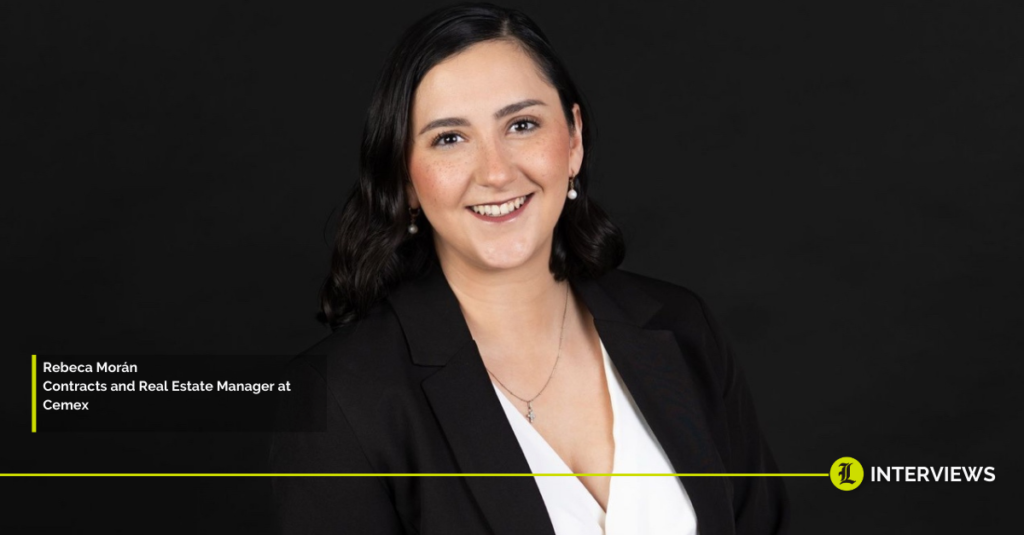
In organisations where the legal department appears only to review and validate, the real risk is no longer legal, but strategic. Rebeca Morán has built her career at Cemex by challenging that model. From her beginnings as an intern to her current role as Contracts and Real Estate Manager, her approach to practising law has been defined by proactivity, operational understanding and early participation in shaping decisions that allow the business to move forward with legal certainty.
Her vision reflects a broader transformation of the in-house role: a shift from reaction to judgment, from control to strategic partnership, and from the legal function as a brake to the legal function as an enabler of the business.
From the outset of her career, Morán understood that professional growth does not occur by inertia. “The most important decision was not to wait for opportunities to come to me, but to create them,” she says. By carefully observing the needs of her leaders and of the company, conducting her own research and anticipating those needs, she shaped her internal trajectory. This approach enabled her to assume responsibilities organically and, in less than a decade, progress from intern to analyst, then to National Head of Contracts, and now to Legal Manager for Contracts and Real Estate.
More than a succession of titles, her career reflects the development of sound judgment grounded in a deep understanding of how the business truly operates.
Today, Rebeca Morán is our guest on Voices of Law: Dialogue with Partners and General Counsel from Latin America.

From the lawyer who reviews to the lawyer who designs
The turning point came when she stopped intervening only at the end of the process. “I began participating before there was even a contract,” she explains. From that moment on, the sales and operations teams sought her out not merely for validation, but to think through how to structure a viable operation.
“I stopped being the lawyer who says ‘yes, it can be done’ or ‘no’, and became part of the team that designs how to do it properly.”
That shift redefined her role and repositioned the legal function within the strategic conversation.
Working closely with critical industrial assets and long-term projects reinforced a key idea for her: the law is not abstract. “Every contractual clause has a real impact,” she notes. A delay, an ambiguity or a poorly managed risk can result in a plant shutdown or a project that never materialises.
For that reason, she insists that the legal department must operate in constant contact with business realities. “My role is not to impose legal terms from behind a desk, but to translate business needs into legal language that protects the company without hindering its operations.”
Anticipating risks without slowing the business
In Mexico, the legal management of real estate and industrial assets presents structural challenges. Legal certainty regarding land tenure, regularisation processes, ejidos (communal landholdings) and the complexity of property regimes remains a constant concern, compounded by regulatory changes in environmental matters, land use and permitting. Added to this is the pace demanded by the business. “Finding the balance between legal certainty and operational agility is a daily exercise,” she explains.
For Morán, that balance is achieved through anticipation and communication.
“If you wait until the project is already under way to review the contracts, you will always be behind the operation,” she warns.
Anticipating risks means identifying them before they become obstacles, but it also requires discernment. “Not all risks have the same impact, nor are all battles worth fighting.”
Part of the legal function’s value lies in distinguishing what is critical from what is negotiable, so that the business can proceed with informed, acceptable and properly documented risks.
Leading through credibility, not hierarchy
From an in-house perspective, the business expectation is clear. “The business expects solutions, not just diagnoses,” she summarises. It wants to know whether something can be done, how and within what timeframe. Trust is built when the legal team demonstrates that it understands the operation and shares the objective of making the project succeed. In cross-functional environments, leadership is not imposed by hierarchy.
“You cannot impose; you have to persuade.”
That same leadership extends to her team. Morán leads nine professionals and acknowledges that the transition from colleague to manager was one of the most complex challenges of her career. Over time, she realised that proximity does not weaken authority when accompanied by clarity, support and direction. “Respect is earned when your team knows where it is going and why.”
“Technology does not replace judgment or critical thinking; it enhances them”
When speaking about her team, Morán is clear about the qualities she values most: curiosity, proactivity and clarity in communication. “A good lawyer is not the one who uses the most technical language, but the one who ensures that all parties understand what is at stake.”
Technology complements these capabilities. Artificial intelligence, contract management systems and electronic signatures are already reshaping legal practice. “Technology does not replace judgment or critical thinking; it enhances them.” In her view, lawyers who fail to leverage these tools risk falling behind.
External firms: thinking together, not reacting
In her experience, the firms that deliver genuine value are those that understand the client’s business, not merely the case file. “They are the firms with whom you can think out loud and build solutions together.” By contrast, those that limit themselves to reactive responses lose relevance in an environment that demands foresight and strategic vision.
Monterrey: a space for honest debate
Her participation in the Monterrey Legal Forum 2026, organised by Gericó Associates, follows the same logic that guides her daily work. She is keen to share Cemex’s experience in legal innovation, contract management and the use of artificial intelligence in controlled environments, but above all to encourage an honest debate.
“This is my first time participating, and I am interested in sharing what we have done in terms of innovation: implementing contract management systems and using artificial intelligence in closed-loop platforms.”
Yet the real focus, she insists, lies in addressing uncomfortable questions: “What is truly preventing us from adopting technology? Is it budget constraints, resistance to change, lack of knowledge or fear of being replaced?” When legal leaders speak candidly about their obstacles, not only their successes, collective learning becomes far more meaningful.
The conversation with Rebeca Morán makes one point clear: the value of a legal department is not measured solely by the risks it mitigates, but by the decisions it enables. Its leadership is neither declarative nor reactive; it begins before the contract is signed, in understanding the transaction and anticipating potential issues without obstructing progress.
At a time when legal departments are redefining their place within organisations, her perspective confirms an irreversible shift: law that arrives late protects less; law that understands the business allows it to grow.
In short
What’s the smartest thing anyone has ever said to you (and who said it)?
“From head to mouth,” my mother.A book?
The Kite Runner, by Khaled Hosseini. (If the intention was A Thousand Splendid Suns*, the correct styling would be: A Thousand Splendid Suns, by Khaled Hosseini.)*A sport?
Football.A song?
“Die for You”, by The Weeknd.If you weren’t a lawyer, what would you be?
A chef.Your favourite food?
Japanese cuisine.What puts you in a bad mood?
A lack of honesty.A key to success?
Create your own opportunities.