

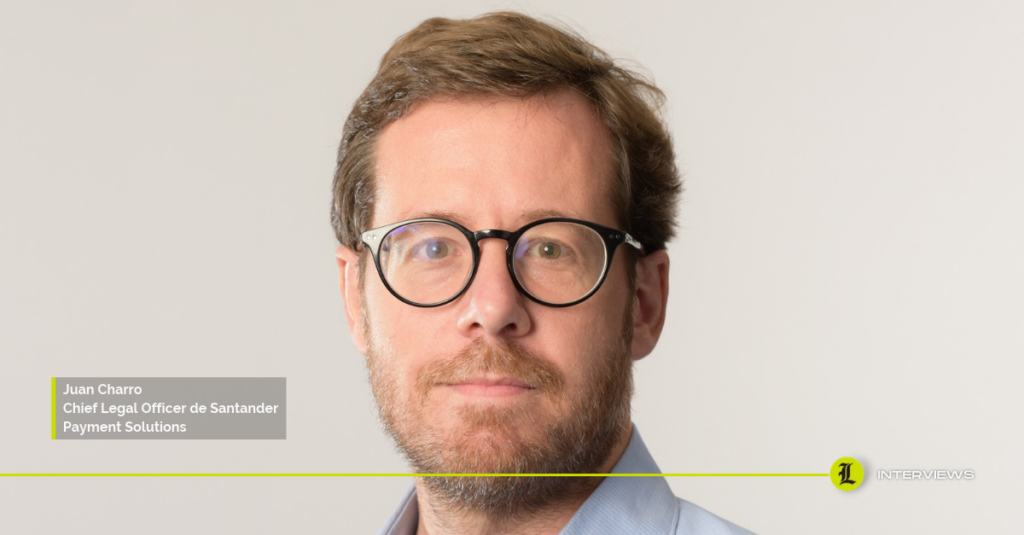
Juan Charro, Chief Legal Officer of Santander Payment Solutions, the global payments business of the Santander Group, attributes his career path to steps that at the time seemed risky. The first was leaving a law firm for a multinational corporation. Then, once there, he entered the global payments business after many years in another area of specialization. This willingness to venture into areas he doesn’t fully understand is reflected in his leadership style. Charro maintains that the legal function often makes decisions without complete information, and that the key is knowing which risks are acceptable and when it’s appropriate to pause and delve deeper. In payments, where innovation advances faster than regulation, he also believes that this uncertainty gives the Legal department the opportunity to anticipate standards. The condition, he warns, is to act with sound judgment, “without letting fear of risk limit opportunities”.

You head the legal function at Santander Payment Solutions, the global payments business of the Santander Group. What risky decision proved decisive in getting you here?
I believe it’s been the result of several decisions made at different times. It’s a fairly classic answer, but I sincerely believe the key has been not being afraid to take steps that, at first glance, might seem risky. I’ve always tried to maintain my curiosity and be open to learning about and exploring new areas, such as the decision to move from a law firm to a multinational company, and then, within the latter, to work in the global payments business after many years in another area of specialization. I think that careers that aren’t perfectly linear are increasingly valued, which undoubtedly requires accepting some uncertainty and venturing into unfamiliar territory. The important thing is to do so judiciously, but without letting fear of risk limit opportunities.
As head of a legal team, many decisions must be made without having all the information. How do you deal with that?
It’s inevitable. Every day, we encounter many issues that require us to navigate with a degree of uncertainty, either because the information is incomplete or because business timelines don’t allow us to wait for it. But that doesn’t mean deciding blindly. The key lies in having the knowledge, experience, and sometimes even the instinct necessary to ensure that these decisions don’t exceed reasonable limits in terms of legal risk. It’s about knowing how to identify what’s essential, which risks are acceptable and which aren’t, and when it’s wise to pause and delve deeper before taking action. And the trust our clients place in us is also crucial: it’s what allows us, when the time comes, to distinguish between situations where a decision can be made with the available information and those where it’s impossible to proceed without further analysis.
In this process, the team is fundamental. Often, the best combination arises from combining the dynamism and speed of younger lawyers with the experience of more senior lawyers who have already faced similar situations and can anticipate potential problems. This blend of agility and experience allows us to make quick yet sound decisions.
What culture are you trying to build in your legal team?
I strive to foster a culture that combines agility with the necessary rigor. It’s clear that businesses increasingly need quick answers and practical solutions, but in the Legal department, we cannot allow that speed to compromise the quality of analysis or lead to taking risks we’re not even aware of.
That’s why it’s important to me that teams understand the priorities, feel a sense of urgency, and at the same time, know how to identify the issues that require further investigation and deeper analysis. There’s another element that’s essential for me: teamwork and working without egos. Precisely because of the need for quick responses, it makes no sense not to rely on the team when other members can contribute greater expertise on a specific topic. If everyone understands that success belongs to the team and not to any one individual, I think we’ll be on the right track.
A Chief Legal Officer supports the business, but must also know when to rein it in. When should a legal leader say no?
We start from the premise that “no” should be the exception and not the starting point.
Clearly, there are issues where the level of legal risk prevents us from proceeding as planned. In those cases, we must be very clear, especially when the company’s values, which we believe in, are also at stake.
But our obligation doesn’t end with identifying the problem. The true value of the legal function lies in understanding what the business wants to achieve and seeking alternatives that allow it to reach that objective while reducing or eliminating risk. Rather than simply stating that a proposal cannot be implemented, we must try to respond with another proposal that allows it to achieve—fully or partially—those same objectives.
In the payments sector, technological innovation is constant and regulation is increasingly demanding. What role does the legal function play in ensuring that both advance in tandem?
A fundamental part of our work involves learning to navigate uncertain environments. Innovation often moves much faster than regulation, generating questions for which there are no definitive answers yet. But this uncertainty also presents an opportunity. If we are close enough to the business, we can understand the legal issues from their earliest stages and contribute to establishing standards proactively, rather than simply reacting once they have already been defined.
This requires ongoing dialogue in two directions: closely supporting the business and, at the same time, maintaining constructive interaction with other stakeholders such as regulators, who sometimes face the same challenge of trying to anticipate technologies that evolve at enormous speed.
The agentic commerce sector is a good example of this: it’s evolving very rapidly while legal and regulatory issues remain unresolved. This is precisely where Legal can add the most value: by understanding the technology, identifying relevant questions, and helping both businesses and the regulatory ecosystem find solutions and answers.
You are a member of the jury for the Gala Nacional del Derecho – Legal Leadership Awards 2026 , which recognizes excellence in marketing, communication, and business development within the legal sector. What can initiatives like this contribute to the Ibero-American legal sector?
I believe that these kinds of initiatives help, above all, to build bridges. We live and work in an increasingly globalized world, where legal and business challenges transcend borders with remarkable ease. We, for example, have a strong presence in a wide variety of Latin American countries.
That’s why it’s important for the legal community to become increasingly close and connected. These awards allow us to recognize talent and initiatives, but also to share experiences, build relationships among professionals from different countries, and learn from diverse legal and business realities. Particularly between Europe and Latin America, there is a great opportunity to further strengthen these ties.
The ultimate value lies not only in individual recognition, but in building a closer, more open, and more global legal community.
The interview with Juan Charro reveals a leadership style built on teamwork. His emphasis on speed rests on two key elements. The first is the combination of young lawyers, accustomed to swift action, with senior lawyers who can anticipate potential problems. The second is an ego-free culture where, as he points out, success belongs to the team. Charro applies this same logic of connection to the regional level. He notes that the group has a presence in a wide variety of Latin American countries and believes that initiatives like the Legal Leadership Awards help build bridges between professionals from different countries, with a particularly clear opportunity between Europe and Latin America. His vision paints a picture of a legal function that gains strength by accumulating knowledge, both within the team and across jurisdictions, with an objective he himself articulates: “to build a closer, more open, and more global legal community.”