
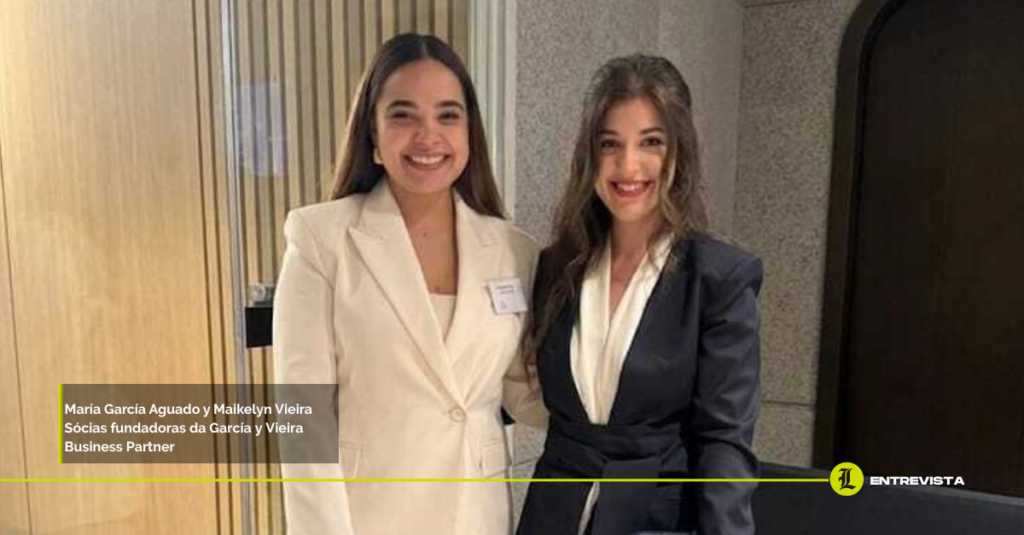
María García Aguado and Maikelyn Vieira didn’t enter the market to occupy a space, but to challenge it. After years working within the REIT sector, they both identified a disconnect that was hard to ignore: legal advice existed, but it wasn’t always where the decisions were actually made. From this observation , García y Vieira Business Partner was born, a firm that not only redefines a niche, but also the role of lawyers in increasingly complex transactions.
The origin: detecting a gap that was not obvious
The starting point wasn’t an obvious opportunity, but rather accumulated friction. Having experienced the sector from the inside allowed them to understand that the problem wasn’t a lack of advice, but rather their approach.
As founding partner Maikelyn Vieira explains, “García y Vieira was born precisely from a very practical vision of the sector… from knowing firsthand not only how it works, but also the real needs they face on a daily basis.” This internal experience made visible a gap that, from the outside, wasn’t always perceived.
María García Aguado, for her part, puts it more directly: “It is not born to be just another alternative, but to fill a gap that is difficult to justify in a market as sophisticated as real estate,” says the founding partner.
And that void had a name: generalism.
Because, although SOCIMIs have historically been well advised, they have been advised—as he points out—from a perspective that doesn’t always align with their nature. “A SOCIMI is not a real estate company with tax advantages; it is a company with its own entirely unique legal, operational, and strategic logic.”
From there, the conclusion was inevitable: what was needed was not more advice, but a different kind of advice.
The breaking point: stop being late
That diagnosis led them to question the traditional office model. Not as a superficial criticism, but as a structural observation.
“Traditional consulting tends to operate reactively: it intervenes when there is a transaction, a problem, or a specific need,” explains García Aguado. In other words, it intervenes when the room for maneuver is already limited.
In contrast, his proposal changes the moment – and, with it, the role – of the lawyer.
“We don’t intervene in the process, we are part of the process.”
The difference is significant. It means being present at the stage where the relevant decisions are made, which, as they emphasize, are not strictly legal in nature. “The relevant decisions aren’t made at legal moments, but at business moments. And if the advisor isn’t integrated into that process, they’re too late.”
This is probably the most important point of the entire conversation. Because it doesn’t talk about how advice is given, but about when and from where it is given.
From execution to design: where the value is generated
From that point of view, legal work is transformed. The focus shifts from execution to design.
“The preventative approach isn’t just a phase of legal work; it’s how we understand any operation,” says García Aguado. In other words, it’s not about anticipating problems occasionally, but about building from the ground up.
This is especially critical in the world of REITs, where complexity is not isolated but structural. In that context, being late doesn’t mean solving a problem, but rather integrating it into operations.
As Vieira summarizes:
“The success of this type of operation is determined long before its execution.”
That’s why their involvement begins even before a formal transaction takes place: they analyze the vehicle’s logic, the growth strategy, and the governance. In short, they design the architecture upon which everything else will be built.
García Aguado takes it a step further:
“Our job is not only to identify contingencies, but to prevent the architecture of the operation from generating them.”
Moldless operations: when the precedent does not exist
This approach has allowed them to participate in operations that, until recently, did not have a clear fit in the market: dual listings, takeovers between micro REITs or complex merger structures.
However, far from presenting them as exceptions, both agree on an idea that dismantles a certain narrative of the sector:
“Many of these operations had not been done before not because they were impossible, but because they required a different approach.”
Herein lies another key lesson: there are no standard operations, even if attempts are made to treat them as such. The real challenge lies not in applying the rules, but in making regulation, corporate structure, and market logic coexist seamlessly.
“What really makes the difference is the ability to build structures that work in practice, not just on paper,” explains García Aguado.
And at that point, the lawyer ceases to be an executor and becomes an active part of the project.
Specialization as a structure, not as a niche
At the same time, their decision to operate as a boutique is not due to a limitation, but to a deliberate strategy.
“It is not a consequence, but a strategic decision,” insists García Aguado.
In a context of concentration in the legal sector, where scale seems to prevail, they put forward the opposite argument: in highly technical areas, precision is not an added value, it is the core of the service.
This translates into a very specific model:
- Extreme specialization.
- Agility in decision-making.
- Direct involvement in every operation.
“There are no intermediate layers, no dilution of knowledge,” they explain. Whoever designs the operation is the one who executes it.
And that direct connection, in a market where complexity is growing, becomes an advantage that is difficult to replicate.
A more demanding market, a different advisor
The context in which they operate further reinforces this model. The REIT market is moving towards a more mature phase: more consolidation, greater pressure on returns, and an increasing level of sophistication on the part of investors.
At the same time, regulation—both national and European—raises the standard in transparency, supervision, and corporate governance.
Given this scenario, legal advice cannot be limited to reacting.
“Anticipating means understanding where the market is evolving, not just where regulation is evolving,” says García Aguado.
This implies a change in mindset: working from the operational reality of the vehicle, not just from its regulatory framework. And, above all, designing structures capable of adapting to an environment that no longer allows for rigid solutions.
Redefine size, redefine leadership
The firm’s rapid positioning – recognized by Legal 500 as a “Firm to Watch” – is explained not by speed, but by focus.
“Radical specialization and participation in pioneering operations accelerate reputation,” they point out.
But there is one idea that runs through this part of the conversation and that connects with the change of model: size ceases to be a measure of capacity.
“How is it possible for a team of two people to execute what is traditionally done by much larger teams?” is a question they say they hear frequently.
The answer goes back to the origin: focus, specialization and real presence in decision-making.
In that sense, young leadership—and in this case, female leadership—is not defined by structure, but by the ability to understand, anticipate, and execute in complex environments.
If there’s one thing that María García Aguado and Maikelyn Vieira make clear, it’s that change in the legal sector won’t come solely from technology, regulation, or market consolidation.
It will come – and is already coming – from a deeper transformation: that of the role of the lawyer.
“The market doesn’t need more legal advice, but a different kind of advice.”
One that doesn’t arrive when the operation is already underway, but when it is still being defined.
One that does not merely interpret structures, but thinks about them from within.
Because, in an environment where complexity is structural, the real value is no longer in solving problems, but in preventing them from existing.
And it is in this change – silent, but decisive – that the future of the legal profession begins to be redefined.