

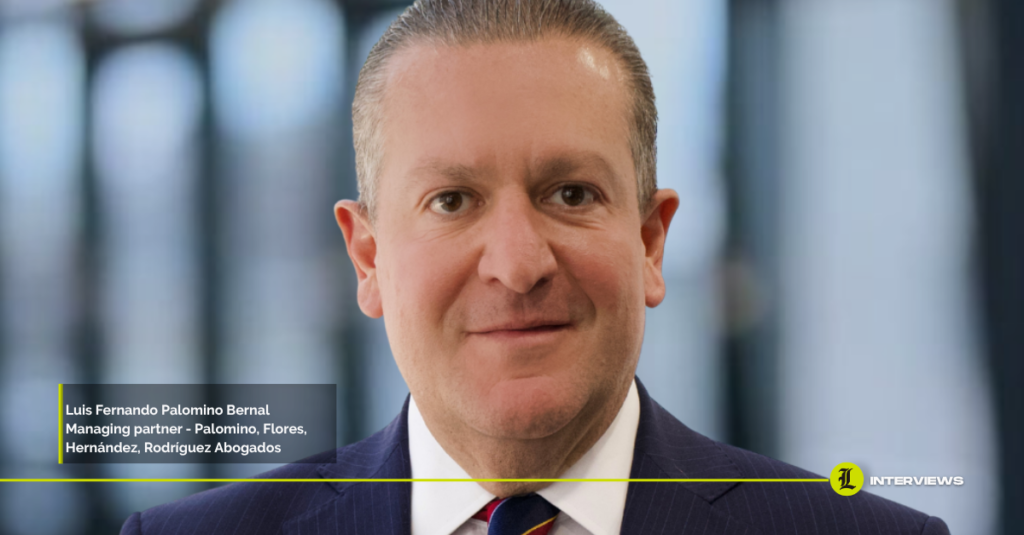
Luis Fernando Palomino Bernal, managing partner of Palomino, Flores, Hernández, Rodríguez Abogados, places the decisive moment of a business crisis in the willingness of the board of directors to activate a legal insolvency process in a timely manner, above the financial diagnosis itself.
With thirty years of experience that began during the Mexican financial crisis of 1996, and a regional perspective built from the presidency of the Mexican Chapter of the Ibero-American Institute of Bankruptcy Law and his participation in the Latin American Committee of INSOL, he identifies a pattern that is repeated in Latin American jurisdictions: banks restrict or limit financing to companies in crisis, and this restriction redirects restructurings towards private venture capital, while the absence of truthful information between the legal, accounting and treasury areas turns any contingency into a threat that escalates to the criminal sphere.
“A common problem throughout Latin America is financing for companies in crisis, since, for example, in jurisdictions like Mexico, banks are prohibited or limited from doing so. That is why it is necessary to turn to private venture capital to finance these operations,” he stated.

After more than 25 years of litigation and more than two decades advising business groups in crisis, at what point in an insolvency process does the legal decision carry more weight than the strictly financial decision?
Palomino Bernal places the origin of that reading in his own trajectory:
This year is very special for me, as I’m not only turning 50, but also celebrating 30 years of litigation and advising companies in crisis. My career began in 1996, during the height of the financial crisis in Mexico, known as the “December Mistake” or internationally as the “Tequila Effect.”
Therefore, having advised many companies and entrepreneurs in situations of financial crisis, I can tell you that the legal decision that weighs more heavily than the strictly financial one occurs when the entrepreneur decides in time, with sufficient time and money, to initiate a legal insolvency process.
In Latin business culture, what others will say carries much more weight than what really needs to be done, and doing it regardless of what others think.
I have witnessed firsthand how, when faced with a financial crisis, business owners often convince themselves that the issue will magically resolve itself. Instead of initiating a formal restructuring through bankruptcy proceedings, they begin to request more time, provide more guarantees, and involve more joint and several obligors, only to realize a year later that it didn’t work and that they are now forced to resort to a process with a disadvantage, with more assets at risk, and without cash.
Similarly, I have had the opportunity to advise those who, with a cool head, have been able to self-analyze, understand that they are in crisis, that this is natural to business, and know how to use the legal tools to go in a timely manner, and with time and money, I insist, to a legal insolvency process.
Personally, I find it difficult to understand parents who refuse medical treatment or surgery for their children with serious illnesses because it goes against their religious beliefs, and that child dies when they could have been saved. I find it equally difficult to understand business owners who don’t take care of their companies by addressing their needs in a timely manner through the legal restructuring process.
Your participation on INSOL’s Latin America Committee gives you a rare comparative perspective. What structurally distinguishes a financial restructuring process in Mexico from one in other Latin American jurisdictions where you have direct visibility?
Regional comparison leads to a shared diagnosis:
The Latin American committee of INSOL, which will hold its 2027 annual seminar in Mexico City, is tasked with analyzing and studying the different ways of addressing and legislating restructuring in our countries, finding very similar problems due to shared cultural identities. For the past four years, a Latin American roundtable organized by INSOL and the World Bank has been presenting these issues and generating legislative changes.
A common problem throughout Latin America is financing for companies in crisis, since, for example, jurisdictions like Mexico prohibit or restrict banks from doing so. This is why private venture capital must be used to finance these operations.
There are three things that I believe Mexico urgently needs to address in this matter:
- The correct regulation of insolvency of micro, small and medium-sized enterprises.
- The need to restructure the company and its jointly liable parties, even if they are not merchants. If this is not addressed, separate proceedings must be initiated when the civil insolvency provisions of the National Code of Civil and Family Procedures apply.
- An effective pre-bankruptcy system using Alternative Dispute Resolution methods.
As president of the Mexican Chapter of the Ibero-American Institute of Insolvency Law, what recent change in Mexican insolvency practice do you believe has not yet been assimilated by most firms advising companies in crisis?
From his role at the head of the Institute, he identifies a specific gap:
When there is a widespread crisis, not limited to a specific sector or situation, it means that many companies of all sizes and across all sectors are facing the same problem simultaneously. This creates a domino effect: a company that cannot pay its suppliers and creditors, in turn, causes them to be unable to pay theirs, and so on.
The problem is that many of the lawyers who serve these companies unfortunately lack the tools and specialized knowledge in this area.
Hence the important work of associations such as the Ibero-American Institute of Insolvency Law, which among its main activities is to carry out seminars and congresses for all lawyers so that they are prepared and can properly advise their clients.
So what do I think hasn’t been grasped by several law firms advising companies in crisis? That continuous and up-to-date legal training is required for their partners and associates.
From your experience as an advisor to business groups in crisis, what is the most common mistake a board of directors makes in the first weeks of a liquidity crisis, before the matter reaches a firm like yours?
In the council chamber, the pattern repeats itself:
There are several recurring mistakes, but I’ll focus on two.
The first is leaving the company without liquidity when it had the tools to have avoided it.
If I were a professional diver and suddenly realized I had 5 minutes of oxygen left, I would either find someone to give me another tank or head straight to the surface, but you wouldn’t see the diver continuing to swim to the opposite side of the surface, photographing fish as if nothing were wrong.
That’s what happens when you know you have a serious liquidity problem, and you keep borrowing to pay what’s due, digging one hole to cover another, but each time bigger; you know that collapse is imminent and instead of rising to the surface and solving it, you don’t stop the bleeding and you don’t take the bull by the horns.
The second option is to kick the can down the road, as we say in Mexico. Even knowing that the business needs a fundamental restructuring, offering creditors a repayment period, higher interest rates, and more guarantees only postpones the problem, perhaps for another year, but under worse conditions.
Your practice combines restructuring with white-collar crime litigation. At what point does an insolvency crisis begin to have, in practice, a criminal risk dimension for the company’s directors?
The border with criminal law, he says, has identifiable signs:
When they begin to engage in ruinous or fraudulent acts. Examples include self-seizures or “screws,” donations or gratuitous acts to strip the company of assets, selling for 1 what is worth 1,000, etc.
It also gets complicated when they start altering the financial statements and accounting, because at that moment they are overcome by the momentary need to obtain more borrowed money.
Your firm is sponsoring the Foro Gerencias Legales México 2026, which concludes on September 3 with the panel “Operating in High-Risk Environments: Compliance Strategies and Corporate Resilience.” Based on your experience in resolving corporate crises, what distinguishes a legal management team that achieves true resilience from one that merely manages the contingency while it lasts?
That bond, he argues, is built behind closed doors:
The most effective restructurings we’ve handled have occurred when there’s excellent communication between the legal team and the firm. Everyone must cooperate because often the issue isn’t the technical expertise of the participating lawyers, but rather their emotional capacity to set aside ego and work as a team toward the common goal of rescuing the company. This is no easy task, and we’ve invested heavily in training our staff to develop this emotional intelligence for collaborative work. The legal team that successfully adapts, works alongside the external advisor, and focuses on the core issues toward a shared objective is the one that wins.
That same closing panel brings together compliance, cybersecurity, and corporate resilience under a single risk umbrella. Where do you place the risk of insolvency within that framework, when many companies still treat it as an isolated treasury issue rather than as part of comprehensive legal management?
The risk of insolvency, he warns, requires integration into general legal management:
The fundamental issue is to have or achieve communication with truthful information for correct decision making.
If the accounting department doesn’t reflect the company’s true situation, if the treasury doesn’t report the lack of liquidity and everything starts to be financed with taxes and suppliers, and if the legal department doesn’t truly make legal contingencies transparent by saying it will win all the lawsuits, it’s just a matter of time before things explode.
With over two decades of training lawyers in Bankruptcy Law at Universidad Panamericana, what is changing today in the way young firms understand insolvency, that you didn’t see ten years ago?
Facing the next generation of lawyers, it marks a paradigm shift:
Fortunately, the Pan-American University gives students the opportunity to take the subject of Commercial Bankruptcy Law, since it is not taught in many universities or law schools.
Today, young lawyers need an international perspective on restructuring, as many of their current or future clients operate across borders. They must be familiar with and able to utilize the available tools for conducting insolvency proceedings in Mexico and related processes abroad, and vice versa.
The most important thing, where I believe the change lies, is that the solution is not only legal but also clearly financial, but in the right order. They must provide their clients with tools that allow them to restructure and obtain financing, so access to private capital must be integrated into the regular ecosystem of services offered.
Finally, if we are fortunate enough that the business owner addresses their liquidity problem in time, young lawyers should try to utilize alternative dispute resolution methods. By this, I mean that not only the company’s lawyers but also the lawyers for the banks or creditors—who often hold the balance of power for better or worse—must be well-trained: achieving restructuring or generating endless lawsuits and ultimately leaving them with an uncollectible debt from a bankrupt company that can no longer create jobs, pay them, or continue making purchases.
The transformation described by Palomino Bernal is not happening only in the boardroom, but also in the training of those who will advise the next generation of corporate crises. If emerging from insolvency increasingly depends on accessing private venture capital rather than traditional banking, the insolvency lawyer’s role shifts from solely procedural matters: they need to understand financing with the same expertise as they do litigation, and extend this dual training to the lawyers for banks and creditors, who often decide whether a restructuring succeeds or ends in lawsuits that neither party wins.