

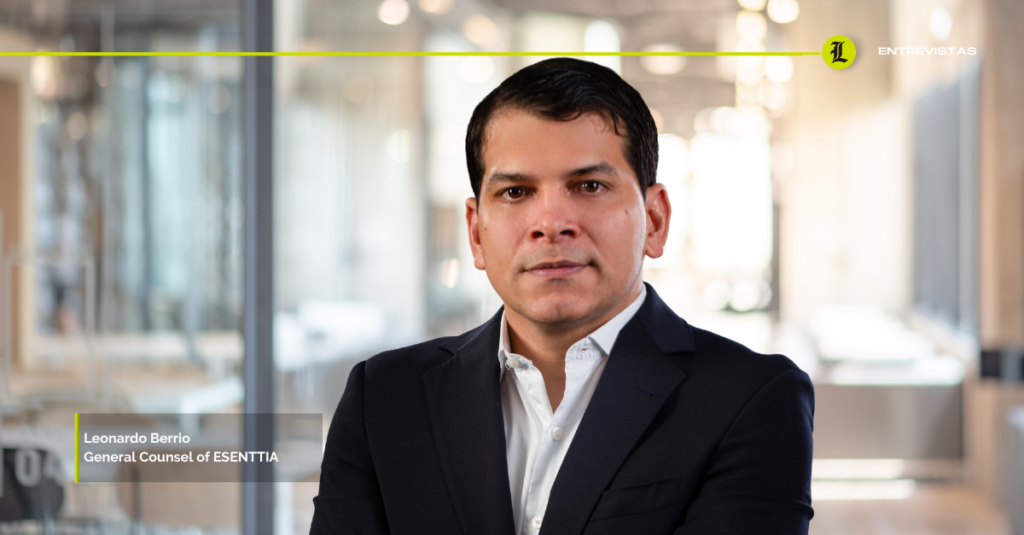
Leonardo Berrio is the general counsel of ESENTTIA, one of Latin America’s leading petrochemical companies, with over 15 years of experience in the Oil & Gas sector. In a single role, he combines the responsibilities of General Secretary and Legal Director. In this interview with Líder Legal, he discusses the integration of corporate governance and the legal function, the role of the legal department in the energy transition and ESG challenges, and why legaltech has moved beyond being an option to become the backbone of corporate legal management.

You have spent your entire career in the Colombian industrial and corporate sector, culminating in your positions as General Secretary and Legal Director at ESENTTIA. What were the turning points that shaped your profile as a corporate lawyer, and what led you to choose in-house practice over a career in a law firm?
Throughout my career in the Oil & Gas sector, which now spans over 15 years, many people tend to assume I’ve always been an in-house lawyer. However, I spent my early professional years at a law firm, for approximately five years, where I had the opportunity to work in both advisory and litigation roles, particularly in matters involving public entities. This was fortunate because it allowed me to develop a comprehensive perspective; I understood that legal counsel and dispute resolution are inextricably linked. Having worked on both fronts gave me a particular sensitivity for analyzing risks and anticipating scenarios, understanding from the outset how legal decisions can escalate into conflicts if not managed properly.
My decision to move into an in-house role stems from my passion for law and my desire to understand how different legal theories translate into reality in every activity undertaken by the business sector. In this regard, my experience confirms that, as in-house lawyers, we have the privilege of witnessing how the law comes to life and becomes the catalyst that enables the existence of companies and organizations.
“Having been on both sides gave me a particular sensitivity to analyze risks and anticipate scenarios, understanding from the outset how legal decisions can escalate into conflicts if they are not managed properly.”
At ESENTTIA, you combine two roles that are separate in many companies: General Secretary and Legal Director. How do you manage this duality in practice, and how does it enrich—or strain—the performance of each function?
Over the past decade, I have witnessed how major Colombian companies have integrated into Corporate Legal Vice Presidencies the roles that were traditionally divided between a General Secretariat focused on corporate matters and, on the other hand, the Legal Department responsible for all legal matters except those of a corporate nature. This model is very similar to that of Anglo-Saxon companies, where the Chief Legal Officer (CLO) is responsible for overseeing the organization’s entire legal strategy, legal risk, as well as regulatory and corporate affairs.
In my experience, this is because the classic role of the legal department has clearly shifted from a reactive and isolated function to that of a strategic ally of the company for decision-making, which is a perfect complement to good corporate governance practices, since the CEO of every company and its Board of Directors require a consolidated strategic legal position, not one fragmented across various areas of the company.
It is essential to always bear in mind that corporate law, which underpins corporate management traditionally handled by the General Secretariat, is not isolated from the various branches of law under the purview of the Legal Department regarding corporate governance. We must remember that both areas share a common legal foundation, and consequently, it is not advisable for senior management to have a fragmented legal framework within the organization.
For example, it was common to find companies that had separate Corporate Governance and Legal departments, with leaders who were peers and reported directly to the CEO. This inevitably led to differences in legal opinion at the highest levels of the organization without any additional body to resolve the conceptual differences between the two legal leaders.
In this sense, there is currently a marked trend in Colombian companies to seek that their highest-level legal executive not only manage the organization’s legal risk, but also, as a strategic ally of the company, be in charge of the management of the company’s corporate governance, accompanied in many cases by activities such as Compliance, crisis management, and even sustainability, which traditionally escaped the direct management of the legal department.
“It is not convenient for the senior management of a company to have the organization’s legal criteria fractured.”
ESENTTIA operates in a sector under increasing regulatory and reputational pressure regarding environmental issues, the circular economy, and the energy transition. How is the legal department responding to these challenges, and what role does the legal area play in the company’s ESG strategy?
In the Oil & Gas and Petrochemical sectors, I’ve had the opportunity to share and work closely with brilliant minds who are driving innovation to levels that seemed impossible until recently, and which are now a reality thanks to the growing awareness that safe operations can be carried out while minimizing or even eliminating their main environmental impacts. The legal aspect is of particular importance, which I could summarize in three components:
The first is that, in a regulatory environment subject to constant changes, which can even lead to the paralysis of an operation if they are impossible to comply with in the short term, it is our duty to have a regulatory management strategy that allows us to anticipate and hold the relevant debates before the regulatory authorities, with the necessary support of technical experts, to ensure that the regulation reflects what the technological, technical as well as the environmental reality requires and allows.
The second component is related to the fact that Colombia, like many Latin American countries, has a highly codified legal system; that is, we are convinced that reality only exists if it is found in a written law. Industry is no exception to this environment, and consequently, the more specialized the economic activity, the higher the applicable regulations and standards. Therefore, one of the main challenges for legal leaders in these organizations is to identify the universe of regulations governing our activity, and subsequently assign those responsible for ensuring compliance. Otherwise, the organization is exposed to a myriad of sanctions that can even lead to the suspension of operations. This requires dynamic tools; the typical, outdated regulatory frameworks that only lawyers understood and consulted are insufficient. Instead, technological tools are needed to serve the company and make regulatory and normative management dynamic.
I will illustrate the third and final component. In 2022, the first molecule of green hydrogen in the country was produced at the Cartagena Refinery. This meant that, from a legal standpoint, the project’s legal strategy had to be designed from scratch in a regulatory environment that was nonexistent at the time. This highlights the need for the legal department to support and design the contractual, regulatory, and corporate governance framework required to promote innovation and energy transition initiatives, especially when, in many cases, no prior framework exists because such initiatives have not been implemented before in the country or in Latin America.
Overall, the legal area is a key player in the ESG strategy, not only from a compliance perspective, but also as a facilitator of the company’s sustainable transformation.
“The legal area must support and design the contractual, regulatory and corporate governance framework required to promote innovation and energy transition initiatives, especially when there is no previous framework because it has not been done before in the country or Latin America.”
The conversation about the role of the Compliance Officer in Latin America has evolved: from guardian of compliance to strategic partner of senior management. How are you experiencing this paradigm shift at ESENTTIA, and what limitations or resistance do you still face?
Let us remember that in the past, legal departments have been conceived as managers of the company’s legal risk, being eminently reactive and isolated from the corporate strategic environment, participating in most cases after the decisions had already been made, acting consequently as a containment area or, why not say it, as the area that picked up the pieces left behind as a result of a decision that left the entity exposed.
This is how, for several years now, I have been promoting a management model and vision for the legal area, which has been called by various names, but which ultimately falls under what the Anglo-Saxons call the Legal Business Partner (LBP) model, which aims to generate added value for the company from legal management, which means a change of philosophy in the way we see the in-house lawyer.
Logically, this change in philosophy must be accompanied by a clear legal strategy for the organization, including strategic pillars that are aligned with the financial and operational strategic indicators the company aims to achieve. In this way, the legal department: (i) becomes involved from the early stages of planning initiatives and projects, (ii) legal risks are adequately anticipated, (iii) execution and decision-making are expedited, (iv) there are fewer lawsuits and contingencies, and (v) the most important outcome is achieved: leveraging the results our stakeholders aspire to.
In my role, I have been fortunate to work with presidents who support and embrace the legal area under this concept, becoming sponsors of this management model, which is crucial to permeate the organizational culture at all levels, changing the traditional perception towards one in which people understand that our role is to be a strategic business partner, focused on enabling decisions, managing risks and promoting a sustainable corporate governance model.
“The Legal Business Partner model aims to generate added value for the company through legal management: this signifies a change in philosophy in how we view in-house lawyers.”
You will be participating in the Foro Gerencias Legales Miami 2026, organized by Gericó Associates. What motivates you to be there, and what is the key debate that must be on the agenda for Latin American legal managers today?
It has always been a privilege to participate in events like the Foro Gerencias Legales Miami, organized by Gericó Associates, which brings together leading legal professionals with whom we share a common interest in driving the evolution of in-house corporate legal management. Among the aspects I value most about these forums is the opportunity to share experiences, learn how others address the same problems or challenges I face, and discover the latest trends in corporate legal management. I am confident that the 2026 Miami chapter will be a valuable forum for reflection, with legal discussions that demonstrate the practical application of corporate law.
Of the agenda that has been designed, all the panels seem relevant to the major analyses we are carrying out in the world of business and corporate law, although I must confess that the Digital Transformation and Corporate Governance panel is of particular interest to me, because I am convinced that the issues associated with legal tech are the transversal backbone of our management; that is, they are not accessories but a structural component, and if we are not at the forefront of these changes we run the risk of being left behind by technology, which is a strategic tool for the present and future of our profession.
“I am convinced that legal tech issues are the backbone of our management: they are not accessories but a structural component.”
Colombia, the industrial sector, more than 15 years accumulating expertise. What remains of Leonardo Berrio when he closes his laptop? And what would he say today to a recent law school graduate who wants to lead the legal department of a company the size of ESENTTIA?
I’m passionate about living life to the fullest. That’s why, when I close my laptop, I try to return to those things that, besides my passion for law, give meaning to my existence.
The sea holds a special place in my life. Whenever I have the chance, I love to go diving with my daughter or surfing with my son in the waters off my beloved Cartagena de Indias. In those moments, my mind drifts to another world, surrounded by calm, tranquility, and beauty. I also take every opportunity to play basketball with my friends, the ones I’ve played with since childhood on every court in my city.
Of course, it’s not all pure adrenaline; I’m also passionate about reading, with historical novels being of particular interest to me, especially those set in ancient Rome. I’m drawn to being transported, through their pages, to that era that laid many of the foundations of our legal system.
Finally, for those lawyers embarking on the arduous yet highly rewarding path of corporate law, I recommend being aware of the significant changes that have occurred in the profession, changes not taught in universities. Therefore, it is essential to develop skills that add value to your work, such as strategic thinking, financial and accounting analysis, artificial intelligence applied to law, ESG (Environmental, Social, and Governance), legal design, and others. Most importantly, if you are as passionate about law as I am, never let that flame be extinguished by the inevitable challenges you will face along this path. When that happens, return to the basics and remember the sense of justice that inspired you to dedicate yourself to this great and noble profession.