

This conversation stems from the report “Which law firm model is prevailing in Portugal: the bets of managing partners in 2026” , an analysis that gathers the vision of several leaders in the sector on the transformations that are marking the evolution of the Portuguese legal market.
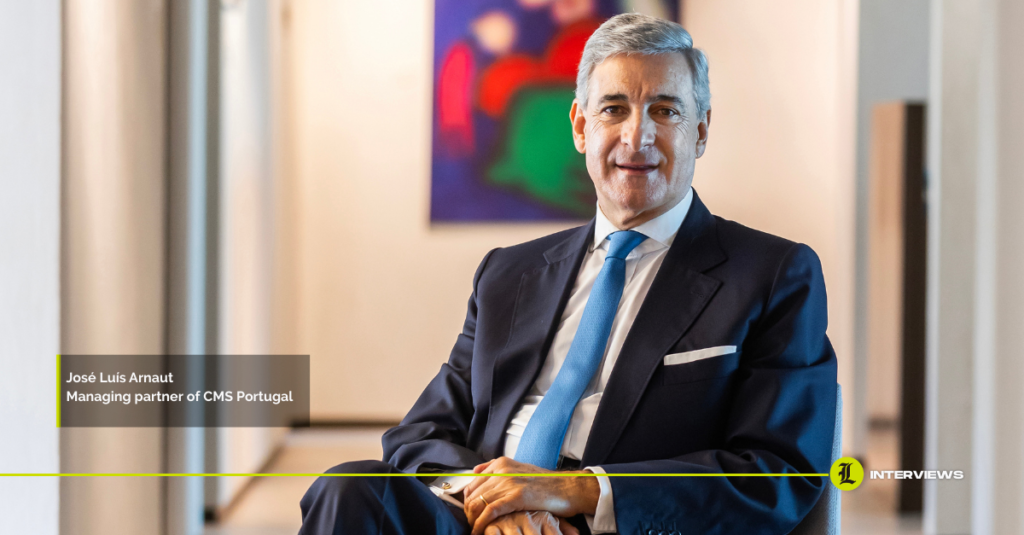
In this context, José Luís Arnaut, managing partner of CMS Portugal, introduces a perspective that reflects the reality of large international networks of lawyers. In an environment where competition is intensifying, clients are increasingly sophisticated, and technology is redefining legal practice, a global dimension is becoming a determining factor for competitiveness.
For Arnaut, the future of law firms depends not only on their positioning in the local market, but also on their ability to integrate into international structures capable of investing in innovation, sharing knowledge, and operating with a common strategy.
“The competitiveness of law firms will increasingly depend on their international scale and their ability to invest in technology.”

International scale as a new factor of competitiveness
The Portuguese legal market is in a moment of transformation marked by increased competition, the internationalization of business operations and the growing complexity of legal matters.
In that context, firms that are part of international networks have a structural advantage: the possibility of combining local knowledge with a global platform of resources, experience and clients.
For José Luís Arnaut, this international dimension constitutes one of the fundamental pillars of CMS’s strategy.
The firm’s objective until 2030 is clear: to consolidate itself as “The Leading Global Relationship Law Firm,” an ambition that reflects not only a market positioning, but a specific way of understanding the organization of legal practice.
According to Arnaut, this strategy is structured around three pillars.
- The first is related to the organizational structure and business development, which are supported by shared tools and a common strategic vision on the evolution of the market.
- “The second pillar is the integration of innovation and talent. Today, those who do not invest in innovation are left out of the game.”
- The third pillar focuses on reporting and leadership, elements that are essential to coordinating an organization of CMS’s scale, where transparency and the active participation of partners in the firm’s strategic direction are fundamental.
Innovation at scale: when technology becomes a structural advantage
Technology has become one of the factors most transforming the legal sector. However, not all law firms are in a position to make the necessary investments to effectively integrate advanced tools into their daily practice.
In the case of CMS, the international dimension of the organization allows for the development of large-scale technological projects.
“Artificial intelligence and new technological tools are profoundly transforming the way we work and provide our services.”
A clear example of this strategy is the implementation of Harvey, one of the most advanced artificial intelligence tools used in the legal sector. CMS is currently the law firm with the largest global implementation of this technology.
“All our lawyers, from trainees to partners, use artificial intelligence tools.”
This widespread integration improves operational efficiency and accelerates processes that traditionally required significant time and resources. But beyond efficiency, Arnaut emphasizes that the true transformation lies in the ability to offer customers a more agile and better-informed service.
“This clearly constitutes a comparative advantage over the competition.”
In the age of artificial intelligence, the customer relationship remains central
Despite the impact of technology, Arnaut insists that the core of the legal profession remains deeply human. “Time passes, but client expectations remain the same: that their matters be resolved.”
What has changed is the way law firms organize their work to achieve that goal.
The new tools allow for improved efficiency in time management and in the processing of legal information, but they do not replace the elements that have historically defined the relationship between lawyer and client.
“Nothing replaces proximity and availability in the relationship with the customer.”
For the managing partner of CMS Portugal, the practice of law remains, above all, a profession of trust, based on the ability to understand the client’s needs and guide them through complex decision-making. “This remains a profession of people serving people.”
Leading a global law firm: business, communication and understanding the client
In an increasingly competitive market, the ability to develop business continues to be one of the key competencies within law firms.
However, Arnaut believes that leadership in contemporary law should be understood as a shared responsibility within the organization.
“At CMS Portugal, every partner and lawyer counts.”
Beyond client acquisition, lawyers must develop a combination of skills that includes technical excellence, communication skills, and a deep understanding of the client’s business. “Nothing replaces quality and availability,” he stated.
In an environment where clients demand quick answers and strategic solutions, the ability to understand the business context in which they operate becomes an essential element of legal advice.
Technology, energy and defense: the sectors that will shape growth
The legal market always evolves in parallel with the economy. For Arnaut, understanding economic dynamics is essential to anticipating the practice areas that will see the most legal activity in the coming years. “The legal sector is not an island,” he states.
In this regard, CMS produces an annual analysis of the European mergers and acquisitions market based on consultations with senior executives and private equity firms. The report, “European M&A 2026: Deals, Doubts and Divergences,” identifies several sectors with significant growth prospects.
Among them, the TMC (Technology, Media and Communications) sector stands out, appearing as the area with the greatest growth potential in Europe in the next twelve months.
At the same time, the current geopolitical context points to an increase in activity in sectors such as energy and defense, which are acquiring increasing importance in the European economy.

Talent, culture and sense of belonging in a global firm
Attracting and retaining talent has become a top priority for law firms. According to Arnaut, the value proposition a firm offers its professionals must be built on a balanced combination of professional development, well-being, and organizational culture.
“Attracting and retaining talent begins with a clear value proposition.”
At CMS Portugal, this proposal includes flexible work policies, benefits adapted to the different stages of professional life, and career plans that allow lawyers to visualize their evolution within the firm.
The organization also places special emphasis on strengthening its internal culture. For Arnaut, a sense of belonging and long-term commitment are fundamental elements for building strong teams in a global firm.
The true legacy of leadership: preparing the next generation
Beyond business strategy or technological innovation, Arnaut believes that leadership in the legal profession also has a generational dimension. “Those of us with more experience have an obligation to leave a legacy,” he said.
This legacy is built through the transmission of knowledge to new generations of lawyers. For the managing partner of CMS Portugal, maintaining a close relationship with younger professionals and supporting their professional development is one of the fundamental responsibilities of those in leadership positions.
Because the knowledge accumulated over the years constitutes one of the most valuable assets of the legal profession.
In an increasingly globalized and technologically advanced legal market, José Luís Arnaut believes that the competitiveness of law firms will depend on their ability to combine three essential elements: international scale, technological innovation, and organizational leadership.
Technology will continue to transform legal practice, and competition will continue to intensify as new players enter the market. But even in this context of accelerated change, Arnaut believes the fundamentals of the profession will remain intact.
Because, ultimately, the legal profession will remain an activity based on trust, accumulated knowledge, and the direct relationship between lawyer and client. A profession that, as we recall, continues to be—above all—a profession of people serving people.