
Strategic communication within law firms has undoubtedly gained essential prominence in today’s legal environment. In a year marked by professionalization and the integration of new technological tools, the sector faces challenges that demand not only communicating more, but above all, communicating better.
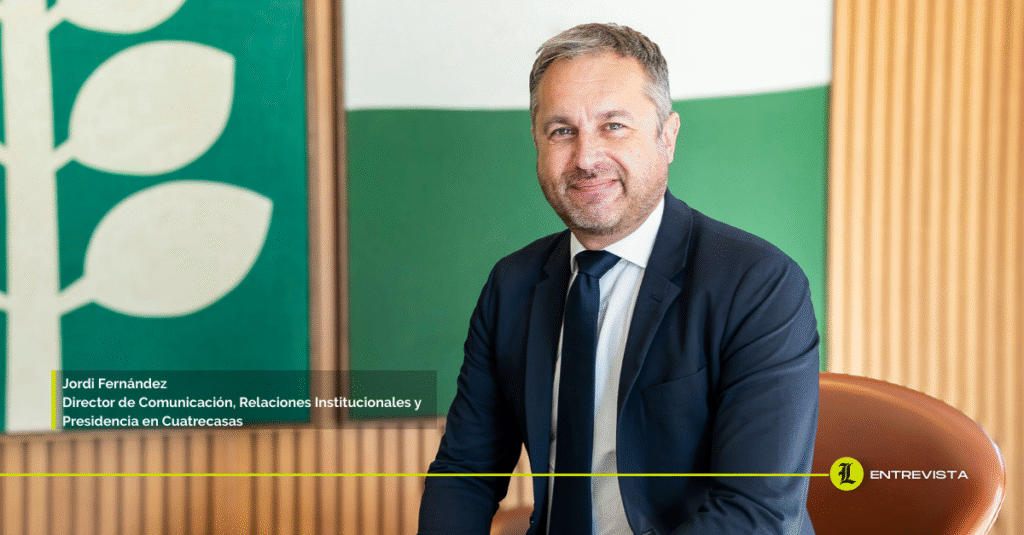
In this special feature, we begin our journey with “Voices of Development, Communication and Legal Marketing,” in dialogue with Jordi Fernández, Director of Communication, Institutional Relations and Presidency at Cuatrecasas. Jordi offers a perspective that bridges tradition and innovation, prudence and visibility, connecting his journalistic background with the leadership of corporate communication in a century-old firm with global reach.
In this conversation, we explore how communication is accompanying the transformation of Cuatrecasas both in Spain and Latin America, the key role of narrative coherence, and the firm’s commitment to technologies such as artificial intelligence to make the communication function more efficient and more human.
We also uncover the three essential steps for a law firm to differentiate itself and strengthen its positioning through an authentic, coherent, and sustainable relationship. This reflection opens a much-needed discussion on the present and future of marketing and communication in the legal industry.

“Communication is not about talking more, but about listening better”
Jordi is oriented towards human relationships and the impact that words generate when used with purpose. Professionally, he is driven by the idea of building trust, both inside and outside the organization. “What has been key to my development is understanding that communication is not about speaking more, but about listening better: to partners, to teams, to the media and to the environment in which we operate.”
Jordi has moved from media communications to leading corporate communication in law firms.
“Journalism taught me three things that I apply every day: the importance of accuracy, empathy with audiences, and the value of credibility. In a firm like Cuatrecasas, these principles are essential. Knowing how to translate the legal into the human and the complex into the understandable is, at its core, a journalistic skill applied to corporate reputation.”
For Jordi, working at a firm with more than 100 years of history, with strong international ambitions and the complexity of Cuatrecasas, “has been an exciting challenge.”
“Managing this duality requires coherence and sensitivity: maintaining our Iberian essence, but with a global narrative. The most rewarding part is witnessing how communication becomes a strategic tool that accompanies the firm’s transformation.”
In a sector as reserved as the legal one, the main challenge for Jordi is “combining prudence and visibility.” For the communications expert, “in the legal world you cannot communicate everything, but you can communicate better. Our challenge lies in being proactive without losing rigor, in projecting an innovative image without giving up sobriety, and in maintaining a constant dialogue with the media, clients and society.”
Communication as a bridge in the firm’s expansion into Latin America
“Communication has been a key pillar. Supporting our expansion in Latin America has meant adapting our messages to different cultural realities, strengthening our employer brand, and consolidating our reputation as a leading firm in the region. We have built bridges between offices, countries, and people, promoting a unified narrative that reinforces the sense of belonging to the same corporate culture.”
In this regard, the Communications Director of Cuatrecasas reflected on the fundamental lines of the communication strategy he leads to ensure coherence and reputation at an international level.
“We work on three pillars: narrative coherence, visual consistency, and emotional connection. Everything we communicate — from an appointment announcement to a pro bono initiative — must convey the same values: excellence, commitment, and approachability. Reputation is not improvised; it is built with every gesture.”
Regarding the strategic objectives and priority challenges set for the end of 2025 and the beginning of 2026 in terms of communication and public relations, Jordi highlighted as a priority “consolidating Cuatrecasas’ international visibility, strengthening internal pride of belonging, and continuing to advance in the incorporation of artificial intelligence into communication. In addition, we want to continue promoting sustainability as part of our institutional narrative and reinforce the firm’s presence in major international forums.”
“ In the coming years we will see more integration between communication, business and technology, more emphasis on purpose and greater attention to the personal brand of partners”
Jordi noted that “the main opportunity lies in further personalizing messages and leveraging technology to better segment and measure impact. It also lies in exploring new formats such as video, podcasts, or interactive narratives that bring the brand closer to different audiences. Innovation in communication begins by daring to tell things differently.”
Regarding the evolution of legal marketing in Spain and Latin America, Jordi affirmed that “legal marketing is becoming professionalized at great speed. Differentiation no longer depends solely on legal expertise, but on the ability to generate trust and deliver added value. In the coming years, we will see greater integration between communication, business, and technology, more focus on purpose, and greater attention to partners’ personal branding.”
Artificial intelligence, a must in communication and crisis management
“We are integrating AI to optimize content writing, improve digital listening, and anticipate reputational risks. It doesn’t replace human judgment, but it does amplify our response capacity. In crisis management, for example, it helps us identify conversation patterns in real time and adjust messages quickly and accurately.”
“First, define an authentic narrative that aligns with your culture. Second, communicate it consistently across all channels. And third, make it sustainable over time, using metrics that measure reputation, not just visibility. Strategic communication isn’t a campaign: it’s a management approach.”
In short
What piece of advice or insightful phrase have you received that you still apply in your work today? “Listen before you speak.” It’s simple, but it sums up 80% of successful communication. Who has been the most influential person in your career and why? I’ve been fortunate to learn from many great professionals, but if I had to name one, it would be Jorge Badía, my CEO until 2022. His strategic vision and his understanding of leadership have profoundly influenced me. Define your work style or personality in one word and tell us something that inspires or motivates you outside of work. I would say “consistent.” I’m inspired by people who transform the ordinary into something extraordinary, both in art and in everyday life. What word defines you? Curiosity. A sport? Ice hockey. Having lived in Canada leaves its mark. A song? “Fix You” by Coldplay. Are you good at cooking? What’s your signature dish? Yes, I really enjoy cooking. They say my Spanish omelet is championship-winning. A childhood memory? Endless summers at the beach with my family and the feeling of absolute freedom. [En pocas palabras0]A key to success?[/En pocas palabras0] Surrounding yourself with people better than you and giving them space to shine. [En pocas palabras1]What inspires you?[/En pocas palabras1] People with purpose and consistency. Those who do the right thing even when no one is watching. [En pocas palabras2]A book?[/En pocas palabras2] “The Coming Wave” by Mustafa Suleyman. Rafael Fontana gave it to me, and I was impressed by how it explains the impact of artificial intelligence on our lives.