
By Heidi Maldonado
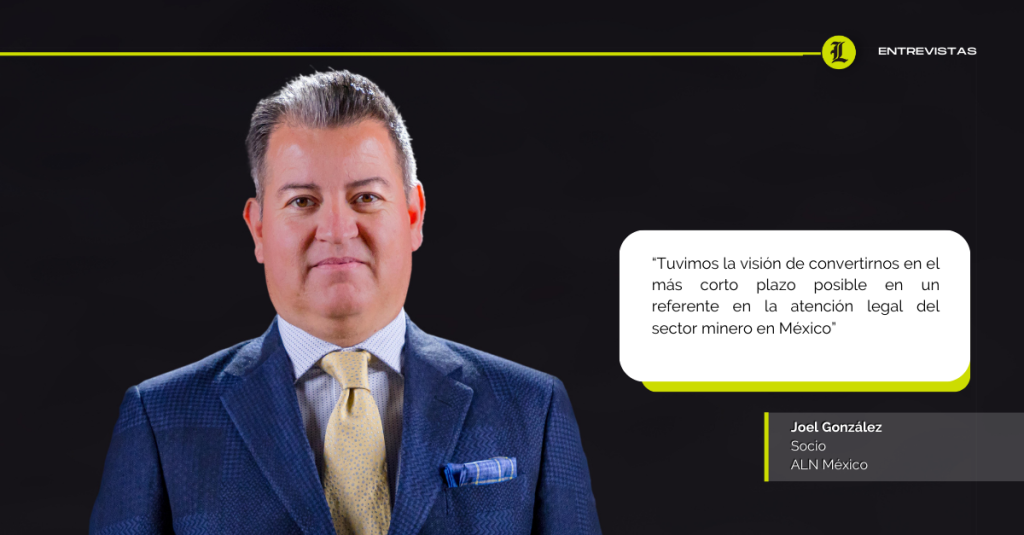
Mexico has traditionally been a mining country, an activity that has undoubtedly been a pillar of the national economy. With this in mind, we spoke with Joel González , partner at the Mexican law firm ALN Abogados, who stated that although in recent years the country has managed to position itself as one of the most important jurisdictions in Latin America for the mining industry, the administration of President López Obrador has taken actions that “lack legal basis and have discouraged and deterred investment.”
In addition, we also spoke with González about the outlook for the mining sector in 2024 in terms of new projects and regulations.
How has the mining sector evolved in Mexico and the region in recent years?
The evolution of the mining sector in Mexico began with the opening to foreign investment, achieving significant progress and modernization through various legal reforms, and prompting the urgent recognition of the globalization of the economy with public policies of openness and competition.
In recent years, Mexico has positioned itself as one of the most important jurisdictions in Latin America for the mining industry. However, under President López Obrador’s administration, a series of actions lacking legal basis have discouraged and deterred both foreign and local investment in the sector. These actions include the refusal to grant mining concessions, delays and omissions in processing permits and applications, not to mention the challenges of obtaining tax refunds and the increased tax burden for companies.
However, we have seen that companies that have historically had success stories in our country continue to consider it a prime destination for investment in the sector, including not only mining companies but also specialized investment funds seeking to increase their participation in Mexico.
How does Mexico compare to other countries in the region in terms of adopting ESG criteria in mining activity?
In recent years we have seen a virtually exponential increase in the adoption of ESG criteria in the sector, which is why at ALN we have acted accordingly with a significant training process for all team members in order to have the opportunity to advise companies on the implementation of ESG strategies in all their processes, and beyond that, to assume the commitment as responsible suppliers in the sector, in which we must also internally assume these commitments, based on international standards.
What are the main legal challenges and obstacles for the mining sector today, and how has your firm addressed them?
The main challenges the industry has faced are the lack of certainty stemming from public policy, such as the refusal or opacity in resolving procedures, resolving applications for new concessions and granting titles, and what we consider to have become the main challenge: the opacity in the resolution of environmental permits.
At ALN, we have designed strategies using a “tailor-made” approach based on the specific needs of each of our clients’ projects. This means that even when dealing with a generalized problem, such as obtaining a permit, each project has specific and unique characteristics that we must consider to determine the best strategy for resolving it.
We can say without a doubt that at ALN we seek to offer innovative and creative solutions that allow our clients to focus on mining activity rather than on legal problems of any nature.
What is the outlook for the mining sector in 2024?
In 2023, ALN celebrated 20 years of experience serving the mining sector. During this time, we have seen how the expectations of both public sector authorities and the communities where mining projects are located have grown year after year, to the point that the industry itself has recognized that the main risk to development stems from ESG policy and compliance.
The outlook for 2024 does not appear any different, although positive news is expected regarding financial markets and an increase in interest in making new investments is already being seen. We will continue working to offer solutions to the problems in order to resolve issues of social and environmental conflicts and, above all, governance and relations with the authorities; in this last area, I believe lies the most important challenge to consider for 2024.
Are any new projects or regulations expected for the sector next year?
As I mentioned, we have seen a very positive change in recent months among the companies and investment funds we work with. Regarding our expectations for 2024, we are currently participating in several due diligence processes for financing and acquisition projects in different states in Mexico.
We expect that these positive changes anticipated in the financial markets will confirm the interest in new acquisitions and the development of projects that generate so much benefit in communities where, outside of mining activity, there are practically no development opportunities.
How did the firm perform this year in the practice areas where it provides advice?
We obtained very positive results, reaffirming our participation in business organizations in the sector with presentations and conferences, advising and defending the interests of various companies, obtaining favorable results in procedures such as the titling of concessions, and more significantly, we have already obtained several positive resolutions rendering the reform to the Mining Law published in May of this year ineffective.
I believe our main focus should remain on presenting solutions that anticipate our clients’ problems rather than simply solving them. I believe that’s where our added value lies: in the ability to raise our hand and point out the problem before it has an impact on our clients’ operations and business strategy.
How much determination and how many difficult decisions have you had to make to be ranked among the best law firms in Mexico today?
For us it was very clear, from the moment we had the opportunity to work with the most important mining companies in the sector in Mexico, we knew that we wanted to dedicate ourselves exclusively to serving this noble industry.
This decision led us to stop serving clients who had been with us for years but whom we did not see as part of the hyper-specialization process we wanted to achieve. We had the vision to become, in the shortest possible time, a benchmark in legal services for the mining sector in Mexico.
This led us to modify our processes, to make a thorough assessment of where we were and where we wanted to go, and despite it being a very demanding path, as required by those who work in this industry, we have managed to have constant training focused on legal issues relevant only to the mining industry.
With 20 years in the market, how much has the culture and mindset of ALN and Mexican law firms in general changed?
In the case of ALN, the constant has been the culture of ongoing training necessary to stay abreast of current issues that are most relevant to the mining sector, always seeking to ensure that courses, diplomas, and training programs are completely relevant or have a direct relationship with the mining industry.
I believe that what distinguishes ALN is our willingness to “get our boots dirty.” We always seek to understand our clients’ projects, which allows us to gain firsthand knowledge of their business plan, how they envision and understand their project, and above all, the needs and expectations of local authorities and communities within their area of influence.
What will the firm’s 2024 strategic plan focus on?
Our business plan for 2024 is based on two pillars:
(i) to reaffirm and strengthen the relationships we have built with our clients in Canada over the years, and
(ii) an active promotional plan that allows us to participate in the main industry events and conferences at the local and international level.
What best practices have you implemented within the firm to attract and retain top prospects?
We have a permanent commitment to understanding our clients’ business needs, providing timely and effective solutions, and above all, we maintain close communication throughout the development of the matters entrusted to us for proper decision-making.
What percentage of parity is the firm at?
60% including administrative staff.