


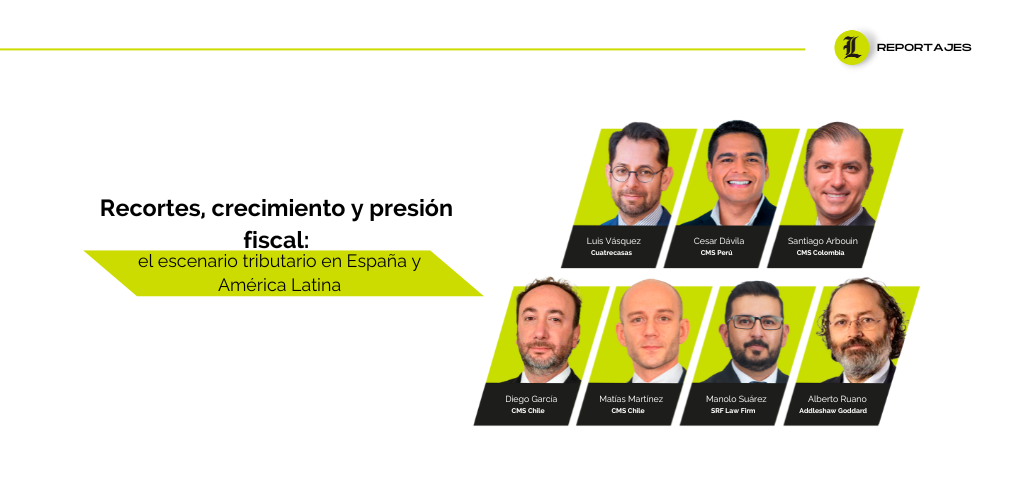
This second part provides a detailed analysis of the tax trends affecting both regions, based on the reflections and strategies of leading tax advisory experts. Against a backdrop of global uncertainty, regulatory reforms, and trade conflicts, this paper addresses the main risks, opportunities, and challenges for companies and investors.
Through the voices of Luis Vazquez, tax litigation partner at Cuatrecasas Mexico; Manolo Suárez, partner in the Tax Department at SRF Law Firm Ecuador; César Dávila, partner in the Tax Department at CMS Peru; Diego García and Matías Ramírez, partner and senior associate in the Tax Department at CMS Chile; Santiago Arbouin, partner in the Tax Department at CMS Colombia; and Alberto Ruano, partner and director of the Tax Department at Addleshaw Goddard in Spain, readers will learn how different jurisdictions are adjusting their tax policies, the effects of current tariffs, and the prospects for regional collaboration to strengthen economic resilience.
We invite you to immerse yourself in this essential dialogue about the fiscal future and the strategies needed to navigate a complex and constantly changing scenario.
Current fiscal outlook in Latin America and Spain for 2025

For Luis Vazquez of Cuatrecasas, Mexico’s fiscal policy during the previous and current administrations focuses on “revenue collection as the main objective,” without increasing existing taxes. “This policy generates many inspections, particularly of large taxpayers, such as multinationals, driven by major infrastructure projects and social programs.”
For his part, César Dávila, from CMS, explains that Peru begins 2025 “with a fiscal deficit of 3.7%, 137% higher than at the beginning of 2024, which increased the Tax Administration’s appetite for revenue collection through campaigns of inductive letters, cross-checking of information, and audits. This situation creates a feeling of constant harassment and fiscal uncertainty among taxpayers. In addition, recent legislative changes (Law 32387) mean that the central government is giving up 2% of its VAT revenue to local governments, which have historically been deficient in budget management, leading the central government to seek to recover this percentage.”

Santiago Arbouin of CMS also points out that the Latin American tax outlook for 2025 is concerning. “We are seeing a context of high fiscal deficits together with weak economic growth across all countries, which makes it impossible to sustain current public spending. Colombia is particularly worrying, with a deficit exceeding 7% of GDP. The tariff war initiated by the United States is slowing down foreign trade, which is essential for countries like Colombia, where more tariffs mean higher prices and lower consumption. In addition, Fitch Ratings’ recent downgrade is affecting investment in Colombian public debt.”
Meanwhile, Manolo Suárez of SRF Law Firm notes that Latin America’s economic projection is around 2%, due to “moderate investment and weakened trade, similar to Spain, which is not showing significant growth. This generates fiscal deficits covered only by external debt and, even when growth occurs, the necessary structural adjustments are postponed as in previous periods.”
Impact of global macroeconomic conditions on fiscal policies
Adapting strategies to advise companies on regulatory changes and greater tax transparency

For Luis Vázquez of Cuatrecasas, tax advisory services focus on reducing unnecessary risks arising from frequent inspections. “In Mexico, the tax authority is highly active and the likelihood of an audit or formal invitation is high, so companies must be prepared for such events. Moreover, the recent judicial reform creates additional uncertainty.”
César Dávila of CMS explains that Peru’s implementation of OECD tax harmonization standards poses significant challenges for tax departments, “especially within multinational companies, in areas such as transfer pricing and beneficial ownership. The key is to raise awareness among all management levels to build a solid culture of tax compliance. CMS’s strategy is based on anticipating international trends as part of a global network.”
Santiago Arbouin notes that CMS Colombia advises clients “through constant monitoring and notification of new tax regulations, ensuring compliance and maintaining compliance processes that minimize the likelihood of costly penalties.”
Manolo Suárez states that SRF Law Firm uses a “strict regulatory radar, integrating local modifications and real-time alerts, collaborating with tax administrations and generating customized briefing reports.”
Alberto Ruano of Addleshaw Goddard explains that Spain has neither introduced recent regulatory changes nor new transparency requirements, as its tax system is consolidated and transparency regulations have been in force for years. “Nevertheless, law firms must maintain continuous adaptation to offer comprehensive and proactive advisory services, staying updated on regulatory developments and participating in industry forums. They also provide training sessions and seminars to help clients rigorously comply with their obligations.”
Spanish taxpayers are under intense scrutiny, making careful management of tax compliance essential. “Law firms also prepare clients to manage crises with fluency, efficiency, and close communication when facing audits or contingencies. Tax advisory services must adopt a multidisciplinary approach that integrates corporate, real estate, financial and labor aspects, not just tax issues.”
In this regard, the specialist notes that the recent increase in tax collection pressure and formal requirements (DAC6, cryptocurrencies, informal transfers) compel law firms to react swiftly to audits, negotiate installment payments or submit voluntary regularizations. This demands efficient protocols, strong teams, and international networks for defense before multilateral forums. “Firms that integrate regulatory monitoring, anticipation, crisis management and strategic vision will deliver a differentiated, high-value service in an increasingly demanding tax environment.”
Perspectives on tax harmonization and cooperation between Latin America and Spain
Luis Vázquez of Cuatrecasas notes that the OECD’s multilateral instrument, which is in force in Mexico, “facilitates tax harmonization and information exchange. Mexico follows OECD recommendations, although its participation in international forums has declined. The OECD’s Pillars I and II initiative, pushed back by U.S. opposition, has given way to such pressures, preventing Mexico from facing a conflict between complying with these recommendations and protecting its relationship with its main trading partner.”
For his part, Manolo Suárez of SRF Law Firm adds that the “bi-regional calendar is active, with the 4th CELAC-EU Summit in November in Santa Marta set to announce common guidelines for automatic exchange of information and homogeneous transfer pricing criteria. Spain and several Latin American countries already share ‘red flag’ algorithms for international tax audits. Although full harmonization is not yet on the horizon, the dialogue is evolving toward compatible standards that will reduce double taxation in intra-group transactions.”
Effects of the 10% tariffs imposed by the US on Latin American exports

Luis Vázquez of Cuatrecasas notes that the tariffs imposed by the Trump administration have not substantially affected Mexican exports to the United States, thanks to inexpensive and skilled labor as well as geographic proximity. “Productive integration, with multiple border crossings throughout the process, makes it impossible to fully eliminate these operations. Companies have tried to limit the number of crossings, but not eliminate them.”
Likewise, Diego García and Matías Ramírez of CMS comment that the imposition of a flat 10% tariff in April 2025 has significantly reshaped regional trade. “Presented as a measure to protect U.S. industry, this policy affects trade flows and the tax and customs architecture across Latin America. Countries such as Chile, Colombia, Ecuador and Argentina — which rely on preferential regimes for exports — lose competitiveness under a flat tariff that disregards preferential origin and bilateral agreements, discouraging customs mechanisms such as certificates of origin and simplified declarations.”
From a customs taxation perspective, the expert explains that “the tariff increases product costs, reduces export volume, affects VAT revenue from exporters, and distorts domestic tax bases, especially in countries with a trade surplus with the U.S. These tariffs represent a form of ‘political taxation’ that violates principles of tax equity and neutrality.”
Responding to such distortions, he argues, requires trade diplomacy, treaty review, the strengthening of trade defense mechanisms, and fiscal reorganization.
Manolo Suárez of SRF Law Firm adds that “U.S. tariff policy has affected countries with positions contrary to the Trump administration and has generated a reduction of roughly 0.3 percentage points in Latin America’s trade surplus, prompting the reorientation of exports toward Asian and European markets.”
Most affected productive sectors and responses from companies and governments
Luis Vázquez of Cuatrecasas highlights that the “tariffs particularly affect new investments in Mexico aimed at productive capacity, especially in the automotive sector due to its complex domestic supply chain.”
Diego García and Matías Ramírez of CMS detail that Latin America’s agribusiness and fresh food sectors are the most affected, including Chilean salmon, Colombian coffee, Ecuadorian shrimp, and beef from the Southern Cone, “which have lost competitiveness due to higher product costs. The perishable nature of these goods makes it difficult to quickly redirect shipments to other markets, leading to losses and logistical pressure. Light manufacturing and textiles in Mexico and Central America are also suffering from the loss of preferential access to the U.S., with companies such as HanesBrands and Fruit of the Loom adjusting their operations.”

In Spain, “there have been impacts on electronic components, medical equipment, green technology, and traditional products such as wine, olive oil, and cured ham, all of which have lost competitiveness. Corporate responses include market diversification, supply chain restructuring, and the use of free-trade zones. Governments are activating diplomatic and legal mechanisms, subsidies, and programs to mitigate these effects, as seen in Colombia.”
For the experts, this scenario reveals the fragility of trade integration in the face of unilateral measures and the need for a structural strategy to strengthen regional capacity.
Manolo Suárez of SRF Law Firm states that “labor-intensive manufacturing, metals, and agribusiness are the most affected sectors, with companies responding through diversification, reuse of certificates, and adjustments to maintain competitiveness. Governments are offering credit lines and negotiating tariff quotas.”
Legal and fiscal tools to mitigate tariff impacts
Luis Vázquez of Cuatrecasas “notes that there are no quick or effective measures to counter tariffs and that the burden ultimately falls on the consumer. In many cases, modifying the production chain to redirect output to tariff-free markets is easier than pursuing legal action.”
From SRF Law Firm, Manolo Suárez points out that “companies are using drawback regimes that refund up to 3% of the FOB value, free-trade zones with preferential tariffs and deferred VAT and customs duties, as well as advance pricing agreements to fix margins and reduce disputes. These instruments are preferred to preserve liquidity while longer-term solutions are explored.”
Adapting advisory services in the face of tariff uncertainty and US tax reform
Luis Vázquez of Cuatrecasas remarks that the “erratic policy of the Trump administration makes it difficult to eliminate uncertainty surrounding shifts in tax paradigms. Advisory work must focus on mitigating risks and maintaining flexibility so that clients can adapt quickly, avoiding rigid structures.”
In this regard, Manolo Suárez of SRF Law Firm notes that the “core task of tax planning is to anticipate future tax impacts, although the complexity of tariff policies makes this increasingly difficult. He recommends identifying alternative markets with tariff stability to keep business operations outside the U.S.”
Perspectives on review or renegotiation of the USMCA and fiscal effects

Luis Vázquez of Cuatrecasas anticipates major impacts in Mexico, with the U.S. “seeking to protect strategic industries and preparing measures to adjust to the judicial reform being implemented in Mexico.”
In this regard, Manolo Suárez of SRF Law Firm warns that U.S. trade policy toward Mexico and Canada is “complex and does not facilitate short-term improvements. The tightening of rules on automotive origin, environmental and labor standards will affect Mexico and Canada, with an inevitable impact on the tax policy of Latin America and Spain, given the importance of the U.S. market.”
Regional integration and cooperation to strengthen fiscal and trade resilience
Luis Vázquez of Cuatrecasas explains that companies will seek to “open new, more business-friendly markets, especially in Europe and countries with free trade agreements, expanding commercial and investment opportunities in Latin America.”
Manolo Suárez of SRF Law Firm states that regional integration and cooperation will create a “strong bloc against U.S. protectionism, facilitating financing and improving preferential access to European markets. The accumulation of origin negotiated by Mercosur, the Pacific Alliance and the EU will enable greater regional value added and cushion the tariff impact.”
Tax opportunities and risks at the end of 2025 and strategic recommendations

From Cuatrecasas, Luis Vázquez advises companies to “focus on risk mitigation and maintain flexible structures.” He recommends “strengthening ties between Latin America and Europe, particularly Spain, as well as exploring Mexican investments in Central and South America.” Latin American companies will need to seek capital sources outside the United States, taking advantage of treaties that protect investments.
Diego García and Matías Ramírez of CMS Chile emphasize that the global scenario, while uncertain and marked by tensions and reforms, also offers opportunities such as “deep integration into global supply chains and the adoption of tax-related technology.” They recommend strengthening international tax policies and preparing consciously for audits and inspections.
César Dávila of CMS describes in Peru the tax risks arising from “legal uncertainty, broad interpretations by tax authorities, lack of technical consensus, and complex litigation.” He suggests reinforcing preventive tax compliance policies, providing economic justifications for transactions, reviewing tax exposures, and maintaining clear strategies for complex disputes.
Regarding Colombia, Santiago Arbouin of CMS notes that the main “concern is the decree that increases corporate income tax advance payments, with ongoing constitutional challenges, and political uncertainty due to elections, which is holding back investment.”
By contrast, Manolo Suárez of SRF Law Firm recommends strengthening “digital–tax compliance, prioritizing ESG-certified projects that offer tax benefits, and diversifying markets and suppliers to create alternative routes in case of a worsening trade war. He stresses that with discipline and a sustainable vision, uncertainty can become a competitive advantage.”
Alberto Ruano of Addleshaw Goddard in Spain indicates that the main tax opportunities in Spain are the arrival of the “Global Minimum Tax (OECD Pillar Two) and new incentives to stimulate productive investment.” The risks stem from constant revenue pressure, the rushed creation of new tax figures, and imbalances in the autonomous community financing system, in addition to congestion in the judiciary.
He ultimately recommends that companies and investors not cut corners when it comes to tax compliance and prevention, and to hire trusted legal counsel.