
In 2025, the fiscal landscape in Spain and Latin America is characterized by its complexity and dynamism, reflecting regional contrasts, structural challenges, and increasing global interconnectedness. While Spain is experiencing a phase of economic growth accompanied by efforts to consolidate its public finances, Latin American countries face significant challenges related to fiscal sustainability, moderate economic growth, and increasing social pressures.
Added to this scenario are international trade tensions, especially the impact of tariffs imposed by the United States, and tax reforms aimed at strengthening revenue collection and raising tax transparency standards.
This report gathers the perspectives and strategies of leading tax advisory firms, offering a comprehensive view of how different jurisdictions are addressing these challenges. It also identifies the emerging tax opportunities and risks for businesses and investors in an environment marked by global uncertainty and increasing international cooperation.
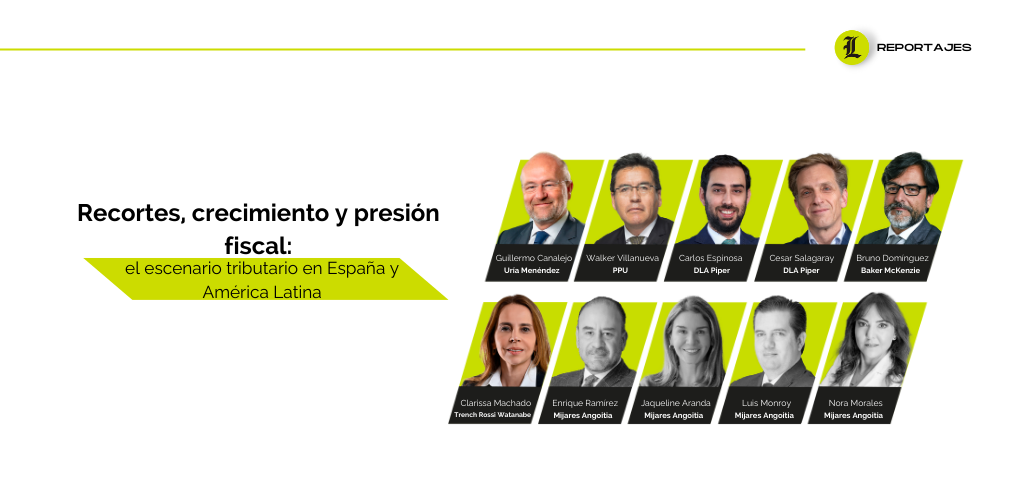
To this end, the participation of leading experts is secured: Guillermo Canalejo, partner in the Tax Law area of Uría Menéndez in Madrid; Walker Villanueva, partner in the Tax and International Trade area of Philippi Prietocarrizosa Ferrero DU & Uría; César Salagaray, partner in charge of the Tax area of DLA Piper in Madrid; Carlos Espinosa, Legal Director of Tax at DLA Piper; Bruno Domínguez, Co-Head of Tax and Private Wealth at Baker McKenzie in Spain; [Uría Menéndez0]Clarissa Machado[/Uría Menéndez0], Tax Partner at [Uría Menéndez1]Trench Rossi Watanabe[/Uría Menéndez1] – a firm that maintains a strategic cooperation agreement with [Uría Menéndez2]Baker McKenzie[/Uría Menéndez2] -; and, on behalf of [Uría Menéndez3]Mijares, Angoitia, Cortés y Fuentes[/Uría Menéndez3], [Uría Menéndez4]Enrique Ramírez[/Uría Menéndez4], partner in the Tax area; [Uría Menéndez5]Nora Morales[/Uría Menéndez5], partner; [Uría Menéndez6]Jaqueline Aranda[/Uría Menéndez6], [Uría Menéndez7]counsel[/Uría Menéndez7]; and [Uría Menéndez8]Luis Monroy[/Uría Menéndez8], partner.
Fiscal Outlook in Latin America for 2025: Growth, Debt and Deficit

Guillermo Canalejo, from Uría, said: “The Spanish economy is going through a growth phase with an upward trend in GDP, accompanied by a reduction in the debt ratio and the public deficit. However, global financial volatility and trade tensions—such as potential US tariff increases—could slow this positive trend.” In this context, the Uría partner said that “Next Generation EU funds, with €750 billion earmarked to overcome the economic and social impacts of the pandemic, have been fundamental in boosting growth in Spain and other EU member states. US tariff increases generate uncertainty that indirectly affects Spain through its main trading partners and slows exports.”
Regarding Latin America, Walker Villanueva (PPU Chile, Colombia, and Peru) stated that “fiscal sustainability and economic growth are central challenges. Peru and Chile have historically maintained low levels of debt relative to GDP and reduced deficits. Peru has a fiscal rule that aims for a deficit of less than 1% of GDP and public debt below 30%, positioning it favorably in Latin America. However, its 3% economic growth is insufficient to generate employment and absorb the working-age youth, which encourages migration. Peru's debt, close to 30%, is largely explained by the impact of the pandemic, but it is expected to decrease driven by the increase in the price of copper.” Nevertheless, according to the PPU partner, over the last three years Peru has shown progressive fiscal deterioration, failing to comply with its own fiscal rules, affected by institutional weakness and political pressure to increase spending, with tax exemptions lacking technical justification and unauthorized public expenditures.
Colombia, for its part, said it faces the challenge of maintaining fiscal sustainability in 2025 amid moderate growth and social pressures. “Fiscal deficits remain high in the region, with a tax burden below the OECD average and a heavy reliance on volatile commodity and oil revenues. Recent reforms have sought to increase revenue through tax and withholding increases, but the deficit and debt remain high in a context of economic slowdown and high informality, exacerbated by labor reform.”
Fiscal challenges and economic realities in Spain and Latin America

César Salagaray and Carlos Espinosa of DLA Piper highlight that in 2025, Spain and Latin America will face heterogeneous fiscal realities, but with common challenges. “In Spain, inflation, rising interest rates, and structural productivity problems have reduced the margins of large multinationals; in Latin America, the diversity is greater, with monetary and exchange rate problems and high public spending as persistent challenges.” Chile and Peru enjoy macroeconomic stability, although political and social tensions make managing spending difficult.
For their part, experts point out that “Mexico maintains a conservative fiscal policy, with a low deficit but insufficient structural revenue collection. Brazil grapples with high debt and a complex tax system, driving reforms. Argentina is beginning to attract investment with strict fiscal policies and favorable regimes, contributing to a decrease in country risk. Global fiscal policies also play a role because Europe transfers knowledge to Latin America, and information exchanges between administrations are increasing, fostering better tax practices and mechanisms such as transfer pricing documentation.”
Fiscal consolidation and regional challenges according to Baker McKenzie

Bruno Domínguez of Baker McKenzie and Clarissa Machado of Trench Rossi Watanabe report that Spain has made significant progress in fiscal consolidation, reducing its public deficit to 2.7% of GDP and showing a downward trend in debt, which has stabilized at around 100% of GDP. “This progress is due to sustained growth and the reversal of extraordinary fiscal measures. In Latin America, the average regional public debt is close to 55% of GDP (Brazil, Chile, Colombia, Mexico, Paraguay, Peru, Uruguay), an increase from the 34% recorded in 2013 according to the IMF. Most countries face fiscal deficits and economic and social instability.”
According to experts, national strategies vary: “Brazil and Colombia prioritize efficient management focused on social spending and poverty reduction, avoiding cuts. Argentina opts for spending and tax cuts and expands investment incentives. Tax reforms frequently seek to increase revenue through new taxes or increases and eliminate tax incentives.
Tax authorities are intensifying their use of technology and rigorous audits, especially of large multinational corporations. Furthermore, international regulations are influencing digital taxation, transparency, compliance, alternative dispute resolution, tax cooperation, wealth taxes, the energy transition, and the fight against tax evasion. Brazil has already adopted a global minimum tax and updated its transfer pricing regulations in accordance with OECD standards; Mexico, Chile, Brazil, Colombia, and Peru are reviewing their digital taxation models, requiring registration of foreign platforms in some cases. Colombia and Brazil are implementing extra-fiscal taxes on goods harmful to health and the environment, currently in effect in Colombia and soon to be implemented in Brazil.
Fiscal efficiency and the fight against tax evasion in Mexico

Enrique Ramírez, Nora Morales, Jaqueline Aranda, and Luis Monroy de Mijares, Angoitia, Cortés, and Fuentes highlight that current Mexican fiscal policy focuses on “increasing collection efficiency by improving tax enforcement and combating evasion and avoidance, without creating or increasing taxes. This has resulted in a real annual increase of 4.7% in net tax revenues as of the fourth quarter of 2024, according to the Tax and Management Report of the Tax Administration Service.”
Impact of global volatility and trade tensions on fiscal policies
Guillermo Canalejo, from Uría, emphasizes that in Spain, international pressure to increase defense spending, coupled with macroeconomic uncertainty, could translate into a significant increase in the tax burden to sustain public spending levels. Furthermore, if economic growth slows, tax revenues could decrease, generating the need for new taxes, as seen with wealth taxes and additional levies on the banking and energy sectors. He also highlights the complex situation in the real estate market, "with persistent tensions in the rental and sales sectors, which position housing as a central focus of fiscal policy with the potential for increased taxation."
Walker Villanueva, of PPU, says that in Latin America, traditionally linked commercially to the United States—although with China playing an increasingly prominent role—"the trade war initiated by the Trump administration has directly impacted products exported by the region, especially Peruvian copper, which could face a 50% tariff, increasing its price in the US. This would mean higher revenues for the US but lower revenues for Peruvian exporters, slowing the economic recovery. However, Peru has sought to mitigate this impact by diversifying its markets and exploring new free trade agreements."
In this regard, he notes that the high dependence on raw materials, limited fiscal capacity, and sensitivity to the cost of external borrowing mean that any tightening of global conditions—such as increased interest rates or lower commodity prices—translates into budget constraints and greater difficulties in financing deficits. “Colombia exemplifies this phenomenon, facing more expensive external credit, economic slowdown, and growing social demands, although inflation remains under control thanks to measures taken by the Central Bank,” he adds.
How firms adapt their strategies in response to regulatory changes and increased demands for tax transparency
Guillermo Canalejo, from Uría, explains that, in an environment marked by increasing regulatory pressures and greater demands for transparency, “their advisory strategy has become proactive and preventative.” They prioritize the early identification and mitigation of tax risks through “the implementation of Advance Pricing Agreements (APAs) and tax rulings,” which aim to avoid disputes with tax authorities. Furthermore, they support their clients in implementing the DAC6 Directive, which raises transparency standards for cross-border tax planning within the European Union. At the same time, they have strengthened operational efficiency by investing in artificial intelligence and automation, enabling a more agile and precise service, adapted to new needs.

César Salagaray and Carlos Espinosa of DLA Piper point out that tax advisory services today go beyond mere tax optimization; they work to offer their clients simplified and secure tax models, based on a deep understanding of the business model and the realities of the sector. Designing global transfer pricing models based on these realities is key, as it provides sustainability and makes it easier for tax authorities to challenge them. They acknowledge the “acceleration in international regulatory changes—such as the BEPS initiative and Pillar 2—which require anticipation and flexibility in tax planning to absorb or adapt to regulatory modifications.” They also emphasize the importance of balancing divergent tax positions internationally and the current priority for companies of avoiding double taxation rather than simply reducing their taxes, given the increasing complexity. “We are also working on redesigning corporate structures to be more adaptable and on strengthening the monitoring of international tax risks. Transparency has become a structural requirement in both Spain and Latin America.”
Meanwhile, Bruno Domínguez of Baker McKenzie and Clarissa Machado of Trench Rossi Watanabe emphasize that “the corporate tax area has evolved from a support role to a strategic one that identifies risks and opportunities affecting the business as a whole. It supports the review of corporate structures and value chains to adapt to an increasingly transparent and dynamic tax environment.” The firm invests in technologies such as artificial intelligence and TaxTech to improve responsiveness and compliance.
Enrique Ramírez, Nora Morales, Jaqueline Aranda, and Luis Monroy de Mijares, Angoitia, Cortés y Fuentes, for their part, emphasize the importance of continuous professional development in local and international regulations "to be able to support their clients through all stages of compliance with tax transparency obligations." Their experience in tax disputes provides a pragmatic and effective approach to the constantly evolving regulatory framework.
Prospects for tax harmonization and cooperation between Latin America and Spain
Guillermo Canalejo, from Uría, points out that the prospects for tax harmonization and cooperation between Latin America and Spain are “positive, although still limited in practical scope. While there is no formal tax harmonization framework like that of the European Union, technical and regulatory cooperation has been strengthened through multilateral forums such as the Inter-American Center of Tax Administrations (CIAT), the OECD, and the UN, especially in the fight against tax evasion, transparency, and international taxation. Spain maintains a solid network of double taxation treaties with most Latin American countries, including recent agreements with Peru, which facilitates bilateral economic relations. Furthermore, the Agreements for the Promotion and Reciprocal Protection of Investments (APPRIs) stand out, providing legal certainty in times of political uncertainty for both regions. Colombia, for example, has developed a doctrinal framework for the implementation of its treaty with Spain, contributing to its effective implementation.”
Currently, the partner explains, “the BEPS project is being implemented through the Multilateral Convention, contributing to global tax harmonization that prevents fraud and base erosion, providing predictability and legal certainty for taxpayers. The next key step is Pillar 2, or the global minimum tax, which Spain has adopted through Law 7/2024, implementing a complementary tax to guarantee a minimum level of taxation for large multinational groups.”

Regarding Latin America, Walker Villanueva of PPU notes that “structural challenges hinder substantive harmonization with European standards, but they do allow for significant progress in best practices and information exchange. Spain has been a key partner in technical assistance and tax modernization. Colombia is showing increasing alignment with international tax principles and is developing an active agenda of bilateral cooperation with Spain in international tax audits, transfer pricing, and the fight against tax evasion, which opens opportunities for deeper collaboration in the coming years, especially in light of the global challenges of tax justice and sustainability.”
From the Peruvian perspective, he asserts, “harmonization begins with its accession process to the OECD, initiated in 2022. The country has declared this accession a matter of national interest, creating a permanent Multisectoral Commission to oversee the process. Peru is also evaluating the possible implementation of Pillar 2, especially given its effects on areas with preferential tax regimes, and continues to negotiate double taxation agreements, such as the recently signed one with the United Kingdom and a draft agreement with Spain. In the near future, global measures are expected to increase taxation on large fortunes, with joint initiatives from Spain and Brazil at the UN to address growing inequality.”
César Salagaray and Carlos Espinosa of DLA Piper point out that, while full tax harmonization is not expected in the short term, real opportunities for cooperation exist. “Spain maintains the most extensive network of double taxation treaties in Latin America and actively participates in forums such as the OECD and CIAT, facilitating the exchange of information and best practices. There is growing interest in Latin America in replicating Spanish models of digital tax control and electronic invoicing, which could lay the groundwork for greater regulatory convergence.”

Bruno Domínguez of Baker McKenzie and Clarissa Machado of Trench Rossi Watanabe, for their part, point to notable progress in technical cooperation driven by organizations such as the Spanish Agency for International Development Cooperation (AECID) and the Brazilian Cooperation Agency. “Criteria are being harmonized in transfer pricing, digital taxation, and the fight against tax evasion. Although there is still no robust institutional framework, the exchange of information and best practices are improving significantly.”
Meanwhile, Enrique Ramírez, Nora Morales, Jaqueline Aranda, and Luis Monroy de Mijares, Angoitia, Cortés, and Fuentes believe that, despite tax differences, “there is a trend toward the adoption of international standards and multilateral collaboration. This is reflected, for example, in the signing of the Multilateral Instrument (MLI) by Mexico and Spain, which modifies treaties to prevent base erosion and profit shifting. Mexico has also increased oversight of transfer pricing and preferential tax regimes, in addition to incorporating obligations for the identification and collection of information on beneficial owners.”
Effects of US tariffs on Latin American exports and the regional trade balance
César Salagaray and Carlos Espinosa of DLA Piper explain that while the Trump administration's proposed 10% tariffs have generated uncertainty, their actual impact depends heavily on practical implementation and the economic sector. “Some sectors, such as pharmaceuticals, luxury goods, and technology products, could absorb these costs, while others—automotive, industrial, and renewable energy infrastructure—would be unviable due to reduced margins. This scenario has highlighted the urgent need to diversify export destinations and review global value chains to increase their resilience. Many clients have quickly moved from measuring the impact to implementing changes to anticipate these effects, including reevaluating value chains and transfer pricing policies to ensure that sales prices are truly at market rates.”
Bruno Domínguez of Baker McKenzie and Clarissa Machado of Trench Rossi Watanabe add that, regardless of the final confirmation of these tariffs, their effects are already being felt, especially in sectors such as steel, aluminum, and agribusiness, impacting the trade balance and forcing a rethinking of export strategies and market diversification. For example, the 2025 announcement of a 40% tariff increase on Brazilian products generated significant political and economic reactions, given the commercial importance of the United States to Brazil, the largest Latin American economy. Brazil will likely seek to negotiate before these tariffs take effect, although the issue is complex and controversial.
Enrique Ramírez, Nora Morales, Jaqueline Aranda, and Luis Monroy, from Mijares, Angoitia, Cortés, and Fuentes, indicate that these tariffs have caused profound trade adjustments in Latin America, “with Mexico being the most affected due to its close integration with the U.S. under the USMCA. Sectors such as manufacturing, automotive, steel, and aluminum have seen their operating costs increase, affecting competitiveness and employment. If this situation continues, Mexico could suffer a drop of approximately 11.25% in its exports to the U.S., with a potential GDP contraction in 2025, estimated between 0.3% and 4%, according to various analysts and organizations such as the IMF.”
Productive sectors most affected by tariffs and business and government responses

On this topic, Guillermo Canalejo of Uría explains that in Spain the sectors most affected by the tariffs are the agri-food sector—particularly olive oil and wine, whose 200% tariff announced in April 2025 was suspended—the automotive sector, threatened with a 25% tariff, and the steel and aluminum sector. From a business perspective, the expected transfer of the tariff cost to the final price is to avoid margin erosion, although the impact will depend largely on the reaction of US consumers, which is why close monitoring and continuous analysis of the market and exports are required.
In Peru, comments Walker Villanueva of PPU, although there is no clear official data on the impact, agricultural products such as grapes, blueberries, avocados, and asparagus are expected to face a drop in demand due to higher prices for the American consumer, also affecting competitiveness against countries without such increases, like Mexico. “There was also a dramatic drop of more than 90% in the jewelry and goldsmithing market after the tariffs were announced in April, although the measure was later suspended. Several sectors are already exploring alternative markets to maintain their export levels.”
César Salagaray and Carlos Espinosa of DLA Piper point out that in Latin America, the most affected sectors have been the automotive industry in Mexico, the steel industry in Brazil, and agribusiness in Argentina. “In Spain, in addition to automotive, sectors such as renewable energy infrastructure and pharmaceuticals also felt the impact, along with traditional products like olive oil, wine, and olives, although with less structural effects. The business response has focused on market diversification, logistics reviews, and production adjustments.” They also mention that they have worked with clients to modify value chains and transfer pricing policies to mitigate the impact by reducing the import value.
Bruno Domínguez of Baker McKenzie and Clarissa Machado of Trench Rossi Watanabe agree that the automotive, manufacturing, and agricultural export sectors are the most vulnerable in Latin America. “In Spain, although the impact is more limited, some industrial sectors with high exposure to the US have been affected. Responses include production relocation, seeking new markets, and strengthening bilateral agreements.”
Enrique Ramírez, Nora Morales, Jaqueline Aranda, and Luis Monroy, from Mijares, Angoitia, Cortés y Fuentes, point out that in Mexico the sectors most affected by tariffs are “manufacturing, automotive, steel, and aluminum, as well as those products that, although manufactured in Mexico, do not comply with the USMCA rules of origin and, therefore, lack preferential tariff certification. The Mexican government has sought to avoid confrontations through concessions on immigration and national security. While possible retaliatory measures were discussed, no tariffs have been imposed to date.”
Legal and fiscal tools to mitigate the impact of tariffs
Guillermo Canalejo, from Uría, highlights that Spain and the European Union provide numerous digital tools to economic actors to understand the challenges of international trade policy and its impact on corporate taxation. “In customs matters, the Spanish Tax Agency offers virtual assistance on Customs, VAT, and excise duties (e.g., Digital Customs Assistance and the Virtual VAT Assistant), including for new taxes such as the levy on non-reusable plastic packaging. These are complemented by European platforms such as Access2Market, which provides detailed information on tariffs, rules of origin, requirements, customs procedures, taxes, trade barriers, and statistics. The EU Directorate-General for Trade also supports companies in resolving market access issues and detecting tax non-compliance.”
In Peru, explains Walker Villanueva of PPU, “there is no specific measure against tariffs, but there are incentives for local production, such as the Drawback regime that returns to the exporter a percentage of the FOB value if imported inputs are incorporated paying tariffs, helping to maintain internationally competitive prices.”
César Salagaray and Carlos Espinosa, from DLA Piper, point out that, beyond changing the location of operations in the supply chain, "the most efficient tools at this time are in the control of the import value to mitigate tariff impact."
Bruno Domínguez of Baker McKenzie and Clarissa Machado of Trench Rossi Watanabe state that “companies can take advantage of double taxation treaties, free trade zones, investment tax incentives, and transfer pricing restructuring. Business models with commercial purpose and economic substance, based on holdings and favorable treaties, are being implemented to achieve a more efficient tax burden.”
Enrique Ramírez, Nora Morales, Jaqueline Aranda, and Luis Monroy, from Mijares, Angoitia, Cortés, and Fuentes, emphasize that “these measures affect both importers and exporters, forcing them to review their contracts and conditions, under INCOTERMS, to define who assumes the payment of tariffs. In many cases, cost-sharing is negotiated, which directly and inevitably impacts the final costs to the consumer.”
Adapting advisory services in the face of tariff uncertainty and US tax reforms
Guillermo Canalejo, from Uría, explains that they “constantly monitor tax reforms in the US, including the measures of the One Big Beautiful Bill, and analyze their impact on subsidiaries of Spanish multinationals in that country. After Brexit, they strengthened their International Trade and Customs team, led by experts in Brussels and Madrid, who advise on post-Brexit trade, sanctions against Russia, and currently on US tariff policy.”
César Salagaray and Carlos Espinosa of DLA Piper explain that they prepare companies for various scenarios by “conducting value chain analysis to redefine transfer prices and mitigate tariff costs.” They incorporate into tax planning “the US variable, such as GILTI or BEAT regulations, and the interaction with global minimum taxes, promoting an integrated legal, accounting, and operational approach.”
For their part, Bruno Domínguez, from Baker McKenzie, and Clarissa Machado, from Trench Rossi Watanabe, mention that they carry out “tax simulations in the face of possible reforms, evaluate geopolitical risks, review corporate structures and advise on international compliance and strategies to diversify exposure to protectionist policies.”
Enrique Ramírez, Nora Morales, Jaqueline Aranda and Luis Monroy, from Mijares, Angoitia, Cortés and Fuentes, recommend reviewing contracts and terms to determine who assumes tariffs, and offer advice "so that producers who do not comply with USMCA rules can access certification of origin and current tariff preferences."
Perspectives on the review or renegotiation of the USMCA and its influence on fiscal and trade policy

Walker Villanueva of PPU shares that, from the Peruvian perspective, “a review or renegotiation of the USMCA does not seek to improve trade conditions for Mexico, but rather will likely remove products from the list of exemptions. This could benefit the Peruvian market by allowing it to compete with those products to enter the US market.”
César Salagaray and Carlos Espinosa of DLA Piper indicate that “the planned review of the USMCA in 2026 could entail significant changes. If the rules of origin are tightened or investment conditions are altered, Mexico and its trading partners will have to adapt quickly. This will impact local tax policies, modifying investment incentives and trade flows. For Spain, a more restrictive USMCA could open up indirect opportunities: companies seeking to diversify their presence in North America might opt for Europe, positioning Spain as a bridge to Latin America.”
Meanwhile, Bruno Domínguez of Baker McKenzie and Clarissa Machado of Trench Rossi Watanabe expect “a technical review of the USMCA in 2026 that could modify the rules of origin, affecting Mexican competitiveness and having repercussions throughout the region. This is being closely watched from Spain due to the significant operations of Spanish companies in Mexico and Latin America.”
Enrique Ramírez, Nora Morales, Jaqueline Aranda, and Luis Monroy, from Mijares, Angoitia, Cortés, and Fuentes, add that “the formal review of the USMCA must take place next year as stipulated, although the process is expected to begin during the second half of 2025. It is anticipated that rather than a review, it will be a comprehensive renegotiation aimed at favoring the United States in multiple ways.”
Role of Ibero-American regional integration and cooperation with Spain in the face of US protectionist policies
Guillermo Canalejo, from Uría, explains that Spain, along with the member states of the European Union, “jointly defines the EU's trade policy. Therefore, decisions affecting Spain's trade relations with non-EU countries are made in accordance with EU law. Recently, the US president decided to impose 30% tariffs on trade with the EU starting August 1st, a 10-percentage-point increase over the previous rate, following negotiations that failed to reach an agreement. However, the possibility of opening negotiations to find a solution to the tariff dispute is being considered.”
In Latin America, says Walker Villanueva of PPU, “there is strong regional cooperation. Peru, for example, is part of important trade agreements such as the Andean Community (CAN), MERCOSUR (through a complementarity agreement), the Pacific Alliance, and various bilateral agreements with Ibero-American countries. It also has a trade agreement with the European Union in effect since 2013. This integration provides a basis for jointly reviewing the entry of products in demand in both markets.”
According to César Salagaray and Carlos Espinosa of DLA Piper, regional integration, although still in progress, represents a key opportunity to address global challenges collectively. Initiatives such as the Pacific Alliance or MERCOSUR could be strengthened by aligning objectives in taxation, customs, and digital cooperation. Spain can contribute its institutional experience, its network of treaties, and its close relationship with the EU to facilitate market access and create synergies in modern and sustainable tax policies.
Bruno Domínguez of Baker McKenzie and Clarissa Machado of Trench Rossi Watanabe emphasize that, although Latin American tax integration is in its early stages, “platforms such as the Inter-American Center of Tax Administrations (CIAT) are promoting progress. Spain can act as an institutional bridge to share European best practices and support tax digitalization. This cooperation is key to confronting protectionist policies and strengthening regional resilience.”
The lawyers Enrique Ramírez, Nora Morales, Jaqueline Aranda, and Luis Monroy, from Mijares, Angoitia, Cortés y Fuentes, add that “regional integration and cooperation between Spain and Latin America are highly relevant in the current context of US protectionism. This scenario offers an opportunity for the region to position itself as an alternative investment destination, contributing to the diversification of global investors' portfolios. Furthermore, integration can improve the region's perception as an attractive destination for investment and facilitate the coordination of new trade and tax policies, thus reducing economic dependence on the US.”
Opportunities, tax risks and strategic recommendations for the second half of 2025

Guillermo Canalejo, a partner at Uría, points out that, in the current macroeconomic context, business opportunities in Spain are driven by economic growth, despite increased tax pressure. His clients are showing “growing interest in reducing tax litigation and mitigating associated risks.” They recommend leveraging Advance Pricing Agreements (APAs) as part of a comprehensive strategy to establish clear and agreed-upon transfer pricing policies that minimize disputes. Furthermore, he emphasizes “the importance of Mutual Agreement Procedures (MAPs) for resolving tax disputes and avoiding double taxation.”highlighting that "Spain has an extensive network of agreements that allow for a global reach in these instruments."
Regarding Latin America, Walker Villanueva of PPU indicates that global uncertainty due to trade tensions and financial volatility limits fiscal space. “Tax reforms in Brazil and Colombia seek greater revenue collection and progressivity, although they face political resistance. The main fiscal risk is the sustainability of public debt and the potential slowdown in growth, which would exacerbate structural deficits. However, opportunities exist in tax digitization, international cooperation, and improved spending efficiency. For example, strengthening tax administration in Colombia could generate greater stability, although the political environment remains uncertain with upcoming presidential elections.”
César Salagaray and Carlos Espinosa of DLA Piper identify key risks such as “political instability, poor implementation of international rules leading to litigation, and partial or contradictory tax reforms that increase uncertainty.” Opportunities include progress in tax digitization, smart tax enforcement, greater transparency, and reforms that strengthen progressivity and sustainable growth. They recommend reviewing tax structures with an international perspective, anticipating the impact of a global minimum tax, committing to robust compliance aligned with ESG values, and diversifying markets and structures to reduce exposure to external shocks.
Bruno Domínguez, partner at Baker McKenzie, and Clarissa Machado, partner at Trench Rossi Watanabe, highlight opportunities in “tax digitization, green incentives, and international cooperation.” The most significant risks are “high debt, structural deficits, and unpopular reforms.” Therefore, they recommend strengthening “international tax planning, diversifying regulatory and geographic risks, and investing in compliance and transparency to take advantage of incentives and avoid penalties.”
Finally, attorneys Enrique Ramírez, Nora Morales, Jaqueline Aranda, and Luis Monroy, from Mijares, Angoitia, Cortés y Fuentes, conclude that, despite inherent risks such as “currency volatility or tax reforms in foreign jurisdictions,” the current context presents an opportunity for Mexico and Spain as investment destinations for taxpayers. “Both countries offer opportunities to diversify portfolios and grow in high-potential markets.” They recommend that companies and investors, when making and maintaining investments, seek tax advice both in their country of residence and in the destination country to mitigate risks and ensure tax compliance.