

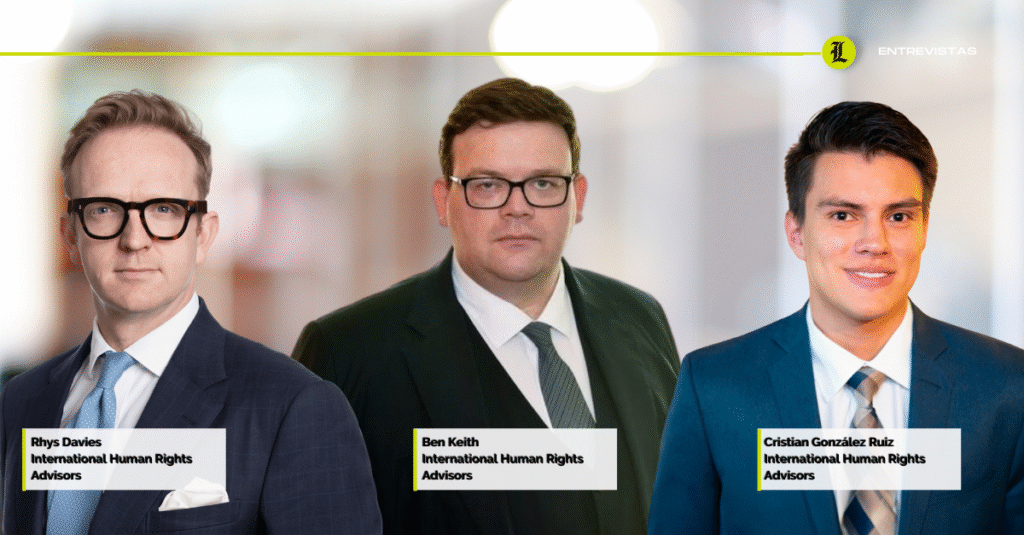
Ben Keith, Rhys Davies y Cristian González Ruiz,
Lawyers specializing in international law and international criminal law from International Human Rights Advisors (IHR Advisors) will be speakers at the conference on transnational crime in Latin America to be held on Monday, December 1, and Tuesday, December 2, in Buenos Aires. This event, held with the support of the International Criminal Court (ICC), addresses one of the most pressing challenges for the region: how to combat transnational crime without the justice systems being subject to misuse.
Buenos Aires is the ideal setting to address this issue, given that the region is facing a complex situation. Authoritarian regimes and democratic governments have increased their instrumental use of Interpol tools, such as Red Notices, to persecute political opponents or exert pressure in commercial disputes. In the panel they lead, the experts examine these challenges and clarify the true role of Interpol, a fundamental network for international cooperation that nevertheless has significant vulnerabilities.
In this interview, they share their perspective on the risks facing justice in Latin America, the types of recurring abuses, and the legal, diplomatic, and communication strategies needed to address them. They also contribute their experience in international litigation, which allows them to articulate effective responses and protect those who are threatened.
It is essential that Latin America lead the reforms necessary to ensure that justice fulfills its purpose of protection and not oppression. This conversation offers an in-depth look at these challenges and the solutions currently underway.
What does it mean for you to participate in a conference in Buenos Aires focused on transnational crime in Latin America and organized with the support of the International Criminal Court?
Buenos Aires is exactly the place where this conversation should take place. Latin America faces unique challenges in combating transnational crime while preventing abuse of justice systems. This conference brings together professionals and policymakers who know these realities firsthand. With the support of the ICC, we are not talking about theory: we are developing practical responses to protect against the instrumentalization of justice while maintaining effective international cooperation.
Why did you consider it important to lead a panel on Interpol in this region, at this particular time?
Latin America is at a turning point. Authoritarian regimes such as Venezuela have learned from Russia and China how to use Red Notices against opposition leaders; we saw this with Edmundo González and Leopoldo López. But it is not just autocracies. Democratic governments are also abusing these tools to pressure investors in commercial disputes. This panel addresses a simple question with complex answers: how can Latin America combat real transnational crime without allowing these mechanisms to be hijacked for political persecution or trade wars?
In your experience, what is the real role—not the commonly imagined one—that Interpol plays in the fight against transnational organized crime?
Contrary to the Hollywood image of Interpol agents conducting raids and arrests, the organization functions primarily as a sophisticated data-sharing network connecting 196 member countries. Its core work consists of facilitating information through tools such as Red Notices—which are requests for location and provisional detention, not international arrest warrants. Interpol fills critical jurisdictional gaps, enabling coordination against transnational threats such as corruption networks, but it has no enforcement powers. All arrests and operations are the exclusive responsibility of national police forces. This technical, behind-the-scenes role is essential, although much more limited than the public often believes.
You have repeatedly pointed out that Interpol is vulnerable to political and corporate abuses. What types of abuse are most frequent?
We observe two main patterns. First, political persecution remains prevalent, with authoritarian regimes systematically violating Article 3, which prohibits activities of a political nature. Venezuela targets opposition figures, China persecutes Uyghurs and dissidents through discreet campaigns, Turkey issued mass requests against alleged Gülenists after the 2016 coup attempt (most of which were rejected by Interpol), and El Salvador has targeted human rights defenders such as Ivania Cruz and Rudy Joya—cases that UN experts have condemned as clear repression. We have also documented Rwanda’s influence operations in Senegal and Madagascar, Sri Lanka’s persecution of fugitive athletes, and Kyrgyzstan’s failed attempt to target a journalist.
Second, the transformation of commercial disputes into criminal cases is a growing threat. States are increasingly resorting to economic crime charges to pressure investors, especially in ISDS disputes. Money laundering investigations in Panama against investors are one example: they result in frozen assets, closed accounts, destroyed reputations, and travel restrictions. The systemic nature of these vulnerabilities is further reflected in concerns about undue influence, such as questions about UAE funding that could compromise Interpol’s impartiality.
What concrete impact can an abusive Red Notice have on a person’s life? Could you give examples without compromising any specific case?
An abusive Red Notice can devastate a person’s life, causing immediate practical and psychological damage. It can lead to sudden arrests at borders or airports, travel bans that separate people from their families and businesses, and loss of financial access through frozen accounts. In terms of reputation, the mere existence of the notice—disseminated to cause as much damage as possible—can ruin careers and relationships. We have seen high-profile figures living in exile in constant fear, with little capacity for advocacy and diplomatic isolation, following patterns similar to Latin American opposition leaders who lose ties and become trapped as asylum seekers. Recent cases include individuals who have had to surrender their passports, appear periodically in court, and face detention while seeking asylum.
When a State uses Interpol to persecute political opponents or in trade disputes, what are the most effective legal tools to challenge such abuse?
The first step is to use Interpol’s own mechanisms. Submit a request for deletion to the Commission for the Control of Data Files (CCF), demonstrating violations of Articles 2 and 3 of the Interpol Constitution or data protection regulations. Document everything meticulously. Kyrgyzstan’s recent failed attempt against a journalist shows that it works when done correctly.
But that is not enough. The underlying orders must be challenged through judicial review in both the issuing and executing countries. Regional human rights courts—the European Court, the Inter-American Court—should also be appealed to, alleging violations of due process. In commercial cases, file counterclaims with ICSID exposing the abuse as a violation of fair treatment. When cases are attacked on several fronts simultaneously, notifications are often canceled before facing proper scrutiny.
International Human Rights Advisors represents clients before tribunals such as the European Court of Human Rights, the ICC, the Inter-American Court, and the more complex mechanisms of the United Nations. What does this experience bring to litigating cases before Interpol?
We know how international courts think. Years before the Inter-American Court mean a thorough understanding of the protections of Article 8. Experience before the ICC shows us how to connect war crimes investigations with challenges before Interpol. UN mechanisms on arbitrary detention? We have successfully invoked them repeatedly to demonstrate political persecution.
This is not theory: it is practical experience. We can link an investigation into crimes against humanity in Venezuela with a challenge before Interpol, strengthening both cases. We know which forum will be most receptive to certain arguments and which precedents carry weight where. Most importantly, we offer clients real options in multiple jurisdictions, not just a single opportunity in a single court. Individual defenses become precedents for systemic reform because we know how to connect the dots between different legal systems.
Many of their interventions combine legal strategy with diplomacy, communication, and international pressure. Why does international litigation today require such an integrated approach?
Because legal victories alone do not stop state persecution. States have become sophisticated in manipulating legal systems—purely legal strategies often fail in the face of coordinated abuse.
That is why we work on multiple fronts. While we file legal challenges, we engage diplomats to put pressure on Interpol internally. Media campaigns expose what is really happening, protect the client’s reputation, and generate public pressure. We mobilize sanctions, ICC scrutiny, UN special procedures—whatever will generate influence. In Venezuela, this approach not only defends individual clients; it challenges the entire system of repression. Each element reinforces the others. Legal action alone would achieve only a fraction of the impact.
In the region, there is a growing use of Interpol and sanctions as instruments in corporate disputes or political conflicts. What global patterns do you see being replicated in Latin America?
Some jurisdictions in Latin America are copying the authoritarian playbook, albeit with regional variations. Venezuela’s Red Notices against opponents follow the same pattern as China’s Fox Hunt operation or Russia’s persecution of dissidents—fabricated charges of treason or financial crimes to silence critics. El Salvador has issued more than 800 notices under emergency powers, an unprecedented escalation even by global standards.
In the commercial sphere, we see the conversion of economic disputes into criminal proceedings, but with a distinctly Latin American twist. Peru targets arbitrators in Odebrecht cases. Panama initiates criminal investigations against investors who file ISDS claims. These tactics combine learned authoritarian methods with regional characteristics: the particular vulnerability of foreign investors in extractive industries, the use of anti-corruption rhetoric to cover up commercial reprisals, the exploitation of weak judicial systems. The result: destruction of investor confidence, unchecked impunity, and economic stagnation. Some elements are unique to the region, but the underlying sophistication comes from studying global precedents.
How should a high-profile company or individual act when facing an imminent risk of abusive international prosecution?
Acting quickly and strategically is essential. First, immediately hire specialized counsel to assess the threat and confirm the existence of a Red Notice by consulting directly with the CCF. If there are reasonable grounds to suspect an imminent issuance, file a preemptive challenge to its validity—this often motivates issuing countries to withdraw the request before facing scrutiny. Recent data shows that rejections for non-compliance rose sharply to 2,462 in 2024, often on procedural or gravity grounds.
Rigorously document all evidence of political or commercial motivation. Request protective measures such as asylum applications, provisional judicial remedies, or voluntary travel notifications in high-risk scenarios. Avoid traveling to jurisdictions with a higher likelihood of enforcement. Activate diplomatic channels and means to expose abuse, while monitoring new tools such as Silver Notices that target assets. In Latin America, early intervention with the CCF has proven particularly effective in preventing detentions and achieving rapid removals.
You also litigate international sanctions —Magnitsky, OFAC, UK. What opportunities does this system offer to combat corruption networks and human rights violations in Latin America?
Sanctions strike where local justice falls short. OFAC’s designation of Venezuela’s Cartel of the Suns as a terrorist organization and asset seizures—all of this destabilizes corruption at its foundations. The UK’s Global Anti-Corruption Regime added new targets in November 2025, and civil society can directly nominate corrupt actors.
These tools freeze assets, block travel, and exclude corrupt actors from the international financial system. Combined with other legal strategies, they create pressure that national systems could never generate on their own. They are particularly effective in Latin America, where corrupt networks often operate transnationally and place their assets abroad precisely to avoid local accountability.
What is the central message you hope to convey during your panel in Buenos Aires?
Interpol remains indispensable in combating transnational crime, but its vulnerability to abuse—particularly acute in Latin America—calls for urgent reform. We need stronger safeguards: stricter verification processes, transparency in country data, robust data protection measures, and genuine human rights oversight. These are not abstract concerns: they determine whether these tools serve justice or facilitate oppression.
Latin America must lead this reform agenda, drawing on experiences from Venezuela, Peru, El Salvador, and other countries. As Interpol’s General Assembly in Marrakesh debates governance reforms, the pilot of Silver Notices for financial crimes, and a possible General Agreement on Privileges and Immunities that could expand legal protections by reducing accountability, our region’s voice is crucial. We must ensure that these mechanisms target real criminals, not political opponents or commercial adversaries.
If you could give just one piece of advice to law firms and criminal defense teams in the region on how to handle cases with international components, what would it be?
Immediately and thoroughly map the international landscape. Do not wait for a Red Notice to appear or for sanctions to be imposed: identify potential international components from the outset, whether they be Interpol notifications, cross-border orders, or sanctions risks. Then, collaborate with specialists who understand not only the legal mechanisms, but also their intersection with human rights frameworks and diplomatic channels.
Isolated national strategies fail in the face of transnational persecution. Understand how the Interpol Commission operates, how it intersects with ICC proceedings, how to take advantage of recent reforms such as enhanced verification of emergency requests—this knowledge transforms defensive reactions into strategic opportunities. You are not just defending a client: you may be driving systemic reform that benefits all those affected by these abuses.