
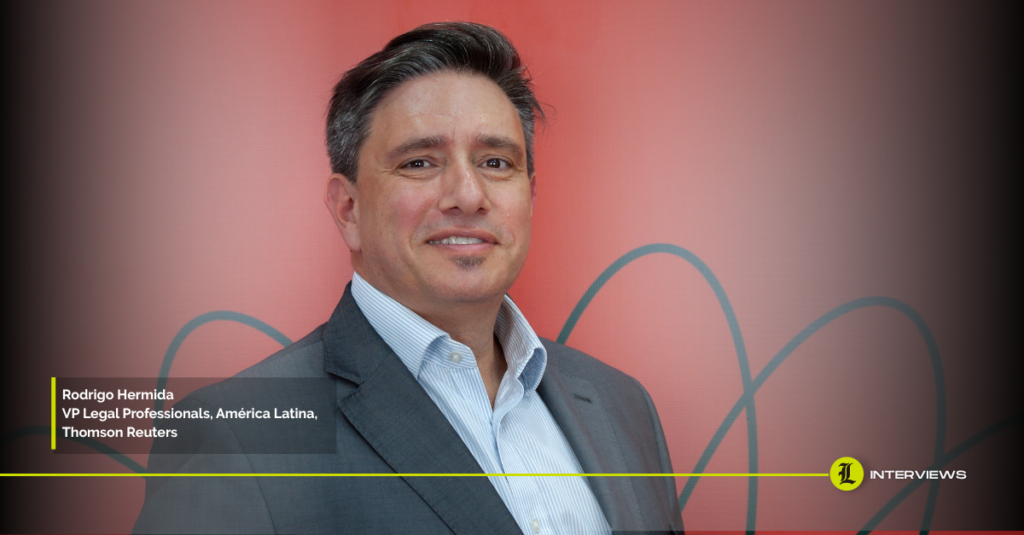
On Lawyer’s Day, Rodrigo Hermida, VP of Legal Professionals for Latin America at Thomson Reuters, argues that the true challenge of legal AI is trust: ensuring that professionals can be held accountable for their results when decisions have real consequences for a client. Hermida explains the criteria that determine how much human oversight an automated task requires, and why efficiency, without traceability, loses all its value in a profession that is accountable to clients, regulators, and courts. His analysis spans three regional perspectives—Brazil, Argentina, and Chile—and raises a fundamental question: how does the market currently measure the success of legal AI?
This August 11th marks Lawyer’s Day in Brazil, just as Bill 2.338/2023—the regulatory framework for AI—is progressing through the Brazilian Congress. From your position at Thomson Reuters, where exactly does AI adoption stand in the Latin American legal sector today: has the region already moved beyond the experimentation phase, or is it still testing the waters?
Regulation has an important role to play in strengthening trust in AI and helping to harness its potential responsibly.
Today, the conversation in our region is no longer about adoption, but about how to bridge the gap between strategy and execution. What we see is that AI is already part of the daily work of many legal professionals, but organizations are still learning how to capture its full potential. According to our Future of Professionals report, based on a global survey of professionals in the legal, tax, risk, global trade, and finance sectors, this gap is already having visible consequences in three dimensions: clients who expect more value from their advisors, professionals who consider access to these tools a key factor in choosing where to work, and organizations facing risks associated with the use of unauthorized AI or “shadow AI.”
In a profession where trust is fundamental, the challenge is to adopt technology strategically and responsibly, because only in this way can it translate into better results for clients.
It’s often said that AI “frees up time” for lawyers, but it’s rarely explained what that recovered time is actually used for. Specifically, what tasks has a lawyer stopped doing thanks to these tools—searching for case law, reviewing contracts, drafting routine documents—and what are they doing now with that time they didn’t have before?
AI is already taking over much of the repetitive work that used to consume valuable hours of a lawyer: reviewing large volumes of documents, tracking case law, comparing contracts, organizing information for due diligence, or preparing the first draft of a brief.
What’s interesting is what happens next. The most advanced studios use that saved time to grow in different ways. Some dedicate it to more complex and strategic matters, others to increasing volume, responsiveness, and consistency, and still others begin developing services that were previously difficult to offer profitably.
The hours recovered are just the starting point. What distinguishes the most advanced firms is how they transform that new capacity into a true competitive advantage.
In legal workflow automation, someone has to decide which tasks a tool can handle without requiring a lawyer to review the output before it’s released. Where does Thomson Reuters draw that line today? Has it had to backtrack in any cases—reinstating human oversight for a task it had previously automated—because the output wasn’t entirely reliable?
The AI adoption strategy must define which tasks it aims to solve, their level of risk, and the degree of human oversight required for each. Depending on the use case, this level of oversight can vary from occasional monitoring to detailed review, but professional judgment remains a fundamental part of the final decision.
At Thomson Reuters, these boundaries are defined from the design stage of our solutions, following our data and AI principles, which prioritize security, privacy, and meaningful human oversight. Technology can provide speed, consistency, and analytical capabilities, but always as a support for professional work and within a framework designed so that the results can be used responsibly in demanding contexts.
In a market where multiple legal technology providers compete with the same argument of efficiency, what is the real difference—not the marketing campaign—between what Thomson Reuters offers and what a law firm achieves by building its own automation with generic AI tools?
Efficiency is just one of the variables that AI must address, but efficiency is of little use without security, traceability, and reliability. Our AI is designed for a profession where every result must be able to stand up to a client, regulator, or court.
This also addresses one of the challenges we see in today’s market, where a significant number of legal professionals use tools not approved by their organizations, creating risks to security, privacy, and data governance. That’s why at Thomson Reuters, we operate under a standard we call Fiduciary-Grade AI™, designed for high-responsibility professions. When professional decisions are at stake, simply being “almost right” isn’t enough.
AI adoption is uneven in Latin America. Which markets in the region are advancing fastest in legal automation, and what explains this difference: regulation, professional culture, technological infrastructure?
I wouldn’t see it so much as a race with one market clearly ahead of the rest, but rather as a region where different countries are adopting AI for different market contexts and reasons. Brazil finds value in automation to manage a scale that few legal systems in the world possess. In Argentina, budget constraints, combined with a culture very open to innovation, are driving intensive use of AI, although there is still a long way to go to move toward more strategic adoption. Chile is one of the markets most inclined to experiment with new technologies.
The interesting thing is that they all converge on the same challenge: moving from using AI to solve specific tasks to integrating it strategically into professional practice.
When automation fails or delivers a result that a lawyer would not have accepted, who is responsible for that in the region today: the law firm, the tool provider, or is there still no clear answer?
As technology becomes more involved in the process, it doesn’t replace fundamental aspects of the profession, such as judgment, client relations, or accountability for decisions. AI can accelerate processes, provide analytics, and help manage large volumes of information, but accountability remains a human responsibility.
Therefore, the conversation shouldn’t focus solely on what happens when a tool fails, but rather on how to design and implement technology that helps reduce that risk from the outset. This is where our global fiduciary-grade AI standard becomes relevant: when a decision has real-world consequences, the results must be able to be examined, verified, and substantiated with the same rigor demanded by legal practice.
Looking three to five years ahead: what aspects of legal work that are currently considered irreducibly human do you think will cease to be so? And what worries you more than it excites you about that transition?
I don’t believe that what makes lawyers unique will disappear; on the contrary, AI may enhance that human aspect. I think professional judgment will become even more relevant, and the ability to interpret nuances, build trust, and make complex decisions will remain profoundly human. What worries me is that the market continues to measure AI’s success by speed when, in professions of high responsibility, trust is far more important. In the coming years, new technologies will emerge capable of doing increasingly more. The real challenge will be ensuring that professionals can trust their results when faced with a decision that has real consequences for a client.
The interview connects points that rarely appear together: what a firm does with the hours that AI frees up—grow in complexity, volume, or new services—what risk an organization runs when its professionals resort to unauthorized tools to fill that gap, and what level of oversight should exist before a result reaches a client. Hermida concludes the argument with the warning that gives meaning to everything mentioned above: the market continues to measure the success of AI by speed, when in a profession of high responsibility the deciding factor is trust, and that trust can only be sustained if, behind every result, there remains human accountability.