

The legal sector is undergoing a profound transformation. Technology, new business models and the emergence of alternative ways of delivering legal services are redefining not only how law is practised, but also how leadership is shaped within the profession.
To mark International Women’s Day, we have gathered conversations with women who are actively influencing change. From legal innovation to firm strategy and the development of new organisational models, these professionals offer insights into the present and future of the legal sector.
Following our conversation with Sara Molina, partner in Legal Tech and Digital Transformation at Pérez-Llorca, we continue this special feature with the perspective of someone who decided to build a completely different legal structure.
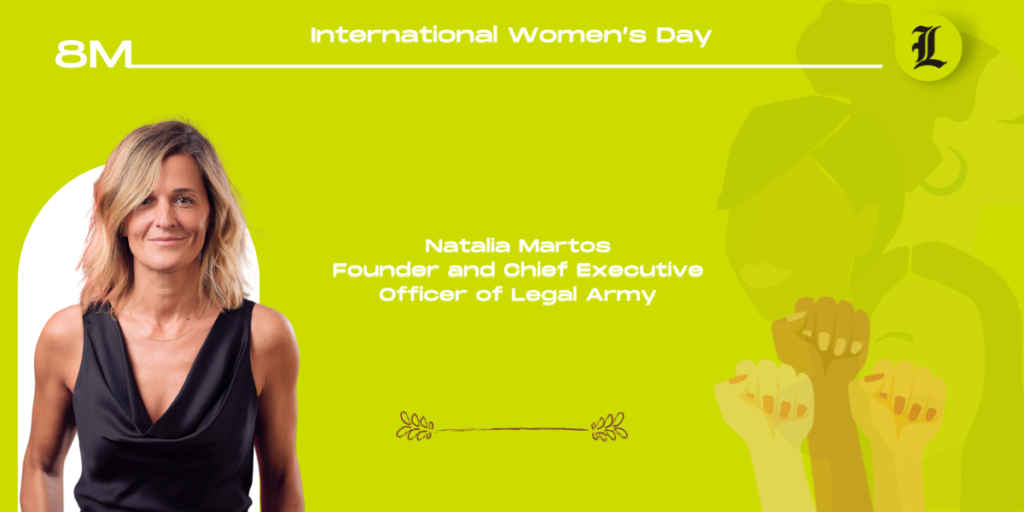
This is the case of Natalia Martos, CEO and founder of Legal Army, a legaltech firm specialising in advising technology companies and digital economy projects. Her career combines experience as both an in-house lawyer and a practitioner in a traditional law firm — a dual perspective that ultimately shaped her view of the limitations of the traditional model of legal service delivery.

Design a different signature from the start
When Natalia Martos decided to create Legal Army, she had a very clear idea: she didn’t want to transfer to the legaltech world the dynamics she had observed for years in traditional law firms. Having worked both within companies and in law firms allowed her to clearly understand where the mismatches occurred between legal advice and the real needs of organizations.
That’s why, he explains, the key decisions were made from the very beginning.
The first was structural: designing the firm around talent, not hierarchy. In many firms, professional value is measured by seniority or individual billings, while in their model, legal expertise, specialization, and the ability to solve complex problems are the true indicators of value.
This change profoundly alters the internal dynamics of a legal organization.
The second decision was organizational: Martos wanted to build a lean, efficient, and client-oriented firm, avoiding the structural costs that often end up distancing traditional firms from the real needs of businesses. This meant giving up oversized structures, ostentatious offices, or organizational models designed more to sustain the organization itself than to solve client problems.
This same approach also led to abandoning the traditional hourly billing model. Instead, Legal Army operates with transparent rates and fixed prices, a decision driven by both efficiency and transparency.
“The hourly system discourages agility and shifts costs to the client that are unrelated to the advice they actually need.”
Leading in the new legal ecosystem
For Martos, the impact of legaltech on the legal sector goes far beyond the incorporation of new technological tools. In reality, he explains, it is transforming the rules of access to leadership within the profession.
For decades, leadership in law firms was closely linked to very rigid structures: marked hierarchies, very linear career models, and internal networks that conditioned access to positions of power.
Technology is disrupting this balance by shifting the focus from structure to the real value each professional brings. Today, a lawyer can lead projects, teams, or even create her own firm without needing to replicate those old models. The new competitive advantage is no longer size or seniority, but specialization, the ability to understand complex environments, and the speed to deliver solutions.
In that context, legaltech allows for the construction of more horizontal, more efficient, and more meritocratic organizations, where leadership is legitimized by judgment rather than formal position.
Furthermore, it opens up a particularly relevant opportunity for women.
“It’s not just about more women reaching positions of power, but about them being able to redefine what it means to lead in the legal sector.”
Detecting the limits of the traditional model
The decision to invest in legaltech didn’t come about suddenly. For years, Martos had observed a series of imbalances within the legal market that would eventually lead her to create her own project.
One of these challenges was the misalignment between traditional firms and the pace of evolution in the digital economy. Technology companies were growing and transforming rapidly, while many legal models continued to operate with parameters designed for a different industry.
The other major mismatch was economic. Many startups and technology companies in growth phases could not access legal advice from large firms due to their pricing structures. This created a clear paradox: companies with enormous growth potential were beyond the reach of traditional advisory models.
In that context, Martos clearly perceived that the sector needed a new model for providing legal services adapted to the digital economy.
And he made a decision that would mark his career.
“If I didn’t do it now, someone would end up building that model.”
That’s when he decided to leave the traditional law firm and create Legal Army from scratch.
Innovate from within… or from without
Based on his experience, Martos believes that true innovation within law firms depends less on technological tools than on organizational culture. The clearest signs that an organization is unprepared for transformation have nothing to do with technology, but rather with mindset.
If technology is understood only as an operational support and not as an opportunity to change the way we work, if decisions continue to be made within rigid hierarchies, or if efficiency is not rewarded because it reduces billable hours, it is difficult for innovation to emerge from within.
“When a structure talks about transformation, but protects its inertia, you know that you will probably have to build something different outside and not inside.”

The new leadership in the legal profession
For the new generation of female lawyers who aspire to lead their own projects or to work in highly specialized legal environments, Martos believes that leadership begins long before taking a formal position.
His main advice is to prioritize expertise over visibility and specialization over haste. In complex environments, he explains, what truly sets a professional apart is not their position, but their ability to understand problems that others cannot solve.
It also encourages new generations not to wait for traditional structures to grant them permission to lead. The sector is changing, and today there are more opportunities to build their own projects or promote different models of legal advice.
Because, in his opinion, leadership doesn’t begin when an appointment arrives.
“It starts when you begin to make decisions with sound judgment.”
The career path of Natalia Martos reflects one of the most interesting transformations the legal profession is experiencing today. In contrast to a traditional model built over decades around highly consolidated hierarchical structures, legaltech is opening up space for new ways of practicing law and also for new forms of leadership.
In this context, more and more female lawyers are finding in legal innovation an opportunity to build their own projects, redefine the rules of the sector and actively participate in its transformation.
Because, as Martos summarizes, true change does not consist solely of accessing existing structures, but of imagining different ones.
“It’s not about occupying spaces in the legal sector, but about creating new ones.”