

In the special report Leaders 2026: Vision and Challenges of Spanish Law Firms, analysing the role of a firm such as DLA Piper is not simply a matter of technological adaptation, but of strategic management.
As one of the largest global firms in the market, with a presence across multiple jurisdictions and a leading role in complex cross-border transactions, its approach to artificial intelligence, technology regulation and sustainability has systemic implications. The issue is not merely how it integrates digital tools, but how it redefines standards of governance, training and legal culture in an environment where regulatory complexity is advancing at the same pace as digitalisation.
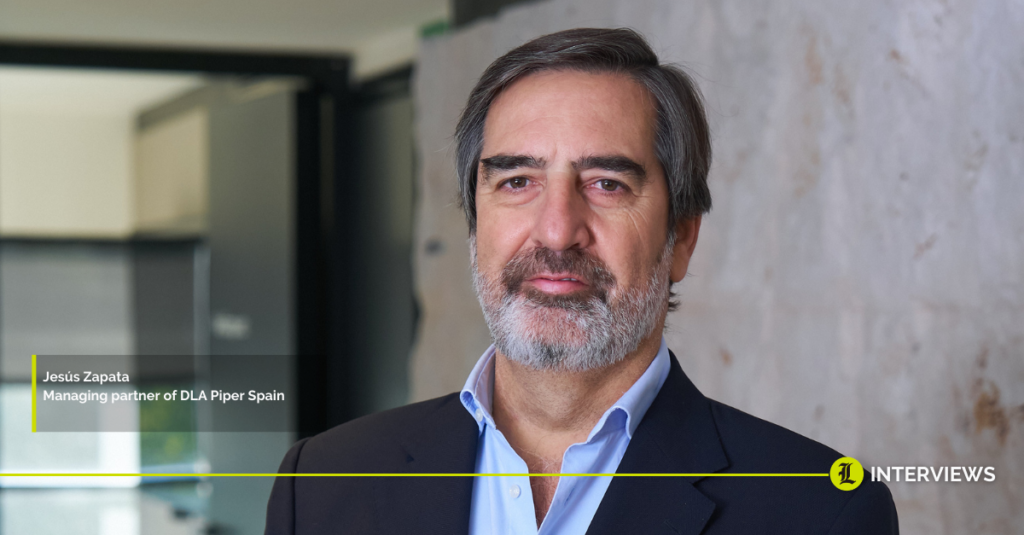
Jesús Zapata, Managing Partner of DLA Piper Spain, puts it plainly: technology can accelerate processes, but legal judgement remains the indispensable core of legal advice.

Responsible AI: structure before speed
For DLA Piper, artificial intelligence is not merely another tool added to the service offering; it represents a structural transformation.
“The integration of artificial intelligence in a global firm such as ours is not conceived as a simple technological adoption, but as a structural transformation guided by principles of legal quality, technical rigour and security.”
The distinction lies in the order of priorities: governance before mass deployment; human oversight before immediate efficiency.
“AI is an extraordinary support, but it does not replace legal judgement; that principle is non-negotiable.”
Each tool is assessed under robust frameworks that address risk, data protection, ethical use and human supervision. The approach is neither uniform nor indiscriminate. It is guided by a simple premise: the right tool for the right task.
The firm offers more than 40 digital solutions within its global technology toolkit, including the deployment of Microsoft Copilot and collaboration with Harvey as a legal AI assistant. Yet the value does not lie in the number of tools, but in their strategic application.
Automation is directed towards repetitive tasks — document review, due diligence, comparative analysis and legal research — thereby freeing up time for higher-value work: strategy, legal creativity and multidisciplinary coordination.
This shift requires structured training. Since 2024, DLA Piper has been running a global Data & AI Literacy programme, which will be expanded in 2026.
“This programme is key to ensuring consistent and responsible adoption across all teams.”
Technology alone does not transform organisations. Culture does.
Defining the technology curve
The objective for 2026 is unequivocal: to consolidate its position as a leading global firm in artificial intelligence, data, cybersecurity and complex technology-driven operations.
“Our goal is to consolidate our position as the leading global firm in artificial intelligence, data, cybersecurity and complex technological operations.”
The strategy combines research, piloting, in-house development, acquisition and deployment of solutions. It is not a question of adapting to the technological curve, but of shaping it. Yet Zapata is clear that the true differentiator is not purely technical.
“Our greatest differentiating factor is not only technological, but cultural.”
The firm operates an international technology hub that connects multiple jurisdictions in order to advise on strategic projects — digital infrastructure, sovereign cloud, fintech and healthtech — from a coordinated global perspective.
It also advises leading market participants on the development and deployment of AI models on a global scale.
“We learn first-hand from the most advanced ecosystem and transfer that knowledge directly into our own internal adoption.”
This dual dynamic — advising on innovation while embedding it internally — positions the firm at a different level: not merely as a user of technology, but as an active participant in defining its legal and operational standards.
2026: accelerated regulation and deep specialisation
The macroeconomic and regulatory environment is set to become increasingly demanding. The acceleration of technology regulation will coincide with greater pressure from businesses for anticipation and predictability.
“Companies will increasingly require anticipation, transparency and predictability in the services they receive.”
For Jesús Zapata, the response lies in deep specialisation and genuine cross-border capability: highly specialised teams able to execute complex transactions under consistent standards across jurisdictions.
In Latin America, he anticipates significant dynamism in M&A activity, driven by European, American and Asian investors pursuing transactions with a combined Spain–Latin America footprint.
“Our goal is not to grow in terms of presence, but to guarantee genuine execution capability in complex operations.”
According to the Managing Partner of DLA Piper Spain, expansion is not measured by the number of offices opened, but by the firm’s effective capacity for global coordination.
Differentiation: technology and sustainability as an integrated model
The firm’s strategy integrates legaltech and ESG within a single structural framework rather than treating them as parallel initiatives.
In the field of legaltech, the focus is on solutions that deliver tangible impact: secure document automation, contractual analysis tools, and review systems that ensure traceability alongside meaningful human oversight.
In sustainability, the emphasis extends well beyond reputational considerations.
“Sustainability is no longer a reputational element, but a regulatory and financial factor with a direct impact on our clients’ business models.”
Embedding ESG criteria into green finance, regulatory reporting and compliance frameworks is not presented as an ancillary practice area, but as a core component of the firm’s growth model and advisory architecture.
Talent and leadership: consistency, empathy and vision
For Zapata, talent retention does not depend solely on economic conditions.
“Creating an environment where each person feels they have genuine space to grow, innovate and contribute is what generates long-term commitment.”
Training in AI applied to law, legaltech workshops from the onboarding stage and accessible leadership form part of that culture.
When asked about leadership, he distils it into three pillars:
“Consistency, empathy and vision.”
He elaborates: “Consistency means aligning what you say with what you do; without that consistency, there is no sustainable leadership.” Vision enables anticipation of the environment. Empathy sustains teams. Consistency builds trust.
Career, patience and balance
Building a solid career requires legal excellence, but also sustained intellectual curiosity. “Today, a lawyer cannot remain focused solely on the letter of the law; they need to understand the sector and the business model.”
Strategic patience, he argues, is essential.
“Haste can be the enemy of quality and sound judgement.”
As for the classic dichotomy between profitability and growth, Zapata is unequivocal:
“Profitability is the foundation that makes healthy and sustainable growth possible; without a profitable structure, any expansion ultimately proves fragile.”
Profitability and growth are not opposing concepts; they are sequential.
By 2026, the legal sector will not be divided between those who use artificial intelligence and those who do not. The real divide will be between those who integrate it within a coherent structure and those who adopt it without a model.
DLA Piper with its global scale, leadership in complex technology-driven operations, and capacity to coordinate across multiple jurisdictions under consistent standards operates on a different plane. It does not merely advise on digital regulation and AI models; it participates in shaping their development.
Technology may set the pace. Leadership, however, will be defined by the coherence between innovation, governance and culture.
In an environment where complexity increases at the same rate as digitalisation, that coherence -structural, strategic and global- constitutes the true competitive advantage of a major international firm.