

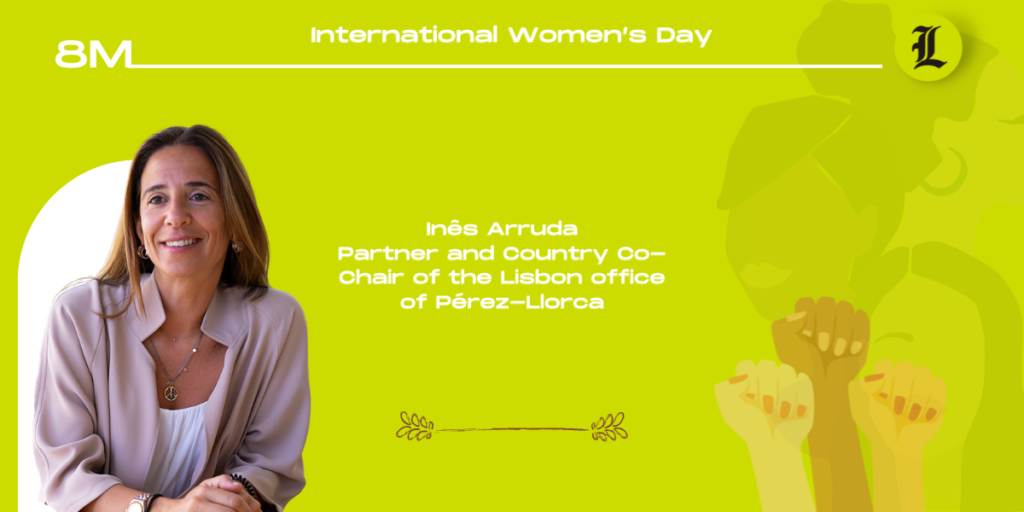
Following the conversations with Sara Molina, Natalia Martos and Sofía Acuña, we conclude this special feature with the perspective of Inês Arruda, partner and country co-chair of Pérez-Llorca’s Lisbon office, one of the professionals who most clearly embodies the increasingly international dimension of European legal practice.
With more than two decades of experience advising on complex labour matters and cross-border corporate transactions, Arruda has built a career shaped by professional decisions that combine ambition, sound judgement and adaptability. She began her career at a large international firm, later founded a boutique specialising in business law, and now forms part of a rapidly expanding international project. This combination of experiences has allowed her to understand law not only as a technical discipline, but also as a strategic tool for managing and developing organisations.
Her leadership also reflects a broader transformation within the legal sector. At a time when firms increasingly operate across multiple jurisdictions and clients make global decisions in real time, the profession demands lawyers capable of coordinating talent, integrating different professional cultures and anticipating the risks that accompany complex business decisions.
From Lisbon, Arruda actively participates in this process. Her understanding of the profession—technically rigorous, business-oriented and focused on the management of international teams—helps explain why her perspective is particularly relevant for understanding how leadership is evolving within international firms.
Ultimately, her career illustrates something that is becoming increasingly evident across the sector: the global legal profession is no longer defined solely by where offices are located, but by who is capable of leading the talent and the decisions that connect them.

The legal profession in an international environment
The addition of Inês Arruda to Pérez-Llorca in 2024 to strengthen the firm’s international strategy in Lisbon confirmed for her a conviction that has guided her career for years: global law is not defined by the number of offices a firm has in different countries.
“Global advocacy is not about having offices spread around the world, but about being able to coordinate teams and decisions across multiple jurisdictions in real time.”
From this perspective, law becomes a direct tool for generating value for organizations. Leading a cross-border practice involves understanding how businesses operate when they grow, reorganize, internationalize, or make acquisitions in different countries.
Arruda defines her practice as business law, in which labor issues are addressed from a strategic perspective. It’s not just about interpreting regulations, but about managing everything related to people within an organization and anticipating how those decisions will impact the business.
This approach requires a deep understanding of the structure and culture of the companies it advises.
Managing talent in a global firm
For Inês Arruda, leadership in an international firm is not defined solely by managing complex matters or expanding the firm into different markets. The real challenge lies in how talent is managed in a professional environment that has changed profoundly in recent years.
“The great challenge of leadership today is not exclusive to women. It consists of managing talent in a hybrid context, with increasingly international teams and very different generational expectations.”
In that context, leadership requires understanding how new generations work and how the balance between professional and personal life is articulated today – the so-called work-life balance – a notion that, he acknowledges, is not always intuitive for those who were trained in traditional models of practicing the profession.
This reflection connects directly with his understanding of labor practice. For Arruda, labor law is not an isolated area within the firm, but a strategic function in the management of organizations.
“Decisions about people determine the execution, risk, and stability of a company.”
That’s why he believes that labor law is probably the area that best reflects the tensions that organizations are going through today: innovation, productivity and well-being.
In an international environment, leadership involves creating the conditions for teams to work diligently and consistently, ensuring common quality standards while maintaining autonomy in execution.
This is where meritocracy, responsibility, and transparency cease to be abstract concepts and become a daily practice, both in work management and in the development of professional careers, including non-linear paths.
Arruda also points out that one of the keys to Pérez-Llorca’s project is the trust that the firm places in its partners.
“Pérez-Llorca has complete confidence in his partners and gives us the space to develop our practice area in the best possible way. That freedom comes with responsibility.”
Regarding the issue of gender, Arruda acknowledges that “in any of the models I’ve worked in, the work is intense, so organization and discipline make all the difference.” That’s why she believes professional leadership should be built on merit and individual responsibility.
“The essential thing is not to start from the premise that being a woman, in and of itself, grants us more rights.”
A signature, a culture
Pérez-Llorca’s international growth – with the consolidation of the project in Portugal and the opening of new international hubs – also poses the challenge of integrating diverse teams without losing the firm’s identity.
For Arruda, the key lies in the concept of “one firm”.
Lisbon, Madrid or London function as different gateways to the same professional culture, based on technical excellence, proximity to the client’s business and collaboration between practice areas.
“We don’t replicate isolated models; we integrate talent into a common matrix of technical requirements and customer service.”
Internal mobility and participation in multi-jurisdictional teams help strengthen that shared identity. A lawyer in Lisbon should feel part of the same project as a colleague in Madrid or any other office of the firm.
In his opinion, this balance between local knowledge and international standards is one of the elements that customers value most.
The strategic evolution of labor law
With more than 20 years of experience advising on complex labor issues and mergers and acquisitions, Arruda has observed how labor practice has evolved into an increasingly strategic role within organizations.
Today, he explains, the success of many transactions depends as much on the cultural and organizational integration of the teams as on the financial or corporate structure of the operation.
That’s why labor consulting is no longer limited to validating legal aspects. It’s about anticipating risks, identifying tensions within organizations, and ensuring that business decisions can be implemented safely in different jurisdictions.
“Innovation is not just about using new tools. It’s about changing the method.”
For Arruda, true innovation in legal advice lies in developing preventive, data-driven advocacy aimed at facilitating strategic decisions.
What does international legal leadership require today?
When speaking with young female lawyers aspiring to international careers, Arruda emphasizes the importance of embracing that ambition from the outset. Exposure to diverse cultural and legal contexts, whether through studies abroad, internships, or cross-border projects, provides the necessary perspective for operating in global environments.
But he also warns that international leadership requires more than technical excellence.
“Being technically flawless is essential, but not sufficient.”
Anyone aspiring to leadership must understand the client’s business, interpret strategic priorities, and coordinate diverse teams with clarity and consistency. Arruda also emphasizes an aspect he considers fundamental and which, in his opinion, is sometimes neglected in younger generations: general knowledge. Reading, understanding what is happening in the world, and grasping how different economic sectors operate allows lawyers to engage in dialogue with executives and boards of directors from a broader perspective.
Because, in today’s legal market, leadership demands an increasingly broad combination of skills: technically impeccable lawyers, but also professionals capable of managing teams, engaging with boards of directors, and challenging the status quo with concrete proposals.
The career path of Inês Arruda reflects how leadership is evolving within international firms. In an increasingly global market, the legal profession demands not only technical excellence, but also the ability to integrate diverse teams, understand different corporate cultures, and anticipate strategic decisions.
Throughout this special for International Women’s Day, the conversations with Sara Molina, Natalia Martos, Sofía Acuña and Inês Arruda have shown different ways of leading within the legal sector.
Different paths, diverse firm models and different areas of specialization, but one common conclusion: leadership in the legal profession is changing.
More and more women are actively participating in this transformation, expanding the ways in which they lead teams, build legal projects, and influence strategic decisions within organizations. Because the future of the legal sector will not be defined solely by the evolution of law firms, but by the people capable of leading the talent, decisions, and cultures that connect this global market.
And along that path, female leadership will continue to be one of the forces driving the next stage of the legal profession.