



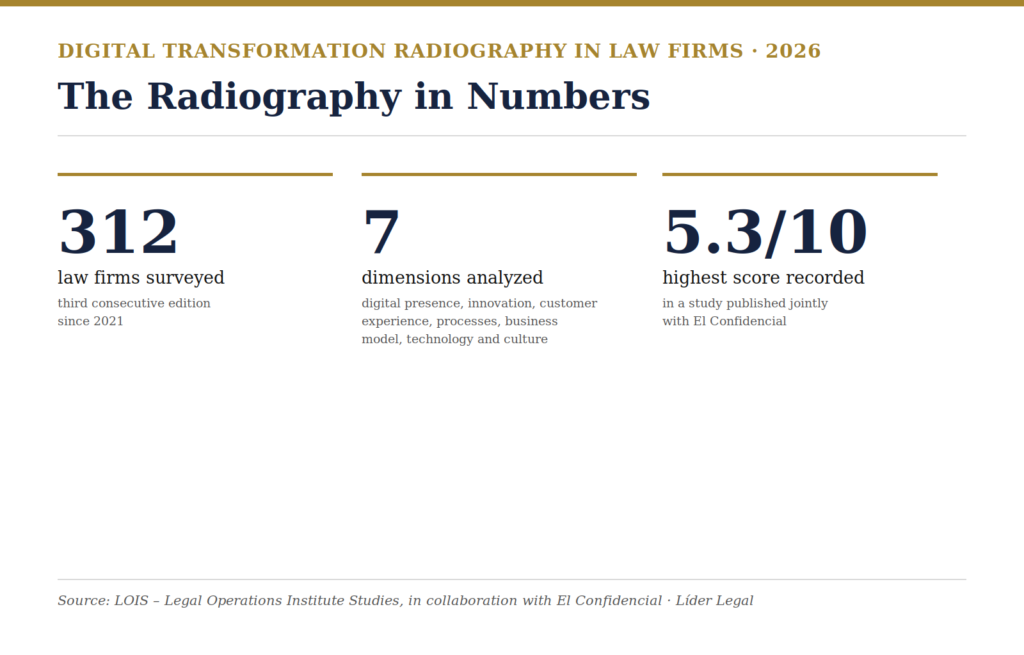
Eugenia Navarro is a founding partner of LOIS – Legal Operations Institute Studies, an organization that, together with El Confidencial, publishes the Digital Transformation in Law Firms report, the benchmark study that has measured the digital maturity of the Spanish legal profession since 2021. The third edition, based on 312 firms and seven dimensions—digital presence, innovation, client experience, processes, business model, technology, and culture—yields the highest score of the three editions: 5.3 out of 10. The report itself warns, however, that this score is not a goal, but rather the starting point for the most demanding phase: one that no longer consists of simply adopting tools, but of rethinking the business. Líder Legal spoke with Navarro about what the numbers still don’t capture, why the billable hours model remains intact despite the pressure from AI, and what all this means for a Latin American legal market that doesn’t move at the same pace as the Anglo-Saxon one.
Having the tool doesn’t mean anything has changed.
The result of this edition is a 5.3 out of 10, the best score of the three editions, although the report itself warns that this figure is not the end of the road but the beginning of the most demanding part. What worries them most about what the numbers still fail to capture?
What worries us most is the gap between declared adoption and actual integration. A firm can subscribe to an AI tool and continue operating exactly as before. The numbers measure the presence of technology, but they don’t capture whether that technology has changed anything: how decisions are made, how work is structured, how value for the client is defined. That leap, from tool to transformation, is the one that very few have made yet, and it’s what will determine who remains relevant in five years.
“That leap, from tool to transformation, is the one that very few have made yet, and it is what will determine who remains relevant in five years.”
A model that penalizes efficiency
The billable hours model has been the economic backbone of law firms for decades. But if AI allows us to resolve in minutes what previously took hours, this model has a structural problem: it penalizes efficiency. Are law firms ready to have this conversation with their clients, or does resistance to change still outweigh market pressure?
No. At least not across the board. Our data shows that the vast majority still bill by the case or by the hour. The conversation about alternative models is happening, but it takes place more in forums and conferences than in actual meetings with clients. The problem is that unless the client demands a change—and many still don’t—the incentive to make a move is weak. AI is accelerating the moment when that conversation will no longer be optional, but we haven’t reached that point yet in most firms.
Whoever can change the model is the one who loses the most if they do
Data shows that, despite the talk about new models, the vast majority of law firms still rely exclusively on fee-for-service arrangements. Where is the real bottleneck to change: in the partners’ culture, in clients who aren’t asking for anything different, or in the fact that alternative models haven’t yet proven to be more profitable?
All three factors exist, but if I had to choose one, I’d say it’s the partners’ culture. Corporate clients increasingly demand efficiency and predictability; they’re no longer as indifferent as they were ten years ago. And there are alternative models—quotas, fixed prices, value-based pricing—that have already proven effective in other markets. The crux of the matter is that those with the power to change the internal compensation model also have the most to lose if they do. This can’t be resolved with conviction alone; it requires that external pressure become impossible to ignore.
“Those who have the power to change the internal compensation model also have the most to lose if they change it.”
The uncomfortable mirror of AI
Artificial intelligence is acting as an accelerator, but also as an uncomfortable mirror: it reveals which firms have real processes and which operate based on hours and individual judgment. What type of firm is best taking advantage of this window of change, and which is at greatest risk of being left out of the relevant market in the next five years?
The best-positioned firms are those that already had documented processes before adopting AI: they know what they have, they can improve it, and they can explain it to the client. Also well-positioned are those that have been investing in technology for years as part of their value proposition, not as a response to a passing fad. At the opposite end of the spectrum, the highest-risk profile is the mid-sized firm that operates as usual, with a good reputation but without clear differentiation, and that relies on its current client base to sustain it for a long time.
Involve partners, don’t impose change on them
Transforming a law firm involves changing the way people work whose compensation, status, and power are tied to the current model. Partners who are billing well under the existing system have every incentive to resist change. How do you lead a transformation when those who have to drive it are precisely those who have the most to lose if it succeeds?
With complete honesty and, where possible, with redesigned incentives. You can’t ask a partner to destroy the model that made them successful without offering them something in return: visibility, new roles, a share in the benefits of efficiency. What does work is involving those partners in designing the change, not imposing it on them. When someone has helped build the new model, they have reasons to defend it. Transformations that fail are usually those that treat partners as obstacles. Those that succeed treat them as part of the asset that needs to be repurposed.
“Transformations that fail are usually those that treat partners as obstacles. Those that succeed treat them as part of the asset that needs to be repurposed.”

The ladder by which one learned no longer exists
For decades, junior lawyers learned by doing: drafting contracts, reviewing due diligence reports, and researching case law. If AI automates these tasks, the training mechanism that has sustained the sector’s talent pool also disappears. How will the senior lawyer of the future be trained if the ladder they historically climbed no longer exists?
This is one of the most serious problems in the sector. The traditional career ladder made sense: junior associates learned by doing real-world tasks, with minimal exposure. If AI performs those tasks, junior associates are left in limbo: they lack the repetitive work that provided training, and they don’t yet have the judgment to properly supervise the machine. The first years of a career will have to be reinvented: more explicit mentoring, more reasoned supervision, and more early client exposure. It’s not impossible, but it requires law firms to invest in training in a way they have historically avoided.
A global diagnosis, a fragmented rhythm
The debate on digital transformation and value models in the legal profession is largely constructed from the Anglo-Saxon market and, to a lesser extent, from Spain. But Líder Legal’s readership operates in Mexico, Colombia, Argentina, Brazil, and Chile. Is this same diagnosis applicable to the Ibero-American legal market, or are there structural factors—maturity of the corporate client, sector concentration, regulatory framework—that cause the change to follow a different logic in the region?
The diagnosis is applicable, but the timing and the levers are different. In Latin America, the sophisticated corporate client exists and exerts pressure in major urban centers and in companies with international headquarters. But the sector is much more fragmented, the regulatory framework varies enormously between countries, and the fundamental digitalization of the courts and administrative processes themselves remains a real barrier. Change is coming, but with greater heterogeneity. There will not be a uniform transformation of the sector: there will be pockets of high modernization alongside areas where the traditional model will survive longer than optimists anticipate.
“There will not be a uniform transformation of the sector: there will be pockets of highly modernized areas alongside areas where the traditional model will survive longer than optimists anticipate.”
2030: the end of the link between time and value
If we look back to this moment in 2030, what do you think will have been the most profound change experienced by the Ibero-American legal sector? And, at the other extreme, what, against all odds, will have remained virtually unchanged?
The most profound change will have been the severing of the automatic link between time and value. By 2030, no one will be able to justify a price solely based on hours invested; clients will already know that AI can do that in minutes. What will have endured, surprisingly, is the centrality of the relationship. Trust, sound judgment in ambiguous situations, the ability to read between the lines—these cannot be automated. The lawyer who thrives will not be the fastest with the tools, but the one who has understood that their value has always been in this relationship, and who can finally dedicate the time it deserves.