

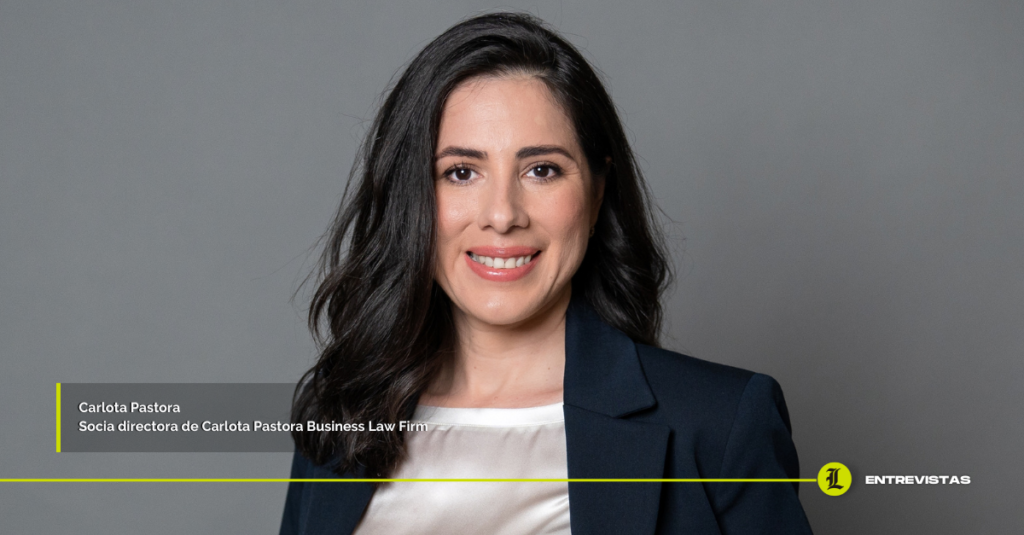
Carlota Pastora Business Law Firm was founded with the purpose of providing excellent legal and tax advice, guided by values of commitment, transparency, and approachability. Today we spoke with its managing partner, Carlota Pastora, who told us about the firm’s history and origins, and the factors that have been key to its consolidation in the field of international taxation and business law in Andorra.
“Since our inception, we have focused on serving the needs of clients with complex assets and business owners who require customized solutions, especially in the areas of international taxation and business law. Our unwavering dedication and collaboration with international experts have allowed us to establish ourselves in Andorra as leaders in our areas of expertise. Working with a proactive and preventative approach reflects our ability to adapt to evolving regulations and legal landscapes, enabling us to offer practical and strategically designed solutions for our clients.”

How does your mission of offering exclusive and personalized legal and tax advice to high-net-worth clients translate into daily practice?
Every client is unique, and that’s why we tailor our strategies and services to their specific needs. From the first contact, we invest time in thoroughly understanding each client’s financial structure and personal or business objectives. This approach allows us to design customized legal and tax solutions that provide peace of mind and achieve optimal results. Furthermore, we foster direct and ongoing communication, ensuring our clients are always informed and confident in the decisions they make.
What are the emerging trends in international tax law that you have identified and how are you preparing to address them for the benefit of your clients?
In the field of international tax law, and particularly as it affects Andorra, one of the most prominent trends today is the growing tax competition between jurisdictions. This phenomenon is driven by a global environment that demands a balance between attracting investment and complying with international standards. Tax competitiveness has intensified in a context marked by initiatives such as the OECD’s BEPS measures, designed to combat base erosion and profit shifting, the implementation of the global minimum tax under Pillar 2, and the increasing emphasis on tax transparency and international cooperation.
Our commitment is clear: to protect our clients’ interests while helping them capitalize on the opportunities that arise in this increasingly competitive global environment. Agility, detailed analysis, and strategic vision are the cornerstones of our ability to remain leaders in international tax and business law, thereby contributing to the success of those who place their trust in us.
Could you explain your comprehensive approach to estate and succession planning, and how you integrate relocation services to maximize your clients’ operational efficiency?
Our comprehensive approach to estate and succession planning focuses on analyzing all the legal and tax implications that may impact the management and transfer of assets. We design customized strategies that not only ensure efficiency in the present but are also geared towards long-term sustainability, benefiting future generations.
Relocating to Andorra, for example, is one of the strategies we recommend when seeking to maximize the performance of our clients’ assets. Andorra is known not only for offering an attractive tax environment but also for its friendly and accessible tax administration, which facilitates compliance with tax obligations within a framework of trust and clarity.
We handle all aspects necessary for a smooth transition, from immigration procedures to the successful settlement of our clients and their families. In this way, we work to ensure the entire process is efficient and hassle-free for our clients.
In an increasingly digital world, what measures can be taken to ensure regulatory compliance and security in the digital corporate environment?
Digitalization offers significant advantages, but also challenges in terms of regulatory compliance and cybersecurity. At our firm, we advise clients on implementing compliance policies tailored to the digital environment. This includes creating internal protocols, developing cybersecurity threat response plans, and monitoring international regulations. We also collaborate with technology specialists to integrate tools that strengthen data security and optimize operational processes.
Could you share a specific example or success story where the application of innovative solutions has made a significant difference in optimizing and preserving a client’s assets?
Andorra is consolidating its position as a destination for clients with increasingly diverse interests across multiple jurisdictions, requiring the use of structures that combine multi-jurisdictional legal and tax advice. This scenario has enabled us to develop strategies that integrate innovation and experience to offer effective solutions based on detailed and personalized analysis.
A recent case we advised on involved a client with interests and assets in Europe and Latin America, whose operations required a restructuring of assets to manage tax and legal risks arising from the various applicable regulations. Through collaborating law firms in the different jurisdictions and a clear action plan, we were able to design a more efficient tax structure to preserve their assets and ensure regulatory compliance in all the jurisdictions involved.
This type of professional engagement allows us to actively collaborate in an environment where global mobility is increasingly common, offering practical solutions tailored to each client. We focus on building strategies that generate real and sustainable results, always committed to prioritizing our clients’ interests.

How do you envision the evolution of the legal environment in Andorra, and what future opportunities do you foresee the country offering for businesses and individuals?
Andorra is establishing itself as an attractive environment for investors and entrepreneurs worldwide, thanks to its economic stability, competitive tax framework, and increasing international openness. The move towards higher transparency standards is also strengthening the country’s reputation. Looking ahead, we anticipate an increase in the attraction of technology companies and foreign investment.
Our goal is to continue being strategic partners for those who wish to settle here, helping them to take advantage of the benefits the country offers.
In this Women’s History Month, what challenges have you encountered throughout your career and how have you seen the legal profession evolve in terms of equal opportunities?
It is undeniable that the legal profession has traditionally been dominated by men, which has led to obstacles associated with certain stereotypes. However, far from seeing them as a barrier, I have always viewed them as opportunities and challenges to give my best and move forward, especially when there is a genuine passion for the law.
I believe the key lies in preparation, commitment, and continuous improvement, which translates into excellence. These are the values that truly determine the impact and career path of any legal professional, regardless of gender. I firmly believe that meritocracy is the path to equitable representation in the sector, and that achieving this goal requires focusing on work, talent, and results.
How do you assess the evolution of the limited presence of women in management or partnership positions in the global legal community?
The presence of women in leadership or partnership positions within the legal profession varies considerably depending on the region or continent, and is deeply influenced by each country’s culture. This evolution cannot be separated from the relationship between women’s roles and motherhood, an aspect that, whether we admit it or not, continues to create differences. However, I believe the key lies not in viewing it as an impediment, but in fostering a realistic and sustainable balance between both facets of life.
From my personal experience as a mother of three, I’ve had times when I decided to slow down professionally, especially after the birth of my two youngest children. It was a conscious decision, and in my case, it was what I wanted to experience at that time. But it shouldn’t be a forced dilemma between career and motherhood. What should be promoted is an environment where motherhood is supported and compatible with professional development. It’s essential to have policies and structures that allow women to fulfill both roles without it hindering their career plans.
The goal should be to build a work environment that recognizes and values different career paths, fostering professional development that allows each woman to continue growing without having to give up or choose one stage of life over another.