

Setting the course for reputation has become one of the most crucial decisions for Brazilian law firms. It’s now understood that the legal sector is experiencing the most competitive period in its history and that, consequently, communication has ceased to be merely a means of dissemination, becoming instead a strategic tool capable of differentiating a firm from its competitors and its own clients.
There is little doubt that communication is a must for law firms operating in the business sector. Publicizing the firm’s strengths, its differentiating values, and the expertise of its professionals remains a guarantee of generating business. But among the Brazilian firms consulted by Líder Legal, there is also no doubt about something more specific: that visibility alone is not enough. It can be bought, accelerated, or manufactured through sheer volume; reputation, on the other hand, is only earned through sustained consistency over time.
Over the past few years, the communications departments of major Brazilian law firms have shifted from an operational and reactive function to a strategic intelligence role, integrated with business development and supported by data. The professionalization of the sector—accelerated by OAB Provimento 205/2021 and a content-saturated market—has led firms to abandon indiscriminate volume in favor of a more sophisticated, measurable, and client-centric positioning.
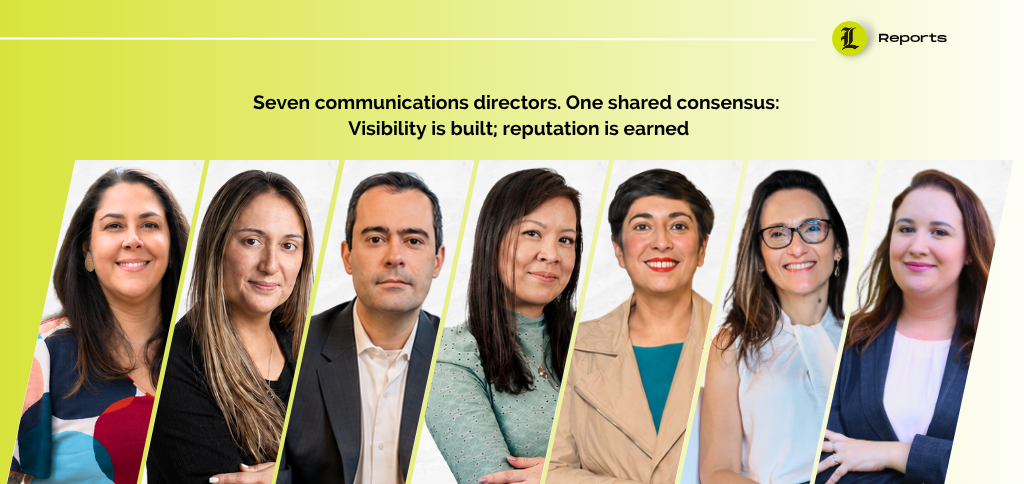
Against this backdrop, Tatiana H. Lau Cintra, Marketing, Communications and BD Manager at Azevedo Sette; Adriana Araújo, Communications and Marketing Manager at BVA; Simone Lanza, Marketing and Business Development Director at FAS Advogados; Ione Moraes, Knowledge Management and Communications Manager at Madrona Advogados; Suzan Mitsuuchi, Head of Marketing and New Business at Siqueira Castro; Sergio Sabino, Marketing, Communications and Business Development Director at TozziniFreire; and Mariana Larsson, Senior Business Development, Marketing and Communications Manager at Trench Rossi Watanabe, discussed at length, block by block, the decisions that are redefining legal reputation in 2026.

The decision with a measurable result that marked the last twelve months
“Nobody recognizes what they don’t know,” Adriana Araújo, BVA
Tatiana H. Lau Cintra, Marketing, Communications, and Business Development Manager at Azevedo Sette, explained that “the most significant decision was to consolidate an integrated communication strategy encompassing institutional positioning, legal knowledge production, and stakeholder engagement. Instead of prioritizing the volume of publications, we shifted our focus to content capable of reinforcing the brand’s strategic attributes and showcasing our work in key sectors of the economy.” She added that “as a result, we saw an increase in qualified press coverage, greater engagement on digital platforms, and more opportunities for networking generated from technical content. More important than the reach indicators, we observed an increasingly consistent market perception of our expertise and ability to anticipate issues relevant to our clients.”
For her part, Adriana Araújo, BVA’s Communications and Marketing Manager, noted that “the most important decision for the Communications and Marketing department was to move from an operational role to a strategic one within the firm… We began serving clients with globally relevant brands, expanded the production of institutional content that delves into legal issues without becoming overly technical, and increased the visibility of the firm’s significant transactions…”. She further explained that “ultimately, no one recognizes what they don’t know.”
To the above, Simone Lanza, Marketing and Business Development Director at FAS Advogados, added that “one of the premises of FAS Advogados’ communication has always been to share relevant content, capable of supporting our readers, clients, and followers in making decisions on issues that impact their businesses… In addition to positive feedback, our personalized communications register an average open rate of 40.5% (reaching 55% in some cases), well above the market average, across the various channels through which we send this content…”. She added: “Between January and December 2025, 665 articles were published in highly relevant media outlets in the Brazilian market (online, print, and television), reaching an audience of over 784 million people and an estimated value of R$ 9.9 million, had that same space been purchased through paid media (not including radio and television placements in that calculation).”
Similarly, Ione Moraes, Knowledge Management and Communication Manager at Madrona Advogados, highlighted that “the main decision was to reposition Communication as an area for building reputation and narrative. In practice, this meant prioritizing higher-quality guidelines, strengthening our full-service positioning, expanding our presence in relevant media, and better organizing the work of spokespeople and technical teams…” She detailed that “during the year, we increased the number of Tier 1 media outlets we reached by 40.42%, resulting in more than 105 press mentions. We also recorded a 59.4% increase in website views and a 164.3% increase in active users, reflecting the strengthening of our digital presence and greater engagement with our content.”

Suzan Mitsuuchi, Head of Marketing and New Business at Siqueira Castro, went further, stating that “the most significant decision of the last 12 months was to transform communication and marketing into a business intelligence platform, integrating marketing, communication, and business development into a single strategic agenda, directly connected to the firm’s growth objectives… Internal demand for market intelligence analysis and reports increased a hundredfold, demonstrating a significant shift in how data and information came to support strategic decisions and business development initiatives…”. Regarding this, she specified that “we managed to solidify the perception that marketing, communication, and business development are not support areas, but rather strategic levers for the firm’s growth.”
From TozziniFreire, Sergio Sabino, Director of Marketing, Communication, and Business Development, broadened the perspective, explaining that “it’s very difficult to plan the communication and brand strategy of a giant like TozziniFreire in just 12 months… From a reputational standpoint, we significantly increased our institutional visibility, gaining space in leading business publications and strengthening the perception of TozziniFreire’s leadership at a crucial moment in its history…”. He also highlighted that “proof of this is that today we are the 3rd largest firm in the country in terms of LinkedIn followers, and 3 years ago we were in 5th place, about to fall to 6th… In other words, more than just communicating changes, we managed to transform a moment of institutional evolution into an asset for reputation, relationships, and business development.”
Closing the session, Mariana Larsson, Senior Manager of Business Development, Marketing, and Communication at Trench Rossi Watanabe, explained that “one of the most important decisions of the last 12 months was to treat the opening of Trench Rossi Watanabe’s new space in Faria Lima not as an isolated communication event, but as an integrated platform for business, reputation, and relationship building… In collaboration with the firm’s leadership, we coordinated the various aspects of the initiative, from the internal communication strategy, press relations, and our own channels to institutional materials, client engagement activities, and in-person meetings in the new space…”. She concluded that “the results were evident in the quality and consistency of the exposure achieved, in the presence of strategic audiences at the events, and, most importantly, in the activation of the space as a venue for networking, connecting, and generating new business opportunities.”
What they focused resources on in 2026 and what they deliberately stopped doing
“We moved towards adopting more precise communication, supported by a shared institutional brand,” Ione Moraes, Madrona Advogados
Tatiana H. Lau Cintra, Marketing, Communications, and Database Manager at Azevedo Sette, explained that “in 2026, we prioritized initiatives focused on building a long-term reputation, market intelligence, and strengthening the institutional brand. This meant reducing efforts on one-off communication actions or participation in initiatives that were not aligned with the firm’s objectives.” She added, “We opted to invest in quality, consistency, and strategic direction, even if that resulted in a lower volume of publications.”
For her part, Adriana Araújo, BVA’s Communications and Marketing Manager, noted that “throughout this year, we made a very conscious choice to focus our efforts on building a long-term reputation, rather than investing in one-off actions or marketing based solely on content volume. Today, there is an enormous amount of information available online, and we perceive that the public increasingly values content that provides depth, context, and a truly useful perspective…” She also pointed out that “at the end of the day, we prefer to produce less, but produce better.”
To the above, Simone Lanza, Marketing and Business Development Director at FAS Advogados, added that “in 2026, the Communications department at FAS Advogados decided to concentrate its resources on the strategic use of artificial intelligence and automation tools, with the goal of increasing team productivity and expanding its capacity to develop more relevant initiatives for clients and for the firm’s positioning… To make this choice viable, we deliberately stopped investing so many resources in isolated actions, generic content, and excessively manual processes that were time-consuming but generated little effective impact…”. She added that “artificial intelligence helps us gain efficiency, but strategic analysis, information curation, message definition, and final validation continue to be driven by the team.”
Similarly, Ione Moraes, Knowledge Management and Communication Manager at Madrona Advogados, highlighted that “in 2026, we focused our resources on building a more sophisticated and consistent positioning: Ambassador Program, publications on new channels, sponsored content, and strengthening the full-service narrative… What was deliberately relegated to the background was reactive and scattered action: communicating on demand, without a method, without a structured narrative plan…”. She also explained that “we moved to adopting more precise communication, supported by a shared institutional brand.”
Suzan Mitsuuchi, Head of Marketing and New Business at Siqueira Castro, went further, stating that “in 2026, we decided to concentrate resources on initiatives capable of strengthening business development in a structured and sustainable way… To that end, we directed our investments to three strategic pillars: 1. Customer centricity and market intelligence. We are strengthening our ability to understand the challenges, priorities, and opportunities of our clients and the sectors in which they operate…”. He added: “2. Technology and innovation at the service of growth. We are also investing in the implementation of CRM tools, artificial intelligence, and information management to make our actions more strategic and precise… 3. Collaborative culture for business generation. Another important focus is strengthening a Business Development culture based on collaboration.”
From TozziniFreire, Sergio Sabino, Director of Marketing, Communication, and Business Development, broadened the perspective, explaining that “with our growth, an additional effort naturally arose in protecting major clients, as well as in harmonizing our employer branding and internal communication elements… We created a recurring agenda of strategic meetings for sector-specific discussions on business opportunities and how we can leverage synergy between teams to increase our market share with strategic clients.” He elaborated that “this accelerates business knowledge and, at the same time, solidifies our collaborative culture within the teams, something very strong at TozziniFreire. This gave us the discipline to prioritize connections and avoided wasting time on meetings with less potential for generating business.”
Closing the session, Mariana Larsson, Senior Manager of Business Development, Marketing, and Communications at Trench Rossi Watanabe, explained that “in 2026, we are concentrating resources on the areas with the greatest potential to support the firm’s growth, positioning, and client relationships… We deliberately reduced the space for isolated, reactive, or volume-driven actions.” She further clarified that “not every advertisement, event, sponsorship, or piece of content deserves the same investment; we prioritize what aligns with relevant practices and sectors, strategic clients, and the firm’s long-term ambitions.”
The obstacle to turning business strategy into a narrative shared by partners

“The biggest obstacle to transforming business strategy into a narrative truly shared by partners lies in the need to reconcile different perspectives, priorities, and action dynamics,” Suzan Mitsuuchi, Siqueira Castro
Tatiana H. Lau Cintra, from Azevedo Sette, explained that “the main challenge is not a lack of alignment, but rather the need to translate a complex and multidisciplinary strategy into a simple and consistent narrative. In law firms, each partner has their own background, specialization, and network of relationships.” She also emphasized that “the role of communication is to connect these individual perspectives with a common institutional vision, without compromising the authenticity of each practice.”
For her part, Adriana Araújo of BVA noted that “today, one of our main challenges is ensuring that this narrative is consistent throughout the firm… Our advantage is that we have extremely accessible and engaged partners.” She concluded that “they are the ones who build the firm’s brand every day, whether in their relationships with clients, the team, or the market.”
To the above, Simone Lanza, from FAS Advogados, added that “the main challenge is to transform a broad business strategy into a simple, concrete narrative connected to the reality of each partner, considering that the different areas of operation have different markets, audiences and priorities… When the partner understands how that narrative relates to their clients, their opportunities and their objectives, they cease to be just a spokesperson and become an active agent of the strategy.”
Along the same lines, Ione Moraes of Madrona Advogados emphasized that “the biggest obstacle is getting partners to understand two things simultaneously: that everything communicates and that they are key players in that strategy, but that this leadership needs to be reinforced by a strong institutional narrative… The central point is to build a core narrative, validated by leadership and adapted to different contexts, which partners then incorporate when communicating with clients, the press, the market, and internal teams.” She elaborated: “When everyone starts from the same foundation, the message gains consistency and strength, regardless of who is speaking or the channel.”
Suzan Mitsuuchi, from Siqueira Castro, went further, stating that “the biggest obstacle to transforming business strategy into a narrative truly shared by partners lies in the need to reconcile different perspectives, priorities, and operating dynamics… Furthermore, there is a characteristic historically present in many law firms: a culture of strong closeness and a sense of ownership in the relationship with clients…”. She also pointed out that “the challenge, therefore, is not to eliminate this characteristic, but to evolve it into a model in which the client is perceived as an institutional asset, and not just as an individual relationship.”
From TozziniFreire, Sergio Sabino broadened the perspective, explaining that “a large firm needs to maintain a constant connection with its partners and provide them with updated and standardized information so that the strength of the brand is perceived… I understand that in full-service firms, each practice tends to see the business through its own lens.” He added, “And that’s not a problem; it’s our key differentiator. Strong practice areas that know the client and their specific needs, well-integrated and with a consistent standard of service, communication, and delivery.”
Closing the session, Mariana Larsson of Trench Rossi Watanabe explained that “the biggest challenge is ensuring that a broad strategy is understood and consistently applied by partners working in different areas, sectors, and markets… BDMC contributes to this alignment by connecting the institutional strategy with the realities of practice groups and with client needs…”. She further explained that “adherence is greater when leaders participate in this process and see how the narrative translates into concrete decisions regarding positioning, client relationships, content, and business development.”
Visibility is manufactured, reputation is earned: the central axis of the debate
“Reputation is not what an organization discloses about itself, but what customers, professionals and the market conclude from its decisions over time,” Sergio Sabino, TozziniFreire
Tatiana H. Lau Cintra, from Azevedo Sette, explained that “visibility can be bought or accelerated. Reputation must be earned over time.” She added, “A well-built reputation results from a combination of technical quality, consistent positioning, market engagement, and effective client delivery… The real differentiator lies in the ability to be remembered for the right reasons, especially during crucial moments for clients.” She elaborated, “That’s why we are so pleased to continue being among the firms most remembered, year after year, by executives of the 100 largest companies by revenue, in the Who’s Represents the Biggest Companies in Latin America survey, conducted by the Latin American Corporate Counsel Association (LACCA).”
For her part, Adriana Araújo of BVA noted that “visibility can be achieved through investment, frequency, or volume of publications… It is built on the consistency between what the firm communicates and what it actually delivers to the market…”. Regarding this, she specified that “the difference lies in the perspective each firm offers. We always strive to contribute a fresh angle to the discussion and base our analysis on the practical experience we have with our clients…”. She also emphasized that “in this way, we don’t need to constantly explain who we are; we let our deliverables, our clients, our operations, and our awards tell that story.”
To the above, Simone Lanza of FAS Advogados added that “the difference lies in the consistency between what the firm communicates, what it actually delivers, and how it is perceived by clients, the market, and its own professionals… It is not enough to address the same topics that are currently trending; it is necessary to present a unique perspective, translate complex issues into concrete business impacts, and demonstrate genuine knowledge of the challenges clients face…”. She concluded that “in short, visibility is being seen. Reputation is being remembered, recognized, and considered when an important decision needs to be made.”
Similarly, Ione Moraes, from Madrona Advogados, emphasized that “visibility generates recognition; reputation generates trust. The difference lies in the consistency of the message, the quality of the analysis, and the ability to deliver, over time, the experience that the brand promises.”
Suzan Mitsuuchi, from Siqueira Castro, went further, stating that “a built reputation is one that generates trust even before hiring. It stems from the consistency between words and actions, from clarity of positioning, from the quality of relationships, and from the ability to generate perceived value over time…”. She elaborated: “I like to say that visible reputation is presence; built reputation is influence… In the end, true reputation is not what the organization says about itself, but what customers, the market, and stakeholders believe about it based on their experiences.”

From TozziniFreire, Sergio Sabino broadened the perspective, explaining that “the key difference lies in the consistency between discourse and practice… Reputation is not what an organization says about itself, but rather what clients, professionals, and the market conclude from its decisions over time.” He also pointed out that “law firms build reputation when they manage to translate their values into concrete actions: in how they develop and compensate their talent, how they interact with clients, how they invest in technology, how they make strategic decisions, and how they navigate times of change.”
Closing the session, Mariana Larsson of Trench Rossi Watanabe explained that “visibility is exposure; reputation is a consistent association between the brand, specific competencies, and a concrete experience… When clients, the market, talent, and opinion leaders begin to spontaneously recognize the firm for certain capabilities, a reputation has been built, not just a presence.” She added that “for this reason, frequency and reach are useful data, but insufficient. What matters is the quality of the audience, adherence to the firm’s priorities, the trust generated, and the ability to transform authority into relationships and opportunities over time.”
What makes a law firm reliable in the eyes of the specialized press
“The most common mistake is treating the press as a channel for exposure, and not as a relationship of trust,” Mariana Larsson, Trench Rossi Watanabe
Tatiana H. Lau Cintra, from Azevedo Sette, explained that “press trust is built through availability, accuracy, and the ability to clearly contextualize complex issues… The most common mistake is treating the relationship with the press solely as an opportunity for self-promotion.” She further explained that “the best relationship is one in which the firm adds value to the advertising campaign even before seeking visibility for itself.”
For her part, Adriana Araújo of BVA noted that “the specialized press seeks much more than a correct technical opinion… We believe that a good lawyer is not only one who masters a subject, but also one who can explain it clearly and practically to those who need to make decisions…”. She added: “We strive to build a long-term relationship based on trust… The important thing is that journalists know they can count on us when they need a technical source, available and committed to contributing to the debate.”
To the above, Simone Lanza of FAS Advogados added that “a law firm becomes a reliable source when it manages to combine three elements: technical knowledge, the ability to translate complex issues, and availability to address the needs of the press… Trust is also built on consistency.” She explained that “journalists need to know that they will find a responsible, objective analysis based on sound knowledge in the firm, even when the best contribution is to acknowledge that there is still insufficient evidence for a definitive conclusion… The most common mistake in this relationship is treating the press solely as a channel for institutional exposure…” Regarding this, she clarified that “exposure should be a consequence of the relevance of the analysis, not its starting point.”
Along the same lines, Ione Moraes of Madrona Advogados emphasized that “a news outlet becomes a reliable source when it offers relevant analysis quickly, clearly, and readily available to help journalists understand complex issues… That’s what sustains the relationship in the long run, not the number of appearances.” She also stressed that “the most common mistake is viewing the press solely as a channel for institutional dissemination.”
Suzan Mitsuuchi, from Siqueira Castro, went further, stating that “a law firm becomes a reliable source for the press when it stops seeking mere exposure and starts generating value through knowledge. Journalists need sources that contribute to understanding the facts, provide context, and help translate complex issues for different audiences…” She concluded that “in the legal market, trust is built over time… When the focus is on contributing to the debate, the quality of the information, visibility, and recognition naturally follow.”
From TozziniFreire, Sergio Sabino explained that “the relationship with any media outlet needs to be respectful and receptive… What must be avoided (not only here, but in any working relationship) is that the journalist-source relationship begins to be understood as a friendship at all times…”. He elaborated: “As sources, we have a responsibility to the newsroom, and the journalist has a responsibility to their media outlet. And we both have a responsibility to the truth.”
Closing the session, Mariana Larsson, from Trench Rossi Watanabe, explained that “a reliable source combines technical expertise, clarity, agility, an understanding of the editorial context, and institutional responsibility… The most common mistake is treating the press as a platform for exposure, and not as a relationship of trust…”. She also pointed out that “the Marketing/Communications department also has the role of knowing when to say ‘no,’ preserving the quality of its interventions, and connecting the press agenda with the issues in which the firm truly has excellence, experience, and a relevant perspective.”
Provimento 205/2021: from limit to stimulus for sophistication
“Contemporary legal communication does not depend on aggressive advertising. It depends on the ability to produce relevant content, generate trust, and build authority ethically,” Tatiana H. Lau Cintra, Azevedo Sette
Tatiana H. Lau Cintra, from Azevedo Sette, explained that “I believe it requires greater strategic sophistication. Contemporary legal communication does not depend on aggressive advertising.” She added that “it depends on the ability to produce relevant content, generate trust, and build authority ethically… For firms with a clear strategy, the challenge is not finding space to communicate, but defining how to communicate consistently and in alignment with the profession’s values.”
For her part, Adriana Araújo of BVA noted that “I believe the Provimento brought more clarity than restrictions. It consolidated important understandings about communication in the legal profession and aligned with a reality that already existed…”. She further explained that “in practice, we never saw it as a barrier. The Provimento does not prevent a firm from building a strong brand, producing relevant content, or developing relationships with its audiences.” And she added: “It reinforces that all of this must be done responsibly and consistently.”
To the above, Simone Lanza of FAS Advogados added that “Provimento 205/2021 directly influences our communication and positioning decisions because it establishes the limits within which legal marketing must develop… We cannot structure legal communication based on promises of results, direct offers of services, incentives to hire, or inappropriate exposure of cases and clients…”. She explained that “at the same time, we understand that the Provimento demands greater strategic sophistication… Therefore, the Provimento is neither ignored nor treated merely as a barrier: it serves as a permanent parameter to ensure that our communication is responsible and, at the same time, strategically differentiated.”
Along the same lines, Ione Moraes, from Madrona Advogados, highlighted that “today, Provimento 205/2021 has much more influence on the form than on the ambition of communication… That is why strategic sophistication is required: differentiation does not come from advertising more, but from producing relevant knowledge, developing reliable spokespeople and building a consistent narrative over time.”
Suzan Mitsuuchi, from Siqueira Castro, went further, stating, “I often joke that I’m still from the Provimento 94 era (laughs)… Over the last two decades, I’ve witnessed a profound transformation in the sector…” She elaborated, “In my view, Provimento 205 is no longer a limitation but rather demands greater strategic sophistication. Today, differentiation doesn’t come from advertising itself, but from the ability to build authority, produce relevant content, offer a good customer experience, and establish genuine relationships with different audiences.” She also emphasized that “if before the discussion was about what couldn’t be done, today the conversation revolves much more around how to do it well.”
Sergio Sabino, from TozziniFreire, broadened the perspective, explaining that “I would say the Provimento functions as a guide to best practices; I don’t see it at all as a barrier in our day-to-day work… At TozziniFreire, we invest heavily in current and relevant formats and content, in the responsible use of artificial intelligence, and in appropriate language, always seeking to make complex legal issues more accessible and interesting, with a focus on contributing to society and the market.” He concluded that “the focus can never be direct promotion, but rather generating value for clients through quality information.”
Closing the session, Mariana Larsson of Trench Rossi Watanabe explained that “Provimento 205/2021 is part of our governance and influences decisions about content, channels, language, segmentation, and ways of engaging with customers… In my view, this demands more strategic sophistication than simply restricting our actions.” She elaborated: “We cannot replicate the promotional logic of consumer markets; we need to build authority through knowledge, consistency, relevance, and relationships of trust… There are concrete limits, of course, but they do not prevent the existence of strong legal brands.” She also pointed out that “on the contrary: they differentiate organizations capable of combining creativity, ethical discipline, market intelligence, and a long-term vision.”
Identity, expansion and international network: three parallel conversations
A different section of the questionnaire was tailored to the specific circumstances of each firm, and therefore the responses are grouped into three separate conversations. Three firms—Azevedo Sette, BVA, and TozziniFreire—discussed how to build a corporate brand that coexists with the media prominence of their star partners. Two others—Madrona Advogados and Siqueira Castro—explained how they manage their narrative during a period of rapid expansion. And the remaining two—FAS Advogados and Trench Rossi Watanabe—detailed how they coordinate the narrative of their international network with the specific characteristics of the Brazilian market.
The firm’s brand versus the prominence of star partners
“The partners are the main ambassadors of our brand and their individual recognition strengthens the firm,” Adriana Araújo, BVA
Tatiana H. Lau Cintra, from Azevedo Sette, explained that “we don’t see this relationship as competition. The partners are one of the firm’s main reputational assets.” She added that “the challenge lies in transforming individual recognition into institutional value… Our goal is to show that the individual success of the partners is part of a larger story, built by a multidisciplinary, integrated, and client-oriented team.”
For her part, Adriana Araújo of BVA noted that “I don’t see this relationship as a dispute between the firm’s brand and the partners’ brands… The partners are the main ambassadors of our brand, and their individual recognition strengthens the firm…”. She further explained that “when a partner gains prominence for a significant achievement, we demonstrate that this recognition is not an isolated event, but rather an expression of our culture, our way of working, and the vision that guides the firm.”
To the above, Sergio Sabino of TozziniFreire added that “in professional services, symbiosis is key. Partners are partners because of the brand.” He further explained that “the brand is the brand because of the partners… Both the firm and the partner tend to lose when they try to disrupt that balance too much…”. He elaborated that “when a client seeks a specific partner, they are also buying into the culture, the structure, the execution capabilities, and the reputation built by the entire firm over decades.”
Managing the rapidly expanding narrative

“More important than announcing a change is communicating its strategic rationale and the value it generates for customers and for brand positioning,” Ione Moraes, Madrona Advogados
Similarly, Ione Moraes, from Madrona, emphasized that “we treat these types of moves as strategic positioning moves, and not just as institutional announcements… More important than announcing a change is communicating its strategic rationale and the value it generates for customers and for the brand’s positioning.”
Suzan Mitsuuchi, from Siqueira Castro, went further, stating that “managing the narrative in a firm the size of Siqueira Castro requires a constant balance between unity and regionality… To achieve this, we rely on three main mechanisms: 1. Structured Governance. The integrated work of the management, executive, and thematic committees ensures strategic alignment, information sharing, and consistent decision-making throughout the organization. 2. Standardization of the Customer Experience. While each office is sensitive to the characteristics of its region, we strive to ensure that the customer experience reflects the same standards of excellence, personalized attention, and quality in every location. 3. Integrated Communication and Shared Culture. We are strengthening our integration channels, including the new intranet and plans structured internal communication and continuous alignment processes with partners and leadership… We believe that expansion, the opening of new locations, or the incorporation of new skills only strengthen the brand when they occur within a shared culture.”
International network and local market: who has the final say
“The final decision rests with FAS Advogados, precisely because of its status as an independent firm and its direct responsibility to clients, the market and the OAB,” Simone Lanza, FAS Advogados
From FAS Advogados, Simone Lanza broadened the perspective by explaining that “FAS Advogados is an independent firm and conducts its business in full compliance with the regulations of the Brazilian Bar Association (OAB)… Ultimately, in matters related to practice and communication in Brazil, the final decision rests with FAS Advogados, precisely because of its status as an independent firm and its direct responsibility to clients, the market, and the OAB.”
Closing the session, Mariana Larsson of Trench Rossi Watanabe explained that “Trench Rossi Watanabe maintains a strategic partnership with Baker McKenzie, which allows us to combine in-depth knowledge of the Brazilian market with an international perspective. For the BDMC practice, this means working daily between two dimensions: leveraging the expertise and best practices of one of the world’s largest law firms while simultaneously maintaining an independent understanding of Brazil’s priorities, sensitivities, and dynamics.” She also emphasized that “as independent organizations, each firm defines its own institutional and communication strategy. Therefore, there is no dispute over who has the final say.” She concluded that “there is governance, dialogue, and coordination on matters of common interest, with respect for the autonomy of each practice.”
Where AI is already working, and what decision would never be delegated to it
“AI is an ally, not a substitute for human sensitivity, especially in a sector where trust is the core asset”, Suzan Mitsuuchi, Siqueira Castro
Tatiana H. Lau Cintra, from Azevedo Sette, explained that “artificial intelligence already plays a significant role in research, market monitoring, information organization, preliminary data analysis, and content production support. However, as a department, we do not delegate decisions related to institutional positioning, reputation management, or communication in sensitive situations to AI…” She elaborated: “AI is an extremely powerful tool. Strategy remains the responsibility of people.”
For her part, Adriana Araújo of BVA noted that “today, artificial intelligence is part of our daily routine. We use it extensively for research, information organization, drafting, translations, revisions, and also for identifying trends.” She also pointed out that “the tool has brought enormous gains in agility and productivity… Communication involves repertoire, creativity, sensitivity, and context.” She added that “there is a ‘spice’ that only a human being can add, and that is precisely what makes content go beyond mere accuracy to become truly creative and generate connection… I would never delegate decisions about positioning, reputation, or relationship building to the tool, for example.”
To the above, Simone Lanza of FAS Advogados added that “we are currently evaluating different artificial intelligence solutions for projects in the Communications area and have already incorporated these tools into some stages of our work, especially in market research, text review and translation, video scriptwriting, information organization, and initial presentation development… The decision I would never delegate to artificial intelligence is the one that requires critical judgment, sensitivity, and responsibility regarding the impact of communication…”. She also explained that “at the end of the day, we are people serving people.”
Along the same lines, Ione Moraes, from Madrona Advogados, highlighted that “AI already replaces part of the operational work of research, information organization, drafting, summaries, transcriptions and adapting content to different formats, always with human review throughout the process… What I would never delegate entirely to AI is the definition of positioning, crisis management and decisions that impact reputation.”
For her part, Suzan Mitsuuchi of Siqueira Castro went further, stating that “AI is already replacing tasks such as market data analysis, competitor monitoring, content optimization, and database segmentation… But I would never delegate decisions regarding institutional positioning, brand narrative, or customer relations.” She added, “AI is an ally, not a substitute for human sensitivity, especially in a sector where trust is the central asset.”
From TozziniFreire, Sergio Sabino explained that “artificial intelligence is an excellent work partner, although complementary and not a 100% replacement in any activity, but it already helps us in various operational activities, contributing to greater productivity… At TozziniFreire we have TF AILA, an AI platform developed by the firm and integrated into our work environment, created internally by ThinkFuture, the firm’s innovation program…”.
He explained that “the decision on any communication strategy can never be delegated to her, especially considering the particularity of the brand and positioning… Knowledge of the business, sensitivity, experience and context are elements that remain, and will probably continue to be, irreplaceable.”
Closing the session, Mariana Larsson of Trench Rossi Watanabe explained that she “would be cautious with the word ‘replace.’ Artificial intelligence already absorbs operational stages of research, synthesis, information organization, project structuring, initial data analysis, and content development…” Regarding this, she clarified that “as a leader, my focus is not only on adopting tools, but also on redesigning processes, defining usage criteria, and developing the team to work more analytically and strategically… I wouldn’t delegate decisions regarding institutional positioning, stakeholder prioritization, or reputational risk assessment…” She also emphasized that “AI should augment professional judgment, not replace it.”
Measuring what matters: from popularity to real influence
“I don’t believe there are any misleading or unnecessary metrics. They all matter, as long as they are well organized,” Sergio Sabino, TozziniFreire
Tatiana H. Lau Cintra, from Azevedo Sette, explained that “we seek to correlate communication initiatives with the generation of relationship opportunities, the strengthening of positioning in strategic sectors, and brand perception among priority audiences. Indicators such as views, reach, or “likes” are important, but insufficient when analyzed in isolation.” She concluded that “without a broader vision, we run the risk of measuring popularity instead of influence, exposure instead of reputation, and activity instead of results.”
For her part, Adriana Araújo of BVA noted that “there isn’t a single indicator capable of measuring the impact of communication on the business, but today BVA is a data-driven environment… The marketing department conducts its work in the same way, and we are always attentive, for example, to the evolution of our presence in legal rankings, the quality of the networking opportunities generated by events—which were significant this semester—and the press coverage when we announce important transactions.” She added: “More than just measuring reach, the team constantly seeks to understand where we are strengthening our presence and how we are making business opportunities viable for the firm.”
Simone Lanza of FAS Advogados added that “today, the main indicator we use is return on investment (ROI)… What really matters is understanding whether that action generated value for the firm.” She also pointed out that “content can have thousands of views and not produce any relevant impact on the business… In the end, communication shouldn’t be measured solely by how many views it gets, but by the value it delivers to the business.”
Along the same lines, Ione Moraes of Madrona Advogados emphasized that “more than the volume of publications, we seek to measure the quality and relevance of the exposure… Without this perspective, we would run the risk of only measuring activity: the number of publications and impressions, notes, or articles.” She added that “effective communication is not necessarily that which produces the most content, but rather that which strengthens reputation, authority, and relationships with strategic audiences.”
Suzan Mitsuuchi, from Siqueira Castro, went further, stating that “unlike other sectors, it is not always possible to establish a direct and immediate relationship between a communication action and the hiring of legal services… Therefore, I believe that the main indicator is not necessarily an isolated number, but rather the ability to connect communication activities with business development initiatives…”. She also explained that “the challenge lies not only in technology, but primarily in culture and information governance.”
Meanwhile, Sergio Sabino from TozziniFreire explained that “all our actions have clear tracking goals, but they all lead to Reputation and Results. Today we can track 100% of the leads we receive and map them by channel, topic, and most requested areas…” He added, “Furthermore, rankings and directories give us a qualitative view of our work, which is strengthened by the in-depth conversations we have with specific clients throughout the year… And that’s why I don’t believe there are any misleading or unnecessary metrics.” He elaborated that “they all matter, as long as they are well organized.”
Closing the session, Mariana Larsson of Trench Rossi Watanabe explained that “we don’t use a single indicator because BDMC operates across different stages of the reputation, relationship, and business generation journey. What we do is start with the objective and build a chain of evidence: audience reached, quality of interaction, relationship progress, opportunity identified, proposal developed, and, when applicable, conversion into work…” She further clarified that “if we only measured publications, events, appearances, or views, we would confuse production with impact… It is this connection to the business that guides our reports, priorities, and resource allocation.”
From disseminating decisions to building them: communication at the board level

“The seat at the table, however, is not automatic. It is earned through the continuous building of credibility and trust within the organization,” Mariana Larsson, Trench Rossi Watanabe
Tatiana H. Lau Cintra, from Azevedo Sette, explained that “the evolution of legal communication hinges precisely on this transformation. Today, communication generates more value when it participates in building the strategy from its inception…”. She also emphasized that “for this change to occur consistently, it is necessary to recognize that communication is not only an instrument of dissemination, but also a tool for positioning, reputation management, and business development.”
For her part, Adriana Araújo of BVA noted that “in my view, it depends a lot on the firm’s maturity. There are still places where communications is brought in at the end of the process, when the decision has already been made and the only question is: ‘How are we going to publicize this?’…” She concluded that “when communications is involved from the beginning, it doesn’t just focus on disclosure. It helps to determine the best way to handle the matter.” She elaborated: “Often, our contribution isn’t to draft a press release, but to recommend a different approach, warn about a reputational risk, or highlight an opportunity that hadn’t yet been considered.”
To the above, Simone Lanza of FAS Advogados added that “at FAS Advogados, the communications professional actively participates in the firm’s strategic discussions… Our team is involved from the initial stages of many decisions, precisely because how an initiative will be perceived by the market, clients, and other stakeholders is part of the strategy itself, and not just its dissemination…”. She also pointed out that “it is at that moment that communication ceases to be an operational support and becomes a lever for business growth.”
In that regard, Ione Moraes, from Madrona Advogados, highlighted that “today, the communications professional already participates in strategic discussions at Madrona Advogados, especially on issues of positioning, reputation and growth… For that, communications needs to be seen as a business area, capable of contributing to the construction of the narrative, anticipating reputational risks, proactively generating value and aligning messages with the firm’s strategy.”
Suzan Mitsuuchi, from Siqueira Castro, stated, “Yes, and I believe that’s a natural move for any marketing and business development area that wants to generate real impact… Since I arrived at Siqueira Castro, I’ve sought to bring marketing, communications, and business development closer to the practice areas and the firm’s decision-making bodies…”. She added, “One of the main challenges for law firms is to strengthen a shared business development culture. This means broadening the understanding that the brand, client relationships, lead generation, and the firm’s growth are everyone’s responsibility, not just that of a specific department.”
From TozziniFreire, Sergio Sabino explained that “the legal market has evolved considerably in this area in recent years. As reputation and business development have had an increasingly direct impact on results, communication has ceased to be seen merely as a dissemination stage and has taken on a more strategic role.” He further explained that “collaboration between the legal and communications departments has long been part of TozziniFreire’s culture… Our governance is very strong in our firm, as we are now approaching the third generation.”
The final speaker was Mariana Larsson of Trench Rossi Watanabe, who explained that “at Trench Rossi Watanabe, the Business Development, Marketing, and Communications area does participate in the firm’s strategic decisions… However, having a seat at the table is not automatic.” She added, “It is earned through the continuous building of credibility and trust within the organization.”
What the market considers outdated (and what they prefer not to rate)
“The most effective legal communication is not the loudest. It is the one that manages to be relevant to the right people at the right time,” Tatiana H. Lau Cintra, Azevedo Sette
Tatiana H. Lau Cintra, from Azevedo Sette, opened the debate, pointing to “the excessive production of generic content motivated solely by the need to keep up with current events… What generates value today is not necessarily publishing first or publishing more, but offering qualified analysis, context, and strategic vision.” She concluded: “The most effective legal communication is not the loudest. It is the one that manages to be relevant to the right people at the right time.”
For her part, Adriana Araújo of BVA noted that “the legal market is enormous and diverse; each organization makes choices compatible with its objectives and its current situation. At BVA, we strive to focus our efforts on communication aligned with the firm’s institutional positioning, so that it contributes to strengthening our reputation and supporting our business strategy.” Regarding this, she specified that “we believe that consistency, credibility, and a long-term vision are the elements that sustain a solid brand.”
To the above, Simone Lanza of FAS Advogados added, “I still see an excess of very generic legal communication in the market, and in some cases, a lack of depth… I consider that logic outdated because visibility alone does not generate relevance…”. She also emphasized that “the mistake lies in worrying more about appearing than about having something relevant to say… At FAS, we seek to follow the opposite path: producing less out of obligation and more out of purpose…”. She concluded, “We believe that a consistent analysis, capable of generating reflection or supporting a decision, is worth more than countless publications that only repeat what the market is already saying.”
In this regard, Ione Moraes, from Madrona Advogados, emphasized that “I prefer not to label any practice as outdated… What works well for one firm doesn’t always work for another, because there’s no single formula that can guarantee the same result for everyone.” She elaborated: “What I consider essential, regardless of the strategy chosen, is to involve people and make them feel part of it.”
Suzan Mitsuuchi, from Siqueira Castro, went further, stating that “I believe a practice still very prevalent in the market is communication that is excessively focused on the firm and not on the client. We still see initiatives focused solely on publicizing internal achievements, rankings, events, or publications, without a clear connection to the real challenges clients face…”. She also noted that “I believe firms that continue to focus only on self-promotion will find it increasingly difficult to build sustainable differentiation.”
From TozziniFreire, Sergio Sabino noted that “I don’t believe any practice is ‘outdated.’ I believe in moments of maturity for law firms…”. He added that “there is room for a plurality of positions, styles, and ways of presenting their story to the market… Therefore, as law firms mature in terms of the importance of having an external perspective as relevant as the internal one, these shifts will be natural, and communication practices will change along with the firm’s culture and strategic plan.”
For her part, Mariana Larsson of Trench Rossi Watanabe stated, “I prefer not to personalize this analysis or associate it with a specific competitor, but there is a practice still quite prevalent in the legal market that I consider increasingly inefficient: the idea that you have to comment on every topic, be present on every channel, and produce a large volume of content. Excessive communication without a clear thesis may even generate visibility in the short term, but it hardly builds differentiation or a consistent reputation…” She further explained that “in the legal market, in particular, reputation is built much more on the quality, consistency, and relevance of interventions over time than simply on the frequency with which a brand appears.”
What they added on their own initiative

“The future of Legal Communication will not only lie in the ability to produce good content, but in transforming scattered information into intelligence, relationships, and action,” Simone Lanza, FAS Advogados
Tatiana H. Lau Cintra, from Azevedo Sette, explained that “the firms that will stand out will be those capable of integrating legal knowledge, data intelligence, and relationship building. Reputation will continue to be the lawyer’s most valuable asset, but it will be built in an environment increasingly influenced by technology, the speed of information, and multiple channels of communication.” She added: “In this scenario, the firms that will win are those that manage to combine technical excellence with clarity of purpose, narrative consistency, and a genuine ability to build trust.”
For her part, Adriana Araújo of BVA noted that “without a doubt. For a long time, there was a perception that communication was solely the responsibility of the communications department…”. She elaborated that “no communication strategy can compensate for leadership that doesn’t share knowledge, doesn’t take a stand, and doesn’t participate in building the firm’s reputation… I think that will be one of the main changes in the coming years…”. Regarding this, she specified that “often, it’s the communications department that will say: ‘that’s the best path,’ ‘that issue shouldn’t be handled that way,’ or ‘that stance could bring more risks than benefits.’ And leadership needs to trust that vision, because reputation is also managed.”
To the above, Simone Lanza of FAS Advogados added, “I believe that one of the main evolutions in legal communication will be to move away from starting solely with the question ‘What does the firm want to communicate?’ and instead begin with the question ‘What do clients need to understand to make better decisions?’… This also requires an increasingly close relationship between Communication, Business Development, and the legal departments…” She also emphasized that “in this sense, the future of legal communication will not only lie in the ability to produce good content, but also in transforming scattered information into intelligence, relationship building, and action.”
Similarly, Suzan Mitsuuchi, from Siqueira Castro, emphasized that “if I had to summarize the current state of the legal profession in one sentence, I would say that we are experiencing a transition from a firm-centric market to a client-centric market. This change impacts everything: communication, business development, technology, experience, and even the way we build reputation.”
Sergio Sabino, from TozziniFreire, went further, stating, “I appreciate the opportunity, and I always like to point out that the communication and reputational positioning of a law firm and other professional services companies need to be connected to people. A deep alignment with the organizational culture is vital to ensure that the client feels that what is communicated institutionally is influenced by the people they interact with.” He concluded, “That is the true brand a firm needs to leave.”
Prospectiva
The fact that seven firms of varying sizes and trajectories independently arrived at the same conceptual distinction suggests that the Brazilian legal market is undergoing a genuine realignment in how it understands its own reputation. But this realignment isn’t happening on just one front: it simultaneously encompasses communication, business development, technology, client experience, and reputation building—five dimensions that the interviewees identified as inseparable.
In communication, the change is functional: it ceased to be the final stage of a process—the one that “disseminates what has already been decided”—and became integrated into the very construction of the strategy. In business development, this shift translated into an operational merger: communication, marketing, and business development no longer compete for budget or prominence, but rather operate as a single growth agenda. In technology, artificial intelligence absorbed the operational workload—research, initial drafting, data analysis—but none of the seven firms delegated the final decision on positioning or reputation management to it: technological sophistication was accompanied, not replaced, by human judgment. In experience, the focus shifted from the office to the client: communication that only publicizes internal achievements was explicitly identified as the most outdated practice in the sector. And in reputation, the report’s central finding, it was established that sustained consistency over time—not volume or frequency—is the only thing the market no longer mistakes for visibility.
Legal communication is no longer measured by how much a firm appears in the media, but rather by how much of what it says can be substantiated under scrutiny. If this trend continues, future cycles of rankings, perception surveys, and external consulting procurement processes in Brazil—and likely in the rest of the region—will begin to more explicitly reward firms that can demonstrate, and not just claim, consistency between their discourse and their work.