

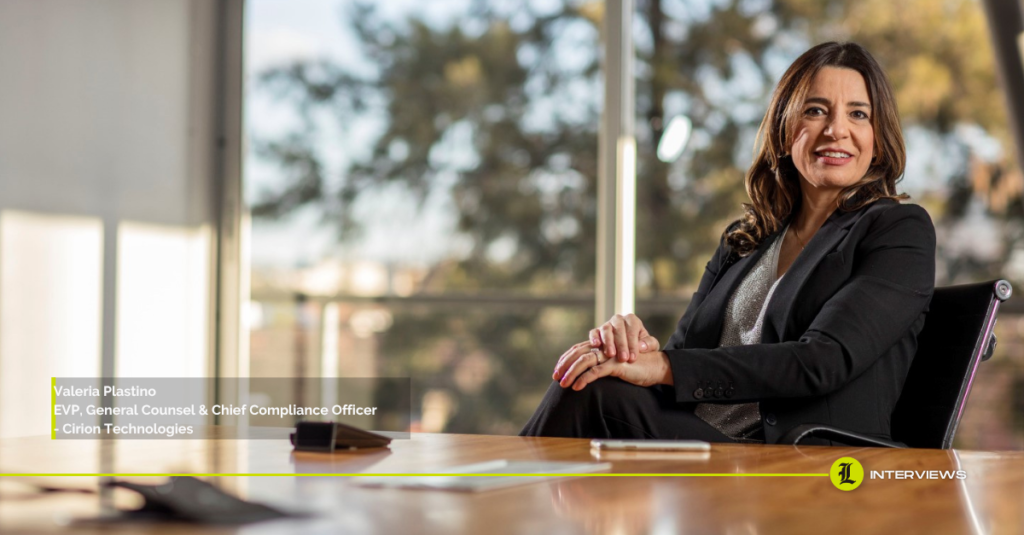
Valeria Plastino is EVP, General Counsel, and Chief Compliance Officer at Cirion Technologies, a digital infrastructure company with a presence in more than 20 Latin American countries. Originally from Argentina, with a career built between top-tier international firms and in-house roles in the technology sector, she combines legal leadership, compliance, and the legal voice on the executive board into a single position. In this conversation with Líder Legal, she discusses regulatory fragmentation in the region, the role of the legal function in digital transformation, and what the Latin American general counsel community is still not addressing with sufficient urgency.

Your career has unfolded at the intersection of corporate law and the technology industry in Latin America. What drew you to the tech sector from a legal perspective, and what experiences shaped you most before joining Cirion?
My career developed from very early on at the intersection of corporate law and highly dynamic industries, and the technology sector has always been particularly attractive to me because of its transformative potential. Unlike other sectors, in technology the legal framework doesn’t just support the business: it enables it. This idea of building legal structures that allow innovation to scale securely is what motivated me.
Before joining Cirion, I had highly formative experiences both in international law firms and in-house roles at technology companies. Working at leading law firms like Paul Weiss and then at Starmedia Networks, one of the first regional digital platforms, exposed me to environments where innovation outpaced regulation. This taught me to view law not reactively, but as a strategic tool.
My time in Latin America was also key, working on projects in various countries across the region and advising multinational investments. There, I gained a deep understanding of the complexities of operating in diverse and often unstable regulatory environments. This combination of technology, internationalization, and regulatory complexity ultimately shaped my profile. Cirion, in that sense, was the natural culmination of that entire journey: a regional digital infrastructure company, operating in 20 Latin American countries, that precisely requires this integrated vision of law, technology, and cross-border operations.
“In technology, the legal framework not only supports the business: it enables it. That idea of building legal structures that allow innovation to scale safely was what motivated me.”
Very few corporate lawyers in Latin America simultaneously hold the positions of EVP, general counsel, and chief compliance officer. How do you manage these three roles on a daily basis?
The key is integration, not separation. In organizations like Cirion, where we operate critical digital infrastructure in multiple jurisdictions, legal, regulatory, and compliance are all part of the same risk management and value creation system.
The role of general counsel ensures legal soundness and strategic support for the business, the role of chief compliance officer guarantees a consistent culture, integrity, and ethical standards throughout the organization, and the EVP function allows these two dimensions to be aligned directly with the business agenda and decision-making at the highest level.
What specifically changes when the legal function has executive rank on the board of directors?
The EVP title, in particular, has a concrete impact: it positions the legal function not only as advisory, but also as part of executive leadership. That changes the conversation: we move from reviewing decisions to co-creating them, incorporating variables such as risk, regulation, reputation, and sustainability from the outset.
In my experience, when legal and compliance are integrated into the business from the design stage, not only are risks mitigated, but execution is also accelerated with greater confidence.
“We went from reviewing decisions to co-creating them, incorporating variables such as risk, regulation, reputation and sustainability from the outset.”
Cirion operates in more than 20 countries where digital regulation is progressing at very different speeds. What are the regulatory fronts that challenge it most today, and how does it design a coherent legal strategy when each jurisdiction imposes its own rules of the game?
Today, the major issues—privacy, cybersecurity, and artificial intelligence—can no longer be analyzed in isolation. From our perspective, they are part of the same regulatory ecosystem where data, infrastructure, governance, and customer trust are deeply interconnected.
The main challenge in Latin America is regulatory fragmentation: each country progresses at a different pace and, in some cases, with different approaches. This necessitates the design of flexible legal strategies based on common principles.
What are the common principles on which this regional strategy is built?
At Cirion we work with three pillars: consistent global standards, especially in data protection and cybersecurity; local adaptability, with a deep understanding of each jurisdiction; and integrated governance, where regulation, security and compliance are managed in a coordinated manner.
In the case of artificial intelligence, it is also key to broaden our perspective: it is not just about regulating algorithms, but the entire ecosystem that makes them possible: data, infrastructure, providers, security, and governance.
“It’s not just about regulating algorithms, but the entire ecosystem that makes them possible: data, infrastructure, providers, security, and governance.”
You represent a profile that is still rare in Latin America: a woman at the highest level of the legal department of a multinational technology company. How have you experienced this reality throughout your career, and what remains to be changed?
Throughout my career, I’ve often been in spaces where female representation was limited, especially at decision-making levels. Over time, that has changed, but there’s still a long way to go.
I believe the most important progress is that the issue is now on the agenda and is perceived as a business priority, not just a diversity priority. However, the challenge is no longer simply getting more women into these roles, but ensuring they find the conditions to develop and remain in them. This requires working on several levels: organizational culture, leadership models, support networks, and policies that allow women to balance professional demands with their personal lives.
It’s also key to highlight role models. When someone sees that it’s possible, that impact multiplies.
“The challenge is no longer just getting more women into those roles, but ensuring they find the conditions to develop and remain in them.”
You will be participating in Foro de Gerencias Legales Miami 2026, organized by Gericó Associates. What motivated you to attend, and what message do you want to share with your peers?
My motivation for participating is linked to the opportunity to have an honest and strategic conversation among those of us who lead the legal function in the region.
From the tech industry, the message is clear: we are entering a stage where trust will be the main enabler of digital growth. And that trust depends, to a large extent, on how we manage the relationship between innovation, regulation, and ethics.
What specific conversation do you think the Latin American community of GCs urgently needs to have, but isn’t having yet?
I believe there is an urgent conversation that we are not yet having in sufficient depth: how to redesign the legal function to truly be a protagonist in the digital transformation.
This implies moving from control to design, from reaction to anticipation, and from a support function to a strategic business partner.
Furthermore, in Latin America as a region, we need to work more on collaborative proposals with the public sector to build smart regulatory frameworks that do not leave us behind in the digital economy.
“There is an urgent conversation that we are not yet having in sufficient depth: how to redesign the legal function to truly be a protagonist in the digital transformation.”
What does Valeria Plastino find when she disconnects from work, and what advice would she give to a young Latin American lawyer who aspires to one day hold a position like hers?
After many years working in demanding and dynamic environments, I learned that disconnecting is not a luxury, but a necessity. I find balance in simple things: time with my family, reading, and activities that allow me to gain perspective. I’m passionate about traveling and discovering new places.
Having built a career across different countries and cultures, I also greatly value moments of pause that allow me to reconnect with what is essential.

And what three things would you say to that young Latin American lawyer who is building her career today?
To a young Latin American lawyer, I would say three things: build a solid technical foundation, but don’t limit yourself to the legal aspects—it’s essential to understand the business; be curious and adaptable, because industries change and the law has to evolve with them; and never underestimate the value of integrity and reputation, because in the long run they are the main assets of a career.
And perhaps most importantly: encourage them to cross geographical and professional boundaries. Many of the most transformative opportunities arise precisely there.
“Never underestimate the value of integrity and reputation: in the long run, they are the most valuable assets in a career.”