
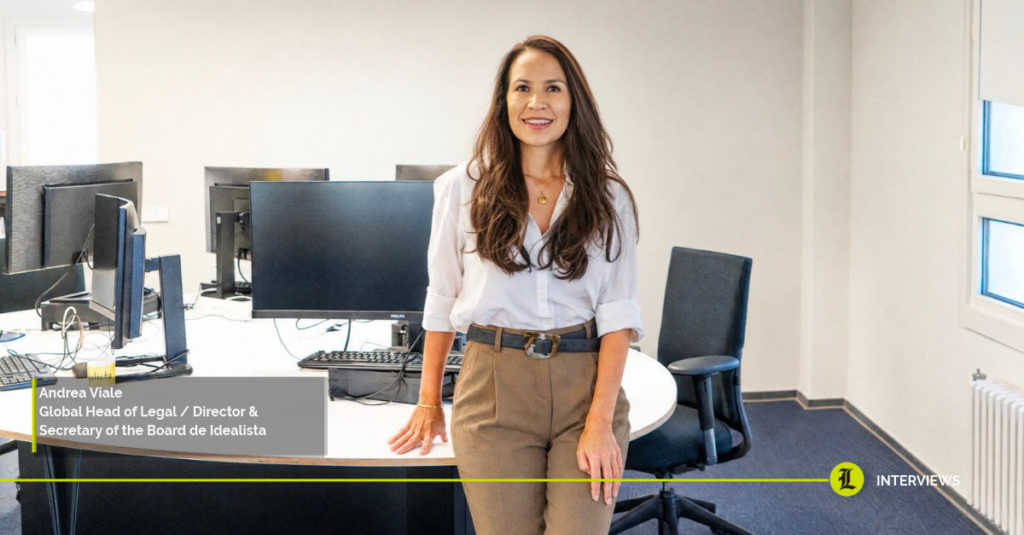
Andrea Viale, Global Head of Legal / Director & Secretary of the Board at idealista, understands legal leadership as a constant exercise in balancing people, jurisdictions, and business priorities. This vision was forged in 2017 when she left large law firms to build the company’s legal team virtually from scratch. There, she learned that the role of general counsel is earned by demonstrating the function’s contribution to the business. Today, she warns, this balance is being tested on three fronts that artificial intelligence is simultaneously accelerating. The first is risk, due to increasing regulatory pressure and unprecedented threats. The second is people, because profiles are needed that combine legal expertise with a vision of processes, data, and product. The third is the budget, which is shifting from external advisors towards technology, while law firms maintain their role in specialized and gray areas.
Faced with this acceleration, Viale believes the human factor is gaining importance. That’s why she places sound judgment and trust at the heart of her dual role as legal counsel and secretary of the Council, and also in how she evaluates in-house professionals, whose value, she maintains, “is increasingly measured by their judgment and the responsibility they assume for the outcome”.
Your career has led you to head idealista’s global legal function. What stage of your career has been decisive in shaping your leadership style?
Undoubtedly, my joining idealista in 2017 was a turning point. I came from seven years at large firms, where I acquired technical rigor and methodology, and had access to large teams, established processes, and readily available resources. At idealista, there was much to build, and I had the opportunity to build the team practically from scratch, with its working methods, tools, and rules for collaboration with the rest of the company.
I learned that the role of general counsel is built and earned: making our contributions to the business visible allowed us to obtain the resources to grow into a multidisciplinary and multijurisdictional team. Working in different jurisdictions and being so exposed to the market taught me to make decisions with agility and sound judgment. And Idealista’s people-centric culture did the rest. What I’m most proud of is having contributed, alongside them, to building what Idealista is today.
Those who lead a legal function today combine legal judgment with the management of people, budgets, and business priorities. What challenges are currently shaping legal leadership?
Legal leadership today, in my opinion, is played out on three fronts: risk, people, and budget. In all three, artificial intelligence (AI) acts as an accelerator.
In terms of risk, regulatory pressure is increasing across the board, both locally and internationally. This is compounded by cybersecurity and the often unprecedented risks associated with AI. In this context, our role is to advise committees and boards of directors on the best course of action, aligned with the company’s strategy, and to help the business move forward safely.
Regarding people, the challenge is to attract and retain profiles that combine legal judgment with a vision of processes, data and product, and to develop the capabilities of the teams to incorporate and adopt end-to-end AI in the processes of the legal area, accompanying them with training.
And in the budget, planning is shifting from spending on personnel and external consultants to investing in technology. This isn’t a replacement, because we still consult firms for specialized and gray areas, but rather a rebalancing that requires demonstrating the return on investment with data and aligning it with business priorities.
In technology-based companies like idealista, the integration of artificial intelligence and the evolution of professional profiles are transforming the legal function. How is this transformation changing the way a legal team is led?
In the age of artificial intelligence, the human factor weighs even more: judgment, listening, and trust.
As a technology-based company, we had been implementing automation and legal operations for years to become more efficient and dedicate our lawyers’ talent to higher value-added matters. With the integration of artificial intelligence, we have seen processes accelerate, but also new risks emerge.
What is expected of a leader has changed. This requires us to adapt and set an example of responsible, judicious, and human-centered approach. It requires us to trust the team and support their upskilling, giving them space to experiment. And it requires us to redefine the value of in-house counsel, which is increasingly measured by their judgment and the responsibility they assume for the outcome.
Leading a global legal team requires coordinating people, jurisdictions, and business priorities. What traits define your leadership style?
Coordinating people, jurisdictions, and business priorities is, at its core, a constant balancing act; my leadership style is defined by how I try to maintain it. I would summarize it in three traits.
The first is putting people at the center without sacrificing technical excellence. I believe they reinforce each other: a technically demanding team performs better when each member feels valued, and they feel valued when they are challenged to their full potential. The second is pragmatism: a proactive team aligned with the strategy, seeking a balance between reducing risk and preserving commercial initiative. The third is integration: maintaining consistency across jurisdictions without losing the local perspective.
You combine the global legal direction of idealista with the secretariat of its Board of Directors. What does it require to lead from this dual position?
It requires being clear about which role I’m playing and maintaining consistency between the two. As legal counsel and a member of the management committee, I support the business and anticipate risks. As secretary of the Board, I ensure that corporate governance is rigorously followed.
What underpins this dual role is trust. The management team needs to know that, as legal counsel, I am an ally of the business; and the Board needs to know that, as secretary, I contribute procedural discipline, discretion, and sound judgment to assess which matters should be brought before the body and when, so that it can make its decisions with all the necessary information.
You are a member of the jury for the Gala Nacional del Derecho – Legal Leadership Awards 2026, which recognizes excellence in marketing, communication, and business development within the legal sector. From your position as an evaluator, what do you particularly value in a nomination?
What I value most is the storytelling of each candidate: their ability to clearly convey who they are, their identity, and what sets them apart in the market. In an environment with so many options, those who stand out are the ones who have something unique to say and say it well.
That narrative must be consistent: what the firm says about itself has to align with what it presents on a daily basis. The best candidates reflect genuine collaboration between marketing, business development, and legal teams.
Andrea Viale applies the same standard of consistency to all the areas she manages. Within her team, this translates into integrating different jurisdictions without losing sight of the local perspective. In her dual role, it becomes the ability to distinguish which hat to wear at any given moment, whether before the management committee or the board. As a judge for the Legal Leadership Awards 2026, she extends this standard to the firms, expecting them to align their public image with their daily practices and for their nominations to reflect genuine collaboration between marketing, business development, and lawyers. Her approach thus connects the internal management of a legal department with how the legal sector presents itself to the market: in both cases, credibility depends on the alignment of narrative and practice.