

This interview is part of the special report “ Which law firm model is becoming dominant in Portugal: the bets of managing partners in 2026 ”, an analysis that gathers the views of the main leaders in the sector on the evolution of the Portuguese legal market.
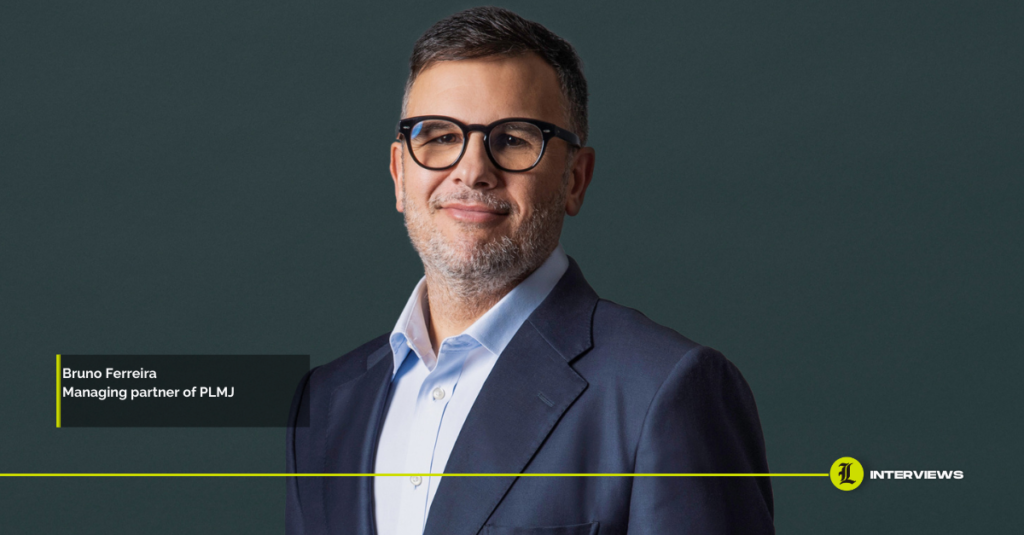
In that context, Bruno Ferreira, managing partner of PLMJ, introduces a particularly relevant reflection: the sector has already made a leap in efficiency thanks to technology, but the real challenge lies in translating that progress into tangible value for the customer, in a model that has not yet finished transforming.
“AI allows routine and low value-added tasks to be performed very quickly… The challenge will be to integrate these efficiencies in a way that effectively translates into value for customers.”
Based on this premise, Ferreira constructs an analysis that covers the major market issues: the real impact of artificial intelligence, the evolution of the corporate client, the redefinition of business development, and the need to rethink the law firm model in an increasingly competitive environment.

From operational efficiency to the real challenge: generating value
Artificial intelligence is already having a clear impact on legal practice, especially in terms of efficiency. However, Ferreira introduces a key distinction from the outset between improving processes and transforming the model. “AI allows routine and low-value-added tasks to be performed very quickly, freeing up lawyers to concentrate on solving complex legal problems,” he explains.
The progress is clear. But not enough.
Because, as he points out, the critical point is not in the tool itself, but in its real impact on the customer: “The challenge will be to integrate these efficiencies in a way that effectively translates into value for customers.”
In other words, the sector has begun to become more efficient, but it has not yet figured out how to turn that efficiency into a clear, measurable, and differentiating value proposition.
A powerful technology, but still in its maturity phase
In contrast to narratives that present artificial intelligence as a fully established disruption, Ferreira adopts a more cautious stance.
“We are still in an initial phase that requires caution,” he notes, adding that “all results must be carefully reviewed and validated.”
This nuance is relevant because it introduces a more realistic reading of the current state of the sector: the technology is already present, but its maturity is still limited.
In fact, he warns that the perception of progress can be misleading: “The fact that AI has been the big topic in the last five years has created the perception that it is in a more advanced stage of maturity than it actually is.”
Even so, there is no doubt about the direction of the change.
“The legal advisory activity is already benefiting from AI as a tool to correct inefficiencies… and, undoubtedly, it will bring about a structural transformation of the sector in the near future, although that change has not yet fully materialized.”
A more sophisticated customer that forces a rethinking of the model
In parallel with technological evolution, the corporate customer has changed profoundly.
Ferreira describes it clearly: “There is an increasing demand for value for money, as well as a greater demand for innovation in legal solutions.”
But the most relevant change is not only economic.
“They are looking for much more than legal expertise: they want a strategic partner aligned with their business objectives.”
This shift is forcing law firms to redefine their way of working. It’s not enough to be technically excellent; it’s necessary to understand the client’s business, anticipate problems, and provide solutions with real impact.
To meet these expectations, Ferreira explains that the approach involves combining several levers: active listening, technological investment, and in-depth sector knowledge.
All of this, he asserts, “demands efficiency, creativity, strategic thinking and a high level of critical thinking.”
Business development ceases to be individual and becomes structural
Another change that Ferreira highlights is the evolution of the business generation model within firms. “The role of the business originator is no longer concentrated in one or two people,” he explains, reflecting the shift from traditional models to more sophisticated structures.
Today, growth depends on a broader system: “a much more professional and strategically designed networking, whose success is also based on accumulated experience and the proven quality of the teams.”
This change has also forced firms to review their internal models.
Ferreira points out that firms that have adapted their evaluation and remuneration systems – incorporating dynamics such as cross-selling or referrals – are better positioned to compete in the future.
Growth in key sectors… and a fundamental structural challenge
Regarding opportunities, Ferreira clearly identifies the areas that will shape the development of the market in Portugal: projects and infrastructure, energy, education, defense, data security, and collective action.
However, beyond specific sectors, it introduces a more profound reflection. The real risk is not just economic or geopolitical. It is structural.
“There is a structural challenge related to the near reinvention of the business model of law firms.”
This challenge is intensified by a key factor: the increasing sophistication of companies’ in-house legal teams.
The combination of technology, cost pressures, and increased internal capacity from clients is forcing law firms to rethink their value proposition from the ground up.
Talent and leadership: a model of sustained high performance
In this context, talent remains the central focus of the model. Ferreira emphasizes the importance of an ongoing strategy, combined with specific programs aimed at developing future leaders.
But where it introduces a particularly powerful image is in organizational culture.
“A firm like ours is made up of true high-performance athletes,” he says.
And that idea has clear implications. It’s not enough to demand results. It’s necessary to build the conditions to sustain them over time: balance, training, support, and well-being.
Leadership, in this sense, plays a decisive role.
“It is simply unthinkable to build an organizational culture that is not, to a large extent, a reflection of the way its leaders think, work, and even feel.”
Bruno Ferreira’s vision introduces one of the most relevant reflections of the special: the legal sector has already begun to transform, but has not yet completed that process.
Technology has improved efficiency, customers have raised their demands, and the market is more competitive, but the model is still in transition.
Because, as he makes clear throughout the conversation, the real challenge is not to do the job better, but to redefine how that job generates value.
And that’s where the competitiveness of law firms will be tested in the coming years.