



Author: David Fuentes Lahoz (David.Fuentes@twobirds.com)
Senior associate in the Intellectual Property department at Bird & Bird
The applicable law
Spanish Unfair Competition Act No. 3/1991 (the “UCA”) establishes freedom of imitation as the general rule: copying a competitor’s products or aesthetic is, in principle, lawful. The UCA does, however, prohibit imitation that creates a likelihood of association with a third party’s products or that amounts to undue free-riding on a competitor’s creative effort or reputation.
This should not be confused with designs, copyright, trade marks, patents and other intangible assets, each governed by its own regime and each capable of protecting against unauthorised copying in its own right. Unfair competition law is a complementary regime to these: it fills the gaps they leave open rather than replacing them.
The case
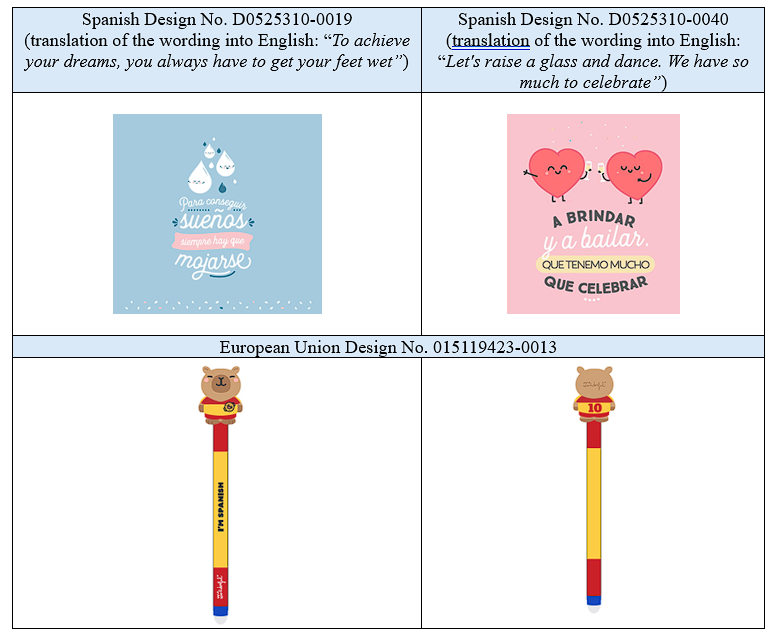
Mr. Wonderful Comunication S.L. (“Mr. Wonderful”) is a company that commercialises a widely recognised aesthetic: kawaii-style illustrations paired with uplifting messages, pastel palettes and rounded typography. Some examples are set out below:
Nevertheless, before February 2011 (when Mr. Wonderful began trading) commercial trends combining humanised drawings with short, upbeat messages in similar styles were already well established.
In March 2021, Mr. Wonderful filed a claim against Clave Denia S.A. and Clave Denia Canarias S.L. (the retail chain trading as “ALE-HOP”) alleging unfair imitation, consumer confusion, misappropriation of reputation and conduct contrary to good faith under the UCA. It sought an injunction, withdrawal and destruction of the allegedly infringing products, damages, publication of the judgment, and a daily penalty of no less than EUR 600.
Notably, although Mr. Wonderful held over 600 designs in Spain and the European Union (examples above), it chose not to invoke those exclusive rights. Nor did it rely on copyright, which under Spanish law arises automatically upon creation, or on unregistered design rights, which confer three years of protection from first disclosure without any filing. The claim was framed exclusively within unfair competition law.
The Commercial Court No. 5 of Valencia (January 2022) dismissed the claim in full. It held, among other issues, that the conceptual elements at issue (kawaii imagery, motivational text, pastel tones) were widespread trends rooted in the public domain, that Mr. Wonderful’s style lacked competitive singularity, and that there was no likelihood of association or confusion at the point of purchase.
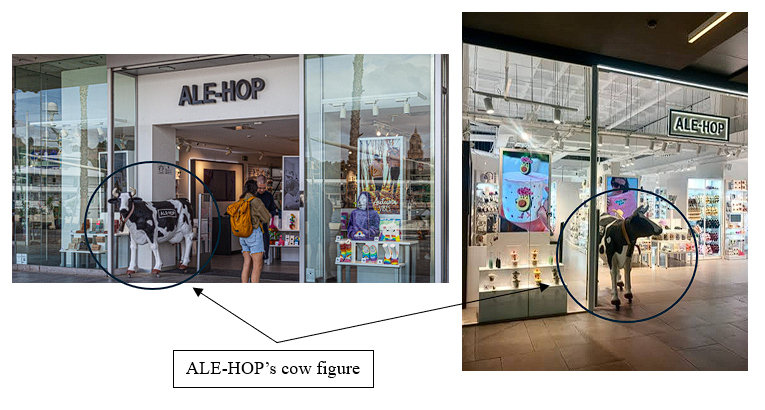
The Court of Appeals of Valencia (November 2022) upheld the dismissal on partly different reasoning. It recognised that Mr. Wonderful’s aesthetic does possess competitive singularity: its visual identity had become sufficiently distinctive so that competitors had aligned their designs with it. However, the remaining requirements for unfair imitation were not met; ALE-HOP’s stores were immediately identifiable through their distinctive cow figure, glazed shop fronts and branded product arrangement, and every product clearly displays the ALE-HOP trade mark. A comment posted on the social network X (formerly Twitter), cited by the Court, captured the consumer reality: “Y ahora voy al Alehop, que es el Mr. Wonderful de los pobres”; translation into English: “Off to ALE-HOP now, it’s the poor man’s Mr. Wonderful”. Below is an image of the cow figure referred to above:
Finally, the Spanish Supreme Court admitted the appeal and, on 10 September 2026, dismissed it, confirming the Court of Appeal’s ruling in full and ordering Mr. Wonderful to bear the procedural costs.
The Supreme Court confirmed that Mr. Wonderful’s aesthetic possesses competitive singularity, but that singularity alone is insufficient. Under the UCA, competitors may reproduce the aesthetic creations of others provided they eliminate any likelihood of association, and ALE-HOP had done exactly that: its stores were identifiable through wide glazed shop fronts, a distinctive product layout, clear signage and, notably, the cow figure at each store entrance, with every product bearing the ALE-HOP trade mark clearly differentiated from its competitor’s branding. In reaching this conclusion, the Court applied its own doctrine, under which any likelihood of association created by an imitation is neutralised where the trade mark and presentation allow the consumer to identify the product’s true commercial origin. As illustration, the Court cited the social media comment mentioned above, finding that it demonstrated precisely this point: the consumer perceives the resemblance while perfectly distinguishing between the two brands. On free-riding, the Court found that Mr. Wonderful had neither evidenced nor quantified its creative investment beyond a passing witness reference to consumer focus groups. On systematic imitation, the alleged figure of 110 copied products had not been established as fact, was not contextualised against ALE-HOP’s total catalogue, and was unsupported by evidence of predatory intent.
Key takeaways and final thought
This outcome is not an isolated misstep but the confirmation of a consistent line of Spanish case law: competitive singularity is a necessary condition for unfair imitation to exist, but it has never been a sufficient one. In the Court of Appeal of Madrid’s decision No. 581/2023 (Adidas v. Scalpers case; confirmed by the Spanish Supreme Court), the court similarly rejected unfair competition claims regarding the alleged imitation of Adidas’ Stan Smith sneakers, holding that the products lacked competitive singularity under the UCA due to the widespread use of similar design elements.
The Mr. Wonderful case goes a step further. Here, singularity was expressly recognised, and the claim still failed because, among other issues, the likelihood of association was neutralised through differentiation at the point of sale. Together, these decisions confirm that where aesthetic elements draw on pre-existing trends, the threshold for unfair imitation under the UCA remains deliberately high; and that clear branding is, on its own, a potential defence against it.
This case offers some practical lessons for any business with intangible assets worth protecting; see below some examples.
If you are a rights holder facing imitation:
- Registering intellectual property assets and relying on them when enforcing rights is generally seen as a reliable foundation for enforcement. A portfolio of registered trade marks, designs and other intangible assets can shift the question from whether a style has competitive singularity to whether a third party has incorporated the registered asset; arguably a more objective standard. In this case, Mr. Wonderful held over 600 designs in Spain and the European Union yet invoked none of them, litigating exclusively on unfair competition grounds; the Supreme Court itself found that omission “telling”.
- Combining causes of action is something rights holders may wish to consider. Unfair competition and design infringement claims are not mutually exclusive, and bringing both can close off lines of defence. Copyright may also be worth invoking where possible: Spanish law permits dual protection, and the Supreme Court has confirmed that artistic works applied to commercial products retain copyright protection (Judgment No. 193/2024). Copyright arises from the mere creation of the corresponding work, requires no registration and endures, as a rule, for the life of the author plus seventy years; far longer than the twenty-five-year maximum for registered designs. Notably, a copyright-based plagiarism claim does not require identical reproduction: Spanish case law (Judgments of the Spanish Supreme Court No. 1125/2003; No. 963/2001; and No. 12/1995) treats as plagiarism any substantial copy reproducing the basic and fundamental structural coincidences of the original work, including disguised copying that merely conceals that similarity, as opposed to accessory or non-transcendental modification; a lower bar than exact duplication. A copyright claim, however, would not necessarily have been straightforward here. Under Spanish and European Union law, copyright requires that the subject matter constitute the author’s own intellectual creation, identifiable with sufficient precision and objectivity (see Judgment of the Court of Justice of the European Union in Case C 310/17). Aesthetic appeal and subjective originality are distinct: the fact that a product is visually recognisable does not make it an original work (see Case C 683/17). While Mr. Wonderful’s individual illustrations may satisfy the originality threshold, its broader aesthetic vocabulary (pastel palettes, rounded typography, motivational messaging) draws on pre-existing kawaii conventions and could be considerably harder to protect. What copyright covers is the specific creative expression, not the style itself. Where a product’s appeal derives from a pre-existing aesthetic convention rather than individual expressive choices, the originality threshold may not be met. In any case, even absent formal registration, unregistered European Union designs confer automatic protection for three years from first disclosure within the European Union. Additionally, where confidential business information has been misappropriated, the Trade Secrets Act No. 1/2019 (the “TSA”) provides independent remedies, including permanent injunctions, seizure of infringing goods, and damages.
- Quantifying creative investment from an early stage may be worth considering. Design hours, market research, validation processes and development costs can be documented as a matter of routine. The Supreme Court rejected Mr. Wonderful’s free-riding argument precisely because it had neither evidenced nor quantified its creative investment beyond a passing witness reference to consumer focus groups; a gap that documentation practices may help to avoid. Where such information has commercial value and is kept confidential, it may additionally qualify for protection as a trade secret under the TSA, provided it satisfies three cumulative requirements: (i) secrecy, not generally known or readily accessible to persons in the relevant circles; (ii) commercial value derived from that secrecy; and (iii) reasonable steps taken to maintain it, such as confidentiality agreements and restricted access protocols. Proper documentation can thus support claims and enforcement.
- Expert evidence often plays a significant role in disputes of this kind, and investing in it is often a sound choice. Mr. Wonderful alleged 110 copied products, but the figure was never established as fact, never contextualised against ALE-HOP’s total catalogue, and was unsupported by evidence of predatory intent; a methodological gap that a properly scoped expert report might help to address. Methodology, sample size, documented chronology and clear conclusions tend to be relevant factors. Where the relevant evidence lies in the hands of the alleged infringer, the Spanish law allows the holder to apply, before instituting proceedings, for fact-finding measures and access to sources of evidence; measures that may prove useful where the line between lawful inspiration and unlawful misappropriation turns on the infringer’s internal processes.
- Auditing and managing an intangible asset portfolio are aspects that businesses may wish to consider periodically. Owning rights is not necessarily the same as deploying them: registration without a use or enforcement strategy may leave value unrealised. Periodically mapping which creative assets exist across the business, which legal regime protects each one (trade marks, designs, patents, copyright, trade secrets) and whether that protection is still in force, still owned by the right entity, and genuinely enforceable, can be a useful exercise. A portfolio review conducted before a dispute arises may, in some cases, be less costly than discovering gaps during one.
If you are accused of infringing:
- Visible differentiation at the point of purchase appears to have been a relevant factor in this case, though not necessarily the only one. In this particular case, ALE-HOP’s defence succeeded on the strength of a distinctive brand clearly applied to every product, unmistakable retail environments and a consistent commercial identity: wide glazed shop fronts, a distinctive product layout, clear signage and the cow figure at every store entrance, with every product bearing the ALE-HOP trade mark. The point was so evident that a social media comment cited by the Supreme Court itself (“Off to ALE-HOP now, it’s the poor man’s Mr. Wonderful”) became part of the evidential record: consumers perceived the resemblance while perfectly distinguishing the two brands. That said, the likelihood of association must be assessed as a whole, and depending on the case, other touchpoints beyond the physical point of sale may also be relevant. Spanish law permits competitors to draw inspiration from, and even reproduce, the aesthetic creations of others, provided the likelihood of association is eliminated considering all relevant circumstances.
- A caveat worth noting: that defence appears to work only against unfair competition claims. Against a registered design right, brand differentiation at the point of sale would not necessarily provide the same safe harbour; had Mr. Wonderful sued on its 600 designs instead, ALE-HOP’s shop fronts and cow figure might have a priori been legally irrelevant to the infringement analysis.
- Filing a protective letter can be a sensible precaution where there is reason to believe a rights holder could seek an ex parte preliminary injunction. Regulated under the Spanish Patents Act No. 24/2015 and admitted by Spanish courts in Intellectual Property matters beyond patents by analogy, a protective letter is a pre-emptive brief setting out the grounds for non-infringement, invalidity or lack of urgency, aimed at persuading the court to dismiss any subsequent ex parte application or convert it into an inter partes hearing. It must be filed before the rights holder’s application and its validity is generally limited to three months, extendable up to six. In some cases, a timely protective letter might have been a useful precautionary measure.
Every court that considered this case acknowledged the same thing: there is something of Mr. Wonderful in ALE-HOP’s products, and that resemblance is no accident. And yet Mr. Wonderful lost at every turn, across five years and all instances, because recognition without legal title is worth nothing. Unfair competition law protects against unfair conduct, not against legitimate competition dressed in a similar style, and once a defendant neutralises the likelihood of association, the inquiry is over; regardless of how recognisable the aesthetic is. A distinctive aesthetic is an economic and strategic asset, arguably Mr. Wonderful’s most valuable one, but an asset without the right legal title behind it is generally a vulnerable one.
The question that matters is a simple one: what are your intangible assets, which legal regimes may protect them, and to what extent has title under each of the available regimes been secured and actively deployed?
Please note that the observations above do not constitute legal advice. Their relevance, if any, will always depend on the particular facts and should be assessed on a case-by-case basis.