

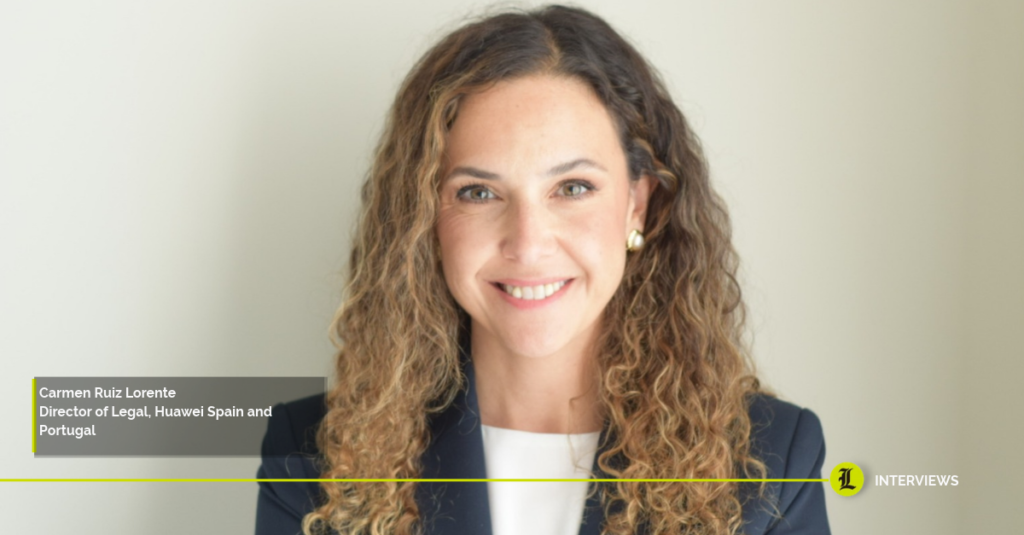
Carmen Ruiz Lorente, Legal Director at Huawei Spain and Portugal, led the company’s legal department during a period when data protection, regulatory compliance, and cybersecurity completely transformed the telecommunications landscape. Today, she believes that artificial intelligence is forcing legal departments to define where their true value lies, and she places it in legal judgment. Ruiz Lorente notes that this demand first affects the training of young lawyers, because many of the tasks through which they traditionally acquired this judgment can now be performed with AI tools. She also points out that internal clients, with easier access to legal information, can question the department’s opinions, and that this requires raising the level of legal advice.
In dealings with external firms, he considers it reasonable to review fees and response times for standardized work. In complex matters, however, he maintains that the value remains in the dialogue between experienced professionals: “That ability to build solutions through dialogue remains, in my opinion, difficult to replace.”

The integration of artificial intelligence and the evolution of professional profiles will shape the future of the legal and technology sector. What challenges does this transformation pose for those who lead legal teams?
There are many, and they affect virtually every aspect of managing a legal team. As head of a legal department, I must foster the professional development of its members, ensure the quality of our advice, and efficiently manage available resources. Artificial intelligence is transforming all three of these areas.
One of the challenges that concerns me most is the training of younger professionals. Traditionally, much of legal judgment was acquired through tasks that required time, effort, and attention to detail, many of which can now be performed with artificial intelligence tools. There is a risk that we will learn to obtain answers before we have learned to formulate the right questions or to recognize when an answer is incorrect.
The solution necessarily involves integrating these tools without compromising learning. It is essential to understand the legal foundations, identify and compare sources, detect errors, and question seemingly convincing conclusions. Critical thinking is not acquired simply by reading a good analysis, but by learning to construct it and taking responsibility for its conclusions.
Another challenge is managing expectations. These tools allow us to increase work capacity and reduce time, but their results still require review and monitoring. Efficiency isn’t simply about producing more in less time, but about dedicating our resources to what truly adds value.
It’s also changing our relationship with internal clients. Artificial intelligence facilitates access to legal information and analysis for professionals in other fields, who can now more easily challenge our opinions. I don’t think we should see this as a threat. On the contrary, it requires us to raise the bar for our contribution. Our value cannot be limited to knowledge of the rules: we must be able to interpret information, contextualize it, evaluate alternatives, and recommend solutions considering their legal, commercial, and reputational implications.
This transformation also affects our relationship with external firms. It is reasonable to review expectations regarding response times, fees, and the value of contracted services, especially for standardized work. However, when we turn to specialists in complex matters, we seek more than just a technically sound analysis: experience, sound judgment, creativity, and the ability to anticipate scenarios and appreciate nuances.
In these matters, there is something especially valuable in the conversation between experienced professionals: a question that shifts the focus, an objection that forces us to reconsider a conclusion, or an alternative we hadn’t considered. This ability to build solutions through dialogue remains, in my opinion, virtually irreplaceable. Artificial intelligence can help us work better, but it also compels us to identify more precisely where our true value lies.
The legal function of a technology company accompanies a business that evolves at great speed. What qualities do you consider essential in someone who leads a legal team in that environment?
For me there are three fundamental ones: empathy, curiosity and rigor.
Empathy is essential for understanding the people we work with. In corporate legal counsel, it’s crucial to understand the business’s needs, the concerns of decision-makers, and the circumstances under which they make those decisions. Empathy is also essential within the team itself, because not everyone needs the same things to thrive or responds to challenges in the same way.
Curiosity allows us to keep learning. In a technology company, this is especially important because the business, technology, and regulations are constantly evolving. I believe a good corporate lawyer should want to understand much more than just the law. They need to understand the industry they work in, how their organization functions, and what’s changing around them.
Rigor is what underpins all of the above. We work in an environment that demands quick responses, but urgency cannot replace analysis. We must be able to distinguish what is truly important, identify risks, and offer reasoned solutions.
For me, these three qualities complement each other: empathy allows for understanding, curiosity helps in discovery, and rigor compels in providing a solid foundation. All three are necessary to perform a legal function closely related to business without losing independence of judgment.
Before taking on the role of legal director for Huawei in Spain and Portugal, there was an initial decision: to dedicate herself to law. What led her to orient her career towards the legal field?
At 18, I chose to study Law and Business Administration because it seemed like a way to get closer to two of the major forces that drive the world: the economic and business world, and the legal world. There was a third area that also greatly appealed to me, and which continues to spark my curiosity: communication. I wanted a broad education that would allow me to better understand how things work, without yet having a very clear idea of where I would steer my career.
Interestingly, it was Law, the discipline that initially seemed most foreign to me and for which I had no family connections, that ultimately won me over. As I progressed through my studies, I was surprised to discover its scope, the issues it allows us to resolve, and the extent to which it permeates our lives.
I think it has a lot to do with my personality. I’ve always believed in the value of rules and the need for structures that govern coexistence. I’m particularly drawn to the architecture of the rule of law, the balance that the separation of powers seeks to achieve, and the capacity of law to transform societies. The way a society is legally organized says a lot about it.
I ended up choosing to practice law and, over time, I have found that this dual training fits especially well with corporate legal advice, where legal knowledge and understanding of the business must necessarily go hand in hand.
Your career at Huawei now spans fourteen years. How has that journey shaped your leadership style?
I joined Huawei in 2012, after working in law firms. We were a very small legal team, and both the company and the telecommunications sector and its regulatory environment were very different from what they are today. In these fourteen years, we have experienced an enormous transformation, both in our business and in our external environment. Areas such as data protection, regulatory compliance, and cybersecurity have undergone a very intense transformation.
In 2017, when the then-legal director left the company, I decided to apply for the position. Huawei chose me over an external candidate, and I have led the legal team in Spain ever since. At the end of 2015, my responsibilities expanded to include Portugal, marking a new phase of coordinating the legal function in both countries.
That decision taught me something I still keep in mind: effort and preparation are essential, but you also have to know when to step up when an opportunity arises. And, above all, it’s crucial that someone trusts you and allows you to demonstrate that you’re ready to take it on.
That experience has shaped my leadership style. I strive to offer my team members that same trust, autonomy, and opportunities for growth. I believe it’s important not to pigeonhole anyone into what they already know how to do, but rather to give them space to discover their full potential. One of the greatest rewards of leading a team is seeing its members develop their own judgment and take on responsibilities they haven’t had the chance to face before.
You have highlighted the importance of women being part of decision-making spaces. Are they still a minority in those spaces within the technology sector?
The gender gap remains a reality in certain technology professions and is already noticeable at the training stage. According to Eurostat, in 2025 women represented only 19.5% of information and communication technology specialists in the European Union. This figure demonstrates that there is still a long way to go.
However, I think we should avoid talking about the technology sector as if it were homogeneous. Within a technology company, very different profiles coexist, and not all of them require STEM training. There are areas, such as legal, financial, human resources, or communications, where the female presence can be considerably higher.
Therefore, I would distinguish two challenges: getting more women into technology professions and ensuring that, in all areas, we actively participate in decision-making spaces. For the first, initiatives that promote STEM careers among girls and young women are essential. For the second, we must seize opportunities, make our voices heard, and gain visibility, not only to pave the way for ourselves but also to consolidate our presence and help ensure that future generations of women find these spaces already conquered.
You are a member of the jury for the Gala Nacional del Derecho – Legal Leadership Awards 2026, which recognizes excellence in marketing, communication, and business development within the legal sector. What does an event like this bring to the legal profession?
That’s precisely it: the opportunity to meet, get to know each other better, and recognize the work of professionals with whom we constantly collaborate, but whose contribution we don’t always fully understand.
The legal sector produces a great deal of high-quality work that, by its very nature, has limited visibility. Marketing, communications, and business development professionals help to highlight its value, make it available to those who may need it, and explain its relevance. This work requires in-depth knowledge of the sector and a combination of skills that deserves recognition.
Being part of the jury allows me to approach this reality from a different perspective. Behind each nomination are projects, decisions, challenges, and results that allow us to appreciate the work of professionals who contribute decisively to the development of our sector.
I also appreciate that this experience has brought me back to the three qualities I mentioned earlier. Curiosity leads us to want to learn about the work of others; rigor, to understand and value it fairly; and empathy, to recognize the effort, difficulties, and contributions behind it. I believe this is a good way to understand not only these awards but also professional relationships: the better we know and understand the work of those around us, the better we can do our own.
Carmen Ruiz Lorente’s career path explains much of her leadership style. In 2017, Huawei chose her to lead the legal team in Spain instead of hiring an external candidate, and she says that decision shaped her leadership approach. Since then, she strives to offer her team the same trust she received: autonomy, opportunities for growth, and space to take on new responsibilities. Her advice to women in the technology sector echoes this lesson. She encourages them to seize opportunities, make their voices heard, and gain visibility so that those who come after them can find these spaces already conquered. Ruiz Lorente applies the three qualities she considers essential—empathy, curiosity, and rigor—to leading a legal department. She also applies them to her role as a judge for the Gala Nacional del Derecho – Legal Leadership Awards 2026, where they help her understand and evaluate the work of other professionals in the sector.