

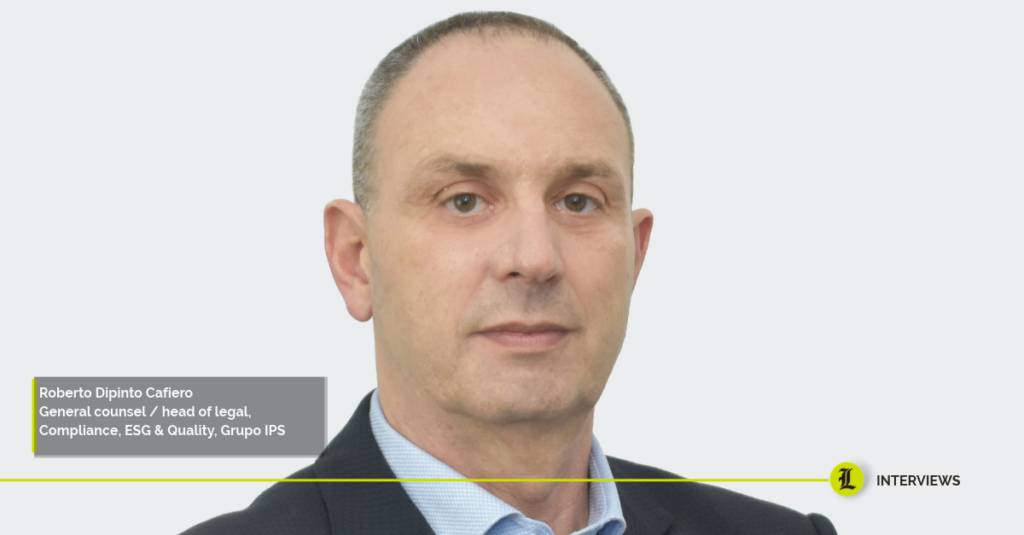
Roberto Dipinto Cafiero, General Counsel and Head of Legal, Compliance, ESG & Quality at Grupo IPS, learned during two negotiations with governments in Bolivia and Ecuador that a contract is only sustainable if it reflects a balance of interests viable for all parties. From this experience stems his concept of a General Counsel who intervenes before a decision is made, and this idea shapes the rest of his vision. In the energy sector, this leads him to anticipate fiscal and political changes in contract design and to work from the outset on community relations in renewable energy projects. At Grupo IPS, where he heads Legal, Compliance, ESG, and Quality, he applies this approach with an integrated team that analyzes each incident considering all its implications. In corporate governance, he argues that every global policy needs its own legal and cultural interpretation in a Latin America that he considers heterogeneous, and warns boards that increasingly extraterritorial regulation can change their strategy without them seeing it coming.
This vision is what will guide the Foro Gerencias Legales Lima 2026, where he aims to explore how to ensure legal departments play a truly strategic role. To achieve this, he believes it is crucial that General Counsels in the region deliberately develop the transferable skills they share, such as risk analysis, negotiation, and understanding the business. “I think that defines the General Counsel that companies need today: not just someone who says what the law allows, but someone who helps decide what to do with it,” he maintains.

Your career spans more than 25 years in Latin America and North America. What stage do you consider decisive in your development as a legal leader?
There were several decisive stages, but I would highlight one that marked a turning point in my understanding of the role of the lawyer.
In 2006, when I was with Repsol in Bolivia, we experienced a particularly complex moment: the nationalization of hydrocarbons and the threat of expropriation. It was then that I understood that simply knowing the new legislation and drafting new contracts wasn’t enough. We had to understand what was happening politically, what the government needed and intended to achieve, what the companies’ interests were, and, at the same time, how to protect the interests of the company we worked for. Ultimately, the contracts were renegotiated, safeguarding the investments made in previous years and, most importantly, ensuring the continuity of operations and jobs.
That’s when I understood what it means to be a strategic lawyer: to be at the table where decisions are made, not just to receive them and then turn them into legal documents.
In practice, this meant working with scenarios: what would happen if the government hardened its position, what real room we had to negotiate, what compromises we could make without jeopardizing the operation’s viability, and what safeguards we needed to maintain. The legal analysis was just one piece of a broader political, economic, and operational picture.
Years later, while at SLB, I had a similar experience in Ecuador. Between 2010 and 2012, I was part of the working group that negotiated the first contractor-financed service contracts with the Ecuadorian government. These contracts opened a new generation of contractual structures in the country, and according to official publications (Primicias.ec) as of July 2022, these contracts had generated approximately USD 19,700 in gross revenue for the Ecuadorian state and a large number of jobs, both direct and indirect.
Again, the challenge was not simply to draft a contract, but to understand what the government, the company, and the other stakeholders needed, and to build a viable structure for everyone.
That type of negotiation teaches something that isn’t in any manual: a contract reflects a balance of interests, and if that balance isn’t sustainable, neither will the contract, no matter how well-drafted it is. That’s why, at those tables, the lawyer’s role wasn’t just to safeguard the text, but to help build a structure that the government could publicly defend and that the company could implement and finance.
Working in different countries, with governments, state-owned enterprises and private companies, taught me that technical knowledge is indispensable, but that, as one grows professionally, it ceases to be sufficient.
The General Counsel needs to understand the business, the environment in which it operates, the risks and, above all, the people involved in the decision, along with the current political and geopolitical context and its evolution in the short, medium and long term.
Today, when I build teams, I look for precisely that: technically sound lawyers, but with a curiosity for the business and the ability to read the context. Technical skills can be taught; the ability to understand what’s at stake in a decision is developed by being exposed to it.
That transition from technical lawyer to strategic lawyer is what has most marked my career.
Much of that experience was gained in the energy sector. What differences do you find in legal risk management between oil and gas projects and renewable energy projects?
There are important differences, but the principle of risk management is the same.
In oil and gas we find highly specialized regulation, long-term contracts, permits, operational risks, relationships with authorities, state-owned companies and various interest groups.
In renewables, other issues arise: land rights, permits, interconnection, energy supply and purchase agreements, financing and, depending on the project, a very close relationship with communities and local authorities.
In renewable energy projects, social risk is also a significant factor: a project can have all its permits in order and still be halted if it lacks community support. Therefore, consultation, land tenure management, and relationships with local authorities must be addressed from the outset, not only when conflict arises.
But, beyond the sector, the important thing is to understand the complete project.
My experience in different countries has taught me that a lawyer cannot simply analyze the contract in front of them. They must understand what lies behind the contract: who the parties are, what each party wants to achieve, the regulatory, political, and even geopolitical context, what dependencies exist, and what might happen if any of these variables change.
In the oil and gas sector, for example, a change in the tax regime, the state-owned company’s policies, or prices can completely alter the economic equation of a contract. Lawyers cannot prevent these changes, but they can anticipate them in the contract’s design: economic rebalancing mechanisms, stabilization clauses, a robust dispute resolution clause, and a clear allocation of risks between the parties.
That is especially relevant in energy, where we are talking about large investments, long-term projects and relationships with governments or state-owned companies.
The difference between a purely technical lawyer and a General Counsel lies, to a large extent, in that ability to look beyond the surface and not only ask “what does the law say?”, but also “what does this mean for the project, for the company, and for the decision we have to make?”.
That’s where legal risk truly becomes business management. And that logic is perfectly applicable outside the energy sector: in an M&A transaction, the lawyer’s job can’t be limited to reviewing documents and preparing the necessary agreements. It’s essential to understand why the company wants that business, what value it’s seeking, what risks could affect that value, and what will happen after the closing.
Today you simultaneously lead the legal, compliance, ESG, and quality areas. What have you learned about leadership in that position?
They are distinct areas, but deeply related, and together they make more sense than they appear from the outside.
Quality manages the Integrated Management System, and Legal manages the Anti-Bribery Management System: two systems that share logic, audits, and controls. ESG deals with permits, licenses, and community relations, which are also legal matters.
Compliance conducts ethics and compliance investigations, while Quality conducts service quality investigations. Why not combine the expertise of both? That’s precisely what we’re doing: merging legal and technical expertise within an interdisciplinary team that learns every day. We’ve conducted investigations into potential quality events and their effects—not only technical, but also financial and reputational—allowing us to combine our experiences and arrive at conclusions that meet the needs of all parties.
This integration has a practical effect: when an incident occurs, we don’t view it from just one perspective. A service quality issue can have contractual, compliance, or reputational implications, and vice versa. Having all four areas under a single vision allows us to detect these connections earlier and respond with a unified voice.
As a company grows and adapts to changing times, the Legal department can no longer operate in isolation. It must be connected to the business, operations, finance, human resources, purchasing, security, quality, and, of course, the company’s management.
Today, a significant part of my job involves supporting that growth and helping the company take a leap forward in how it makes decisions. This means broadening the scope of the Legal department: moving beyond simply interpreting regulations or contracts to contributing sound judgment to decision-making. That, too, is leadership: knowing how to listen, asking the right questions, and helping the organization make better decisions.
This is what I call “management by influence.” Internal clients must embrace the message, not receive it as an imposition; it must become part of their daily mindset. Persuading and influencing: that’s what should distinguish us as General Counsel.
Leading such diverse areas has also taught me to trust specialists. I don’t need to know every technical standard like the Quality Manager, nor every sustainability indicator like the ESG team. My role is to ensure that we all work with the same criteria, that information flows, and that management receives an integrated view, not four separate reports.
And there is something I consider fundamental: our role cannot be limited to saying no. Naturally, the General Counsel must have the independence to say no when appropriate, but when a legally viable alternative exists, our obligation is to help find it.
The goal is not to prevent businesses from taking risks. It’s to help them take risks by understanding what those risks are, what their consequences are, and how to manage them.
For that to happen, Legal needs to get involved in the discussions early. When we’re called in at the end, we can only validate or block things; when we’re involved from the beginning, we can design the solutions.
What is the main difficulty in transferring global corporate governance standards to the regulatory frameworks of Latin America?
The main difficulty is getting global standards to actually work in every country.
Latin America is not a homogeneous bloc. We have countries with different laws, different institutions, different business cultures, and also different ways of relating to authorities, clients, suppliers, and other stakeholders.
That’s why it’s important to distinguish between the principles and how they are implemented. The fundamental principles (integrity, transparency, prevention of corruption, conflicts of interest, respect for local and international regulations) do not change.
What can and should be adapted is the way in which those principles are implemented, without violating them.
A simple example is gifts, invitations, or institutional hospitality. What is a common and even regulated business practice in one country may generate a completely different perception or be prohibited and penalized in another.
The same applies to lobbying. In some jurisdictions it is recognized and regulated as a legitimate activity, while in others it is restricted or even penalized. For this reason, many multinational corporations prohibit it outright in their policies, regardless of local regulations.
That’s why I don’t believe in global policies that are simply translated and distributed. A global policy must have a common principle, but then it needs to be interpreted within local legal and cultural contexts. Procedures, limits, approvals, documentation, and training must be established to ensure that the policy is truly applicable.
In practice, that means involving local stakeholders in the design of the implementation, comparing the policy with local law and with extraterritorial regulations that apply to the company, and setting thresholds, approval flows, and records that make sense in each operation.
Compliance doesn’t exist simply because we have a published policy. It exists when people know what to do in a given situation. That’s why effective communication, training, and persuasion are fundamental, in any country or region.
And there’s one factor I consider crucial: the example set by management. No compliance program works if senior management doesn’t back it up with their own decisions. The tone from the top isn’t just a slogan; it’s what the team sees when they have to choose between closing a deal quickly or closing it properly.
Looking ahead to 2027, what regulatory risk should be on the agenda for boards of directors in Latin America?
The risk I would highlight is that regulation could change business strategy without the board anticipating it. This isn’t due to any specific regulation, but rather the speed at which rules are changing and the sheer number of changes occurring simultaneously. For example, we can discuss the proper use of Artificial Intelligence, which is here to stay and which we must learn to leverage, increasingly stringent data protection regulations, and due diligence regarding supplies, customers, suppliers, and so on.
We are seeing new demands in compliance, data protection, artificial intelligence, sustainability, transparency, supply chains and sector regulation.
Some of these requirements also have extraterritorial reach. Due diligence standards in supply chains, international sanctions, or sustainability reporting requirements originating in other jurisdictions end up being applied to Latin American companies through their clients, partners, or financiers.
And when a company operates or begins to operate in different markets, that complexity multiplies. Legal can no longer simply resolve problems as they arise; it must help build a structure that allows it to anticipate them.
Therefore, boards of directors should ask themselves a different question. Not only “What legal risks do we face?”, but “What regulatory changes could affect our business strategy?” A regulation can modify costs, processes, supply chains, market access conditions, or even the viability of a project.
The General Counsel’s role is to help identify those consequences. Not to present an endless list of regulatory changes, but to say: this is what’s happening, this is what it could mean for us, these are the alternatives, and this is my recommendation.
For this, the board needs a mechanism, not just reports. What I propose is a regulatory risk map linked to the strategic plan, reviewed periodically with management, with a designated person responsible and an action plan for each risk. This way, regulation ceases to be a surprise and becomes another variable in the planning process.
That is one of the main values that a General Counsel can bring today.
At the Foro Gerencias Legales Ciudad de México last September, you pointed out that legal departments share common challenges and that addressing them together helps mitigate them. What common challenge do you hope to bring to the table at the Lima Forum?
The challenge I want to address is how to ensure that legal departments play a truly strategic role within organizations. And for that, there’s a tool I consider key: transferable skills.
All lawyers have experienced different situations, in industries, countries, and companies with different cultures. But many of the skills we develop are useful or applicable in all those situations and contexts.
I have seen it in my own career: completely different situations are resolved using the same tools or by establishing similar strategies with the same ones, and the more senior the position, the more important those skills are.
Therefore, talking about common challenges among General Counsel does not mean that we all have exactly the same problems.
This means that we share tools that we can transfer from one situation to another to solve them.
We may come from different industries, but we all know how to analyze risks, negotiate, manage stakeholders, understand the business, and look for alternatives.
In Lima, I would like to propose that these skills be developed deliberately: sharing real-world cases, learning from how other legal departments have resolved similar problems, and training junior teams in negotiation, business acumen, and communication with management, not just in legal matters. If the General Counsels in the region share this knowledge, all our teams will benefit.
Circumstances, industries, and problems change, but the ability to analyze, understand, negotiate, and help decide accompanies us throughout our entire career.
I think that defines the General Counsel that companies need today: not the one who just says what the law allows, but the one who helps decide what to do with it.
Roberto Dipinto Cafiero dedicates a significant portion of his answers to a question that extends beyond his own role: how does one train a lawyer capable of practicing in this way? His answer has two aspects. In recruitment, he seeks technically sound candidates with a keen interest in the business, because he believes that understanding the context is only acquired through exposure to real-world decisions. Regarding the organization, he maintains that no compliance program functions effectively without the example set by senior management, so the approach that the Legal department tries to convey also depends on what the team observes at the top. Therefore, for Dipinto Cafiero, the strategic function of the legal department depends as much on who leads it as on the support they receive from management.