
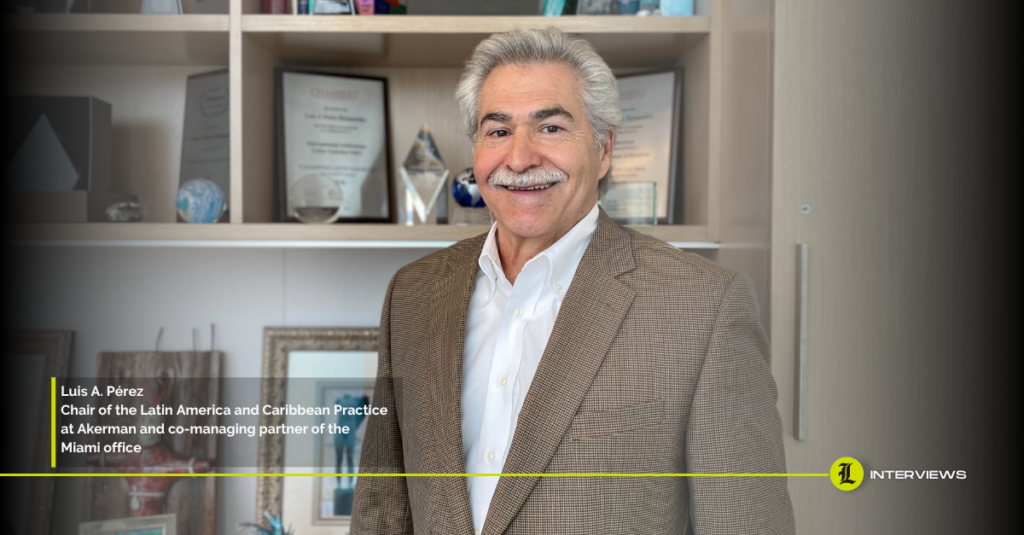
When a Latin American company needs legal advice in the United States, it has several of the most prestigious American firms on the table—all with a presence in Miami, all top-tier. For Luis A. Pérez, chair of the Latin America and Caribbean practice at Akerman and co-managing partner of the Miami office, what allows him to win those mandates is not a technical advantage: it’s trust.
In this conversation with Líder Legal, he explains how he builds that close relationship from Miami, how serious the judicial uncertainty in Mexico is today for foreign investors, what lesson he learned from representing Raytheon in a $155 million arbitration in Madrid, and why he chooses the Joyvio v. Quiroga case as the one that has most marked his arbitration career.
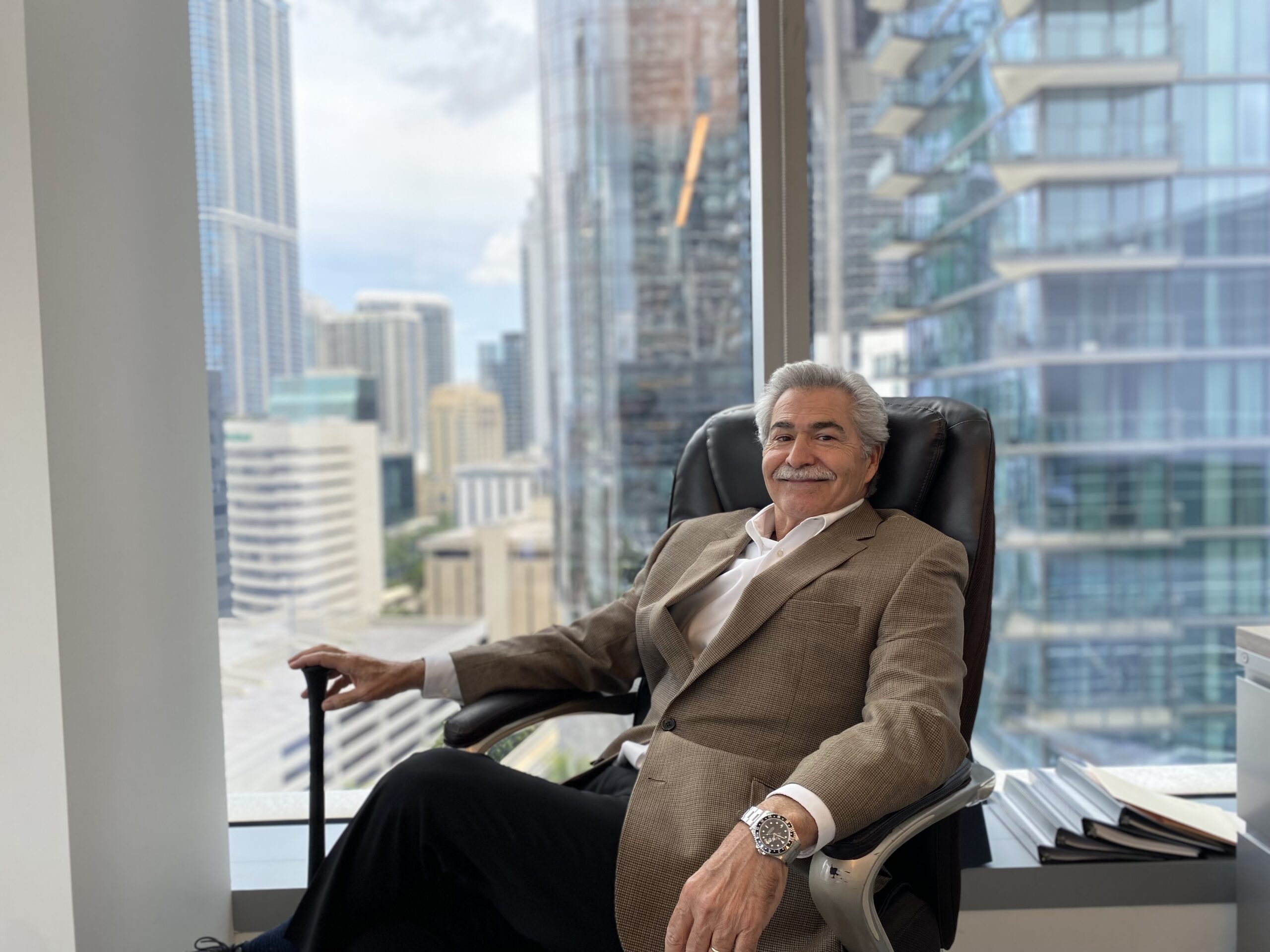
Winning the mandate from the competition from Miami
Akerman is a full-service US firm, not a native Latin American firm, and it competes for the same clients as other top-tier firms from Miami. What allows Akerman to win an mandate over those firms when the client is a Latin American company that could choose any of them?
“We have focused on providing direct client service. From the most experienced lawyers to the most junior, we are all involved in the day-to-day legal activities. Our main goal is to respond to clients as soon as they contact us. This policy has proven very effective because Latin American clients want not only a professional on their side, but also someone they know and trust. This can only be achieved by providing personalized client attention.”
Furthermore, Akerman boasts a significant number of bilingual and multicultural attorneys who not only speak fluent Spanish but also possess a deep understanding of Latin American business culture. We grasp the cultural nuances, idioms, communication styles, and business practices of different countries in the region. This cultural sensitivity fosters a unique connection with our clients, who feel they are working with attorneys who truly understand their realities, expectations, and business practices.
This combination of American legal excellence, personalized attention, and cultural understanding has allowed us to build long-term relationships with Latin American companies. Latin American clients are not just looking for a technically competent lawyer; they are also looking for a trusted advisor who understands their context and with whom they can communicate naturally and directly. We believe that this close relationship, along with our commitment to always being available and fully engaged, is what sets us apart and allows us to win mandates over other highly prestigious firms.”
Miami, still “the center of the universe” for the Latin American client
You have said that Miami is “the center of the universe” when it comes to Latin America. Is that still true today, or is it starting to face real competition from other hubs to capture that flow of investment?
“As I have said repeatedly, Miami is the northernmost city in Latin America. Latinos consider Miami their backyard; they come to visit frequently and know that in this city they will find all the professionals they need, many of whom not only speak Spanish but also have a detailed understanding of Latin American culture. Miami already has fully bicultural professionals in all areas: legal, banking, accounting and finance, real estate, medicine, etc. Latin American clients feel very comfortable and at ease carrying out any transaction they need in Miami.”
Miami, the engine of a practice that is now growing in both directions
You have led Akerman’s Latin America and Caribbean practice since the firm formalized it almost a decade ago, betting on Miami’s proximity to the region. How has the size and mandate of that practice changed from then until now?
“Today we are seeing an increase in the volume of activity with Latin America; we have seen changes from South to North and vice versa. With the political stability in some countries like Argentina, Chile, and Colombia, the volume from North to South has increased. These jurisdictions are more attractive to international investors.”
Mexico: Elected Judges and the Shadow Over the Rule of Law
By mid-2026, Mexico—historically the engine of nearshoring—appears to be the clear laggard of the region: the OECD cut its growth projection to a mere 0.8%, and much of that slowdown is attributed to the uncertainty surrounding the USMCA renegotiation that begins this year. How much is this uncertainty affecting the actual decisions of your clients who are considering investing in Mexico?
“Mexico faces several problems that have affected foreign investment. Although its economy has held up somewhat, it remains a critical and important jurisdiction. One of the serious problems it faces is the decision to open the judiciary, at all levels, to a popular vote. Some judges lack the experience and judgment necessary to handle certain important issues.”
A clear example is international arbitration. Although the process can be carried out under an international arbitral institution, the recognition and enforcement of an award necessarily falls to the judiciary of the country where the award is to be enforced. Therefore, judges will necessarily have to deal with certain legal aspects they do not routinely handle, and this can lead to erroneous decisions. In short, in Mexico there is uncertainty regarding the rule of law, and this is a critical factor for foreign investors.
Raytheon’s lesson: never accept the sovereign’s forum
You represented Raytheon’s German subsidiary in a $155 million ICC arbitration in Madrid against a sovereign government agency over a submarine repair contract. What lesson from that case would you apply today to a multinational negotiating a contract with a government in Latin America?
“The main lesson is that these types of cases—million-dollar lawsuits, multiple jurisdictions and applicable laws, and battling a sovereign—are complex and must be approached in several ways. First, you must seek a neutral forum and never try to submit to the sovereign’s jurisdiction. This is a recipe for guaranteed failure of a claim.”
Usually, one has to seek out different forums and apply pressure through various parallel processes. One must also be very wary of the sovereign’s “agents,” who will attempt to “mediate” the dispute. These attempts must be ignored, and the matter should be addressed directly to the sovereign entity handling the case. Finally, I believe it is crucial to understand that this type of fight is not only waged in a court of law, but also in the court of public opinion.
Mexico as an arbitration venue: “I have no problem choosing it”
In the area of international arbitration, what factors determine whether Mexico is a good choice as the seat of arbitration to resolve a commercial or investment dispute?
“Choosing the arbitral forum, or as it’s called in English, the “seat of arbitration,” involves analyzing several factors. In my opinion, the most important is where the debtor’s assets are located. If they are in Mexico, then I think it’s very important that the forum be Mexico. Especially if the final award is to be recognized and enforced in Mexico. The fact that Mexico is the forum doesn’t mean the arbitration won’t be neutral; that will be the responsibility of the institution conducting the arbitration and the tribunal. The main issue involves the laws of the forum, since these will have an impact on the award and its enforcement. I have no problem choosing Mexico as the forum.”
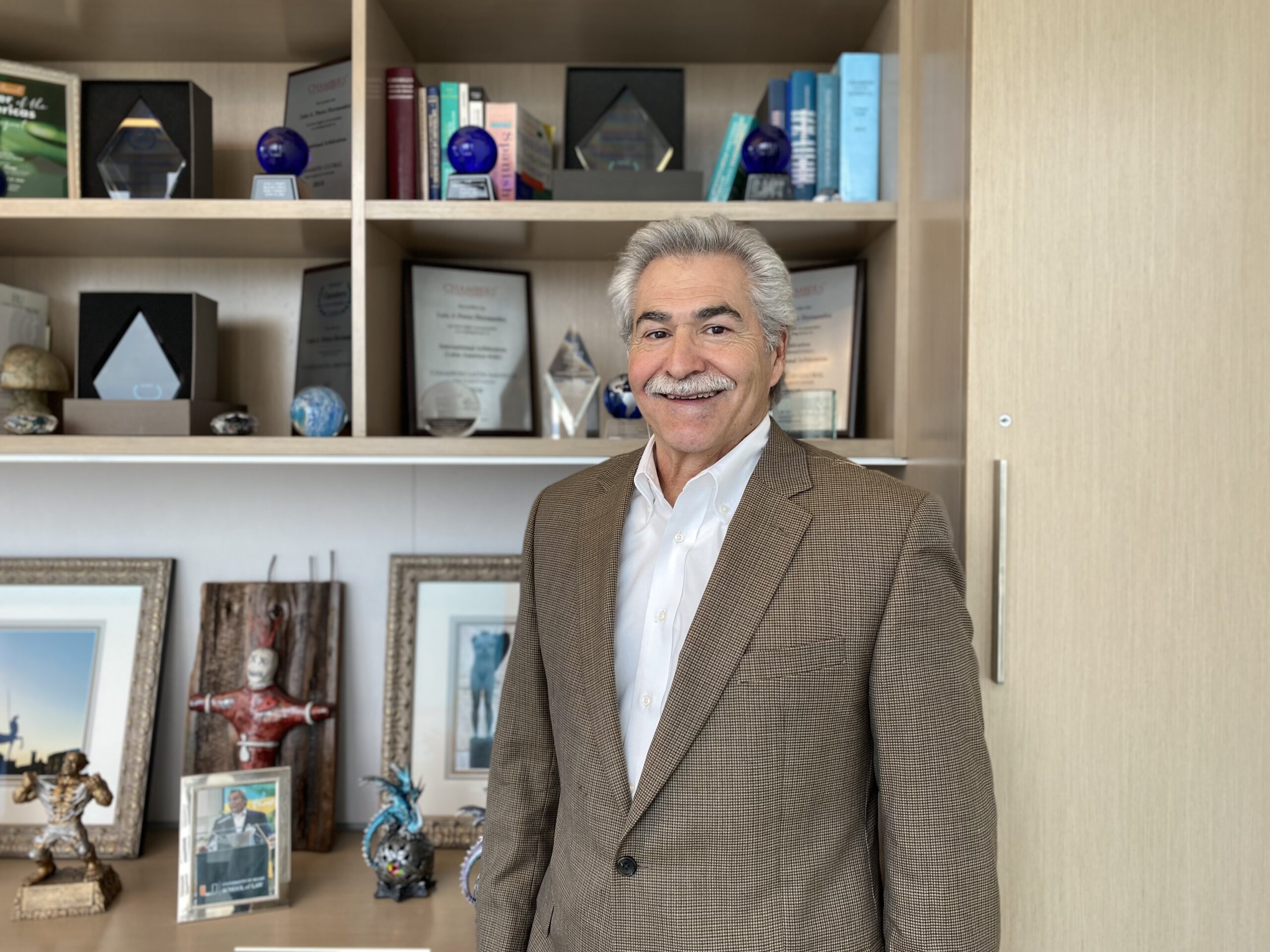
Tariffs, force majeure and the new map of disputes
Having been ranked by Chambers for international arbitration in the region for more than 16 consecutive years, what type of dispute has grown the most in volume in recent years, and what explains this?
“The greatest increase in disputes is related to political/economic issues. If a supplier of goods experiences increased costs due to tariffs, transportation costs, economic barriers, or a lack of raw materials, it will be difficult for them to meet their contractual obligations, especially since these were agreed upon when costs were much lower. Suppliers of products and services must react if their profit margin is reduced or eliminated altogether.”
That’s why contracts need an escape valve to address these changes, whether it’s the ability to renegotiate or to withdraw from the contract entirely (“force majeure”). Many disputes today revolve around the classification of events beyond the control of the parties and whether these events allow the parties to withdraw from the contract without obligation or penalty.
The risk that should most concern general counsel
Thinking about the general counsels who will be attending the Mexico City Legal Management Forum 2026 on September 3rd, what would you say is the dispute risk that should concern them the most?
“The issue that should matter most to general counsel is contract drafting. All sorts of conflicts arise from this, potentially leading to litigation or arbitration. I can’t pinpoint a specific business area, but a correctly and precisely drafted contract can resolve many of the problems that might arise. These days, with the development of AI, there’s a lot of emphasis on what Claude and other programs recommend. Many of these are beneficial, but they don’t replace the experience of professionals who have been dealing with these issues for years.”
The case that marked a career: Joyvio vs. Quiroga
In 2024, the University of Miami recognized him as “The Lawyer of the Americas” for his impact in the region. If you had to point to one case or professional decision that most clearly demonstrated that impact, what would it be?
“The case that has had the greatest impact on my arbitration practice is Joyvio v. Quiroga Spa et al. v. Quiroga Moreno. This is the case in which a Chilean company sold its salmon farm and production to a Chinese company. The Chinese company paid almost one billion dollars for the salmon farm and, after a year, initiated arbitration proceedings against the Chilean company, accusing them of inflating the farm’s value, omission, and fraud, among many other things. The sales contract includes a dispute clause requiring arbitration.”
The tribunal issued an arbitral award in favor of the Chinese company, which was appealed to a Chilean court. The Chilean court reversed the arbitral award, recognizing that the arbitral tribunal had been entirely wrong and had incorrectly applied the applicable law. This was a major victory for Chilean justice and has greatly helped to establish that international arbitration must be respected as agreed by the parties, and that arbitral tribunals cannot interpret the applicable law as they see fit, but rather in accordance with established law.
I have been fortunate enough to be directly involved in this case and am very happy that our client has been able to achieve justice in something of this magnitude and relevance.”