

The Mercosur-EU agreement has reignited the appetite of Brazilian investors, family offices, and business groups for the Portuguese market, in corporate and real estate transactions, in hotels, prime residential properties, and logistics, and in the parallel movement of private wealth transferring assets and family governance to Portugal. But this opportunity has a filter that many investors still underestimate.
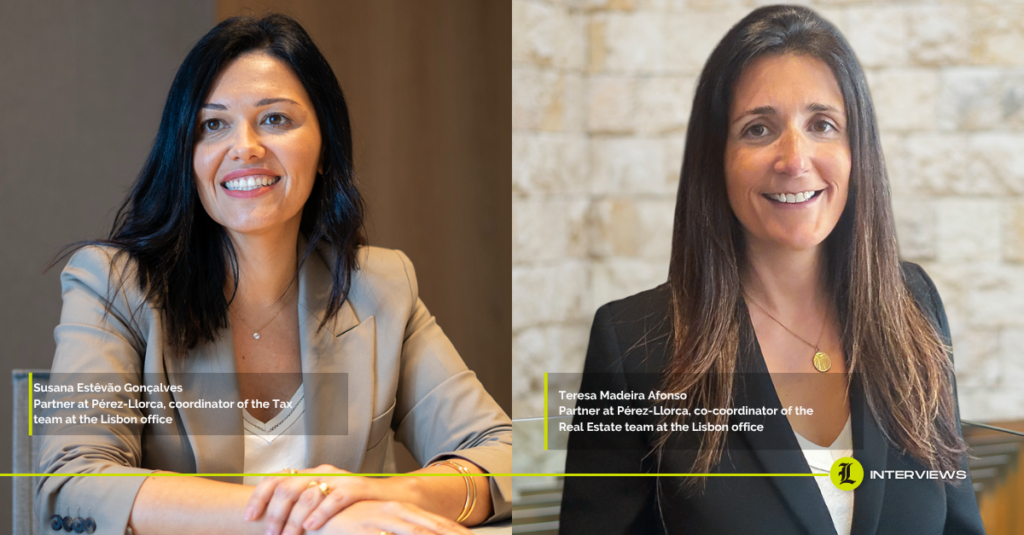
According to Susana Estêvão Gonçalves, coordinator of the Tax Law team, and Teresa Madeira Afonso, deputy coordinator of Real Estate Law—both partners at Pérez-Llorca in Lisbon—the difference between a successful transaction and one that ends in litigation or cost overruns is no longer in the asset itself, but in whether the structure that supports it withstands the scrutiny of economic substance that tax authorities now demand.
Here, both review for Líder Legal that sector map, the advantage of having a team that integrates M&A, real estate and tax from Lisbon, the challenges of structuring family and corporate wealth, and the trends -selectivity, alternative assets, ESG- that will mark the next few years on the Brazil-Portugal axis.

A axis that is being reactivated: Mercosur, Lisbon and the new investment map
How is this new political and economic context reflected in the way Pérez Llorca is viewing the Brazil-Portugal-Europe axis?
Teresa Madeira Afonso begins by placing the current situation in a macro context: “We are at a moment where several dynamics are aligning. The economic and political relationship between Brazil, Portugal, and the European Union has gained new importance: the Mercosur-EU agreement creates one of the largest free trade zones in the world and repositions Portugal as a natural gateway for Brazilian companies and investors into Europe.”
The increase in transactions between Brazil, Portugal, and the rest of Europe requires teams with a thorough understanding of both sides of the Atlantic, capable of translating distinct legal and business realities into a common language. In the real estate and asset investment sector, we are experiencing this shift very concretely. Foreign investors and groups, including Brazilian ones, are viewing Portugal as a gateway to Europe and a platform for investing in assets that combine heritage value with business value: hotels, logistics, data centers, and tourism projects.
From Lisbon, we have supported the structuring of these investments with dynamic teams that integrate the areas of M&A, private equity and real estate, with an integrated understanding of the Brazil-Portugal-Europe axis.”
Her partner, Susana Estêvão Gonçalves, applies this same shift to the tax arena: “From a tax perspective, this framework is also highly relevant. Taxation has long since ceased to be merely an accessory financial variable and has become an integral part of strategic investment decision-making, especially when we talk about cross-border structures, capital flows, dividend distribution, intragroup financing, or corporate reorganizations.
For Brazilian investors looking towards Europe, Portugal is often presented as a natural jurisdiction for analysis, but that assessment has to be done with an integrated view of economic substance, regulatory framework and fiscal predictability.”
Hotels, prime residential and logistics: the sector map and the two stages of due diligence
Lisbon is often touted as a preferred hub for Brazilian companies and capital. What types of transactions and sectors are showing the most dynamism along this Brazil-Portugal axis, and what are some of the main legal challenges these transactions present?
Madeira Afonso identifies three focal points: “We see activity mainly in three areas: hotels and tourism, residential in prime locations and alternative assets such as logistics and data centers.
In many cases, these operations are linked to the installation of technology platforms or service centers for European operations. The legal challenge lies in simultaneously supporting the asset and the structure—licenses, registration, and operating agreements on the one hand; vehicles, financing, and relationships with local partners on the other. When these dimensions are aligned from the outset, the investor has a clear view of the risk and value of the operation.
Estêvão Gonçalves brings that sector map down to practical ground: “In their tax component, these operations frequently raise very practical questions: what is the most suitable vehicle for investment, how to treat flows between Portugal and other jurisdictions of the group, what impacts exist in terms of financing, distribution of results or possible future divestments. In more sophisticated structures, it is also essential to anticipate how the operation might be viewed by the various tax authorities involved, especially in a context where transparency and economic substance are increasingly crucial.”
When the conversation shifts from the sector map to the specific realm of real estate, both partners detail how these transactions are structured in practice. In recent years, real estate in Portugal has been one of the main gateways for international capital. When they look specifically at Brazilian investors and groups, what types of transactions do they see most frequently, and what aspects do they consider most critical in their structuring?
Madeira Afonso provides the same sector map, now with the operational detail of due diligence: “In the case of Brazilian investors and groups, we see three types of transactions with some recurrence. First, hotels and tourism, where Portugal is a consolidated destination and continues to attract projects for the renovation, repositioning, and development of new assets. Second, residential properties in prime locations, often with a long-term rental or build-to-rent focus, rather than for owner-occupied housing. Third, logistics and alternative assets, such as data centers or projects linked to food distribution and nature tourism.”
From a legal standpoint, there are two key moments. The first concerns the asset itself: urban planning and licensing due diligence, registration status, contracts with hotel operators or tenants, and environmental and construction risks.
The second point concerns the structure: a large part of these operations are carried out through special purpose vehicles, with indirect acquisitions of shares, associated financing, and sometimes joint ventures with local partners. Structuring these components from the outset avoids future problems, especially when we are talking about investors who, in addition to their wealth, also have significant business groups in Brazil.”
Estêvão Gonçalves closes the point with the part that is not immediately apparent: “It is not enough to understand the taxation of the asset; it is necessary to understand the taxation of the structure that holds it, the forms of financing used and the way in which the investment may be transferred or divested.
In real estate assets, the choice between direct acquisition, indirect acquisition, co-investment or joint venture can have several relevant impacts on the tax profile of the transaction over time.”
The advantage of thinking about the asset and the structure at the same time
In a global firm like Pérez Llorca, with a strong Iberian presence and a Portuguese-speaking team in Lisbon, what is the specific competitive advantage for Brazilian family offices, investors, and firms that see Portugal as a platform for entering the European Union?
For Madeira Afonso, the answer lies in how the team works, not just where they sit: “The advantage is in integration. In Lisbon, we have a team that combines M&A, private equity, and real estate, and that knows, from experience, both the Portuguese and Brazilian contexts. This allows us to see a transaction not just as the purchase of an asset, but as a piece of a larger strategy—one that involves assets, operating companies, and various jurisdictions.”
For a Brazilian family office or investor, it’s crucial to be able to discuss a project with a team that understands their decision-making process and can reconcile European requirements with the realities of their businesses. Having a strong and structured Iberian and Latin American presence, along with connections to other jurisdictions relevant to Brazil, allows us to offer greater support to those who want to approach these transactions from a truly international perspective.”
Estêvão Gonçalves translates this into terms of timing: “From a tax perspective, this competitive advantage is also measured by the ability to anticipate challenges. In international transactions, it’s common for investors to look at the asset or business first and only then at the tax structure; our role is precisely to ensure that these two stages of analysis are carried out in parallel. In this way, we reduce noise, avoid duplication of effort, and enable the construction of more robust structures, both for corporate investment and for family wealth and private clients.”

When family heritage crosses the Atlantic
Alongside corporate investment, there is a significant private wealth movement, with Brazilian families choosing Portugal to live and expand their businesses in Europe. What types of legal and governance structures have they found, and how does the combination of international wealth planning, taxation, and real estate become crucial?
Madeira Afonso describes a recurring pattern among the families who arrive: “These families aren’t just looking for a property in Portugal—they want to understand how that asset fits into their overall portfolio and the group’s strategy. Typically, there’s an international holding company at the top, special purpose vehicles for investments in Portugal, and below that, assets with a strong heritage and business component.”
What we do, in coordination with the M&A and tax teams, is ensure that the structure makes sense within the global group, that the assets are properly registered, and that the operating agreements reflect how the family wants to manage risk and return. When wealth planning, the corporate structure, and the asset reality are aligned, the investment becomes coherent.”
Estêvão Gonçalves adds the variable that most worries these families: “One of the primary concerns of these families is understanding how the rules of the different jurisdictions in which they operate are structured. Often, we are talking about structures that involve stakes in companies, real estate in several countries, investment vehicles, and diversified income streams.”
The challenge is to ensure that the tax design aligns with the economic reality and the family’s long-term goals, avoiding unnecessary double taxation and, at the same time, steering clear of solutions that could generate reputational risk or future litigation.
The way a business family or a private client structures its wealth must be technically sound, but also consistent with current demands for transparency and substance. Therefore, international wealth structuring can no longer be treated as an isolated exercise: it must be linked to the structure of the companies, real estate assets, succession planning, and the very way the family wants to be present in Portugal and Europe.
Three trends, two readings: selectivity, alternatives, ESG and substance
When you think specifically about Brazilian investors and groups, what trends do you think are most relevant to follow in the coming years?
Madeira Afonso organizes his response into three points, from the asset’s perspective: “I would highlight three.
- The first is market selectivity: we are no longer in a phase of generalized price increases, but rather one of highly concentrated appreciation in quality assets that are well-located and have good operational performance. For a Brazilian investor, the choice of asset is now as important as the decision to enter Portugal.
- The second is the consolidation of alternative segments—logistics, data centers, assets linked to health, education, and nature tourism. In many cases, these segments allow companies to leverage existing competencies in Brazil, whether under construction or in operation, and adapt them to a European context.
- The third is the growing relevance of ESG issues: energy efficiency, certifications, and environmental and social impact. These factors already influence not only asset values but also the appetite of financiers and secondary investors, which is particularly relevant for those entering with a medium- to long-term perspective.”
Estêvão Gonçalves responds with his own trio, from the fiscal and regulatory angle: “I would also highlight three trends.
- First, the growing importance of economic substance and international transparency: Structures that do not reflect the reality of investment have increasingly less room.
- Secondly, there is a need to closely monitor the evolution of the regimes applicable to investment, wealth and cross-border flows, because small changes can have a material impact on the efficiency of the structure.
- Third, the growing importance of taxation as a reputational and strategic variable: today, investing well also means structuring well, with long-term predictability and consistency.”
Advice for your first investment: objective, due diligence and structure from day one
What advice would you give today to a Brazilian investor, business group, or family office considering their first investment in Portugal?
Madeira Afonso summarizes it in three steps: “The first piece of advice is to clarify the objective: whether it is a more asset-oriented operation, a more business-oriented one, or a combination of both. That answer determines the type of asset, the corporate structure, and the form of financing.
The second is to not forgo due diligence, especially regarding urban planning, registration, and contracts. Portugal is a safe and predictable market, but this does not exempt one from verifying, on a case-by-case basis, licenses, contracts, and potential contingencies. Many problems that arise later could have been identified at this stage.
The third is to think about the structure from the beginning in conjunction with the Brazilian reality: where the holding company is located, what vehicle to use in Portugal, how the eventual exit will be carried out and how all this is articulated with the wealth planning of the family or the group.”
Estêvão Gonçalves concludes the interview with the idea that summarizes the central argument of the conversation: “I would add that this process must be undertaken from day one with an integrated vision encompassing legal, tax, and business aspects. A good asset within a poorly designed structure can generate inefficiencies, litigation, or unnecessary costs for years. Conversely, when the investment and its respective structure are planned in advance, with substance and a clear long-term logic, Portugal can function very well as an investment platform, a means of asset restructuring, and a European expansion for Brazilian investors.”