
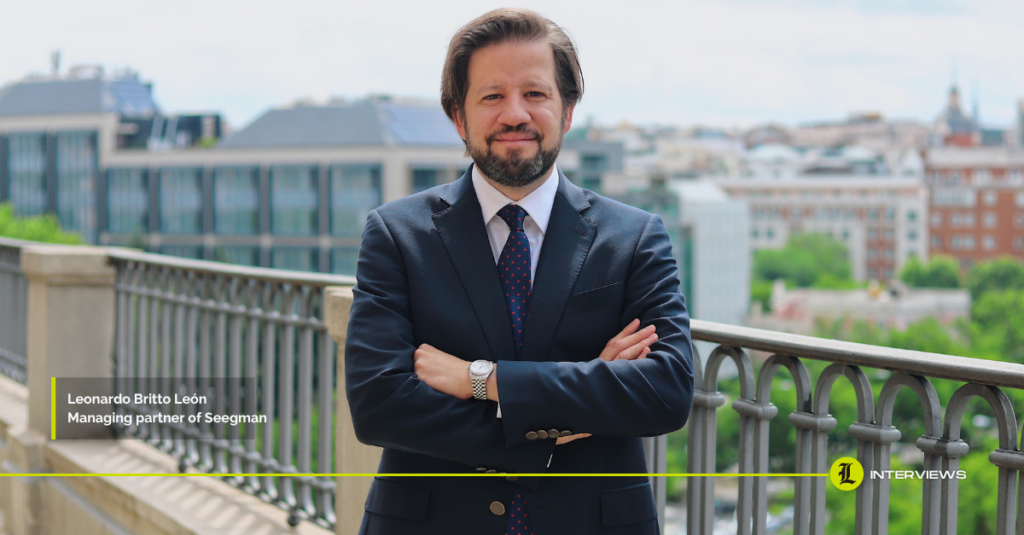
Seegman is a Madrid-headquartered business law firm with an office in Lisbon, practising across corporate, tax, corporate governance, international mobility and M&A. Its client base is predominantly international. The firm has built its reputation on recurring engagements rather than isolated mandates, a distinction its managing partner, Leonardo Britto, treats not as a positioning choice but as a structural one.
In this interview with Líder Legal, Britto sets out how that model operates across the Iberian Peninsula and why Spain and Portugal occupy a central position in the Ibero-American business ecosystem today.
A firm defined by its clients, not its transactions
The legal market defaults to episodic engagement: one transaction, one client, one team. Seegman was built on a different premise. Since its founding, the firm has concentrated on something harder to construct and harder to replicate: sustained trust.
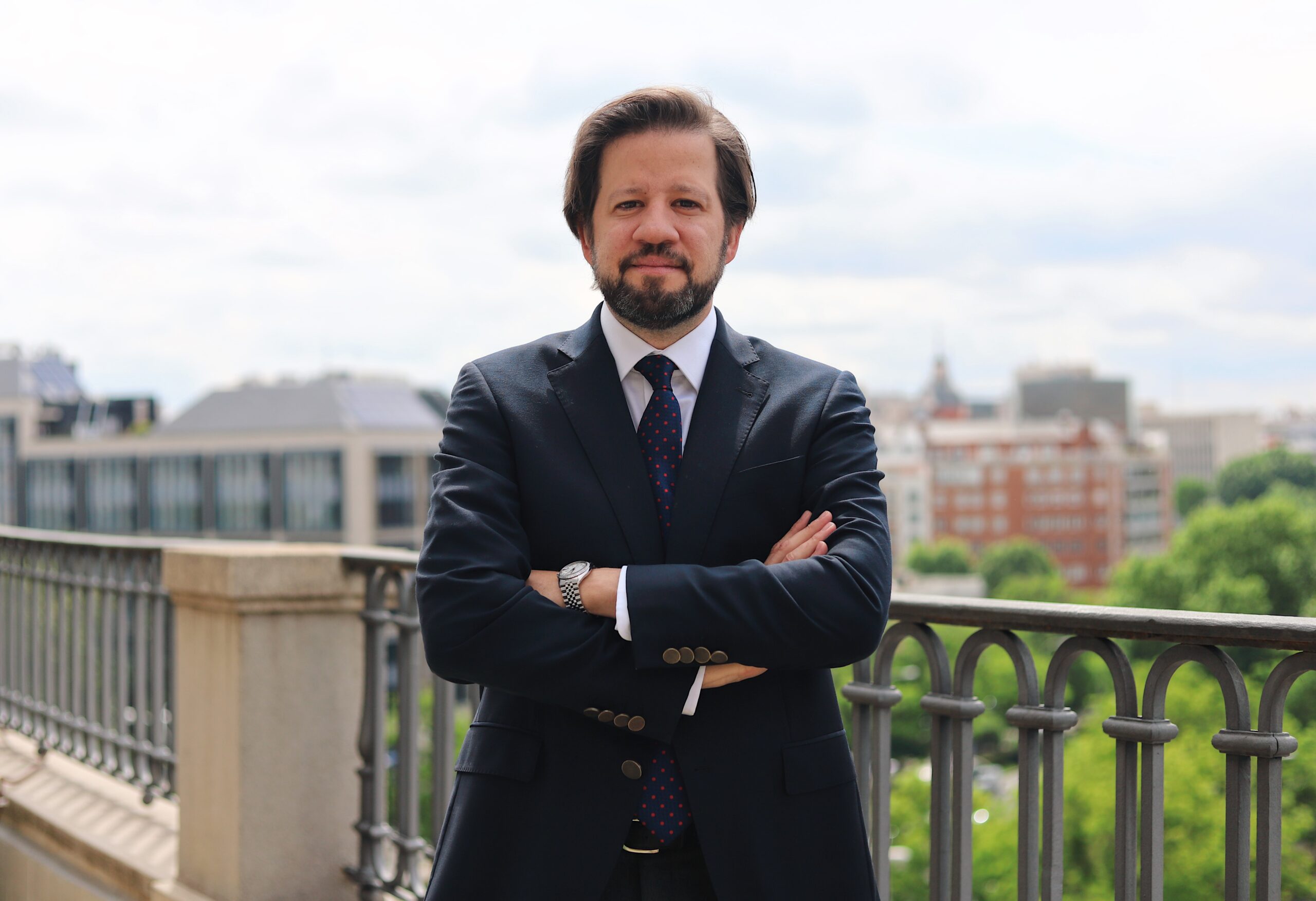
“Seegman has not been built by advising clients on one-off transactions, but on long-term, trusting relationships that are very focused on the client’s actual business,” says managing partner Leonardo Britto.
That philosophy has a concrete structural expression. The firm brings together commercial, corporate, tax, labour, international mobility and corporate governance practices under one roof, with headquarters in Madrid and an office in Lisbon. The design is deliberate: to support the client across their entire business lifecycle, not only at a single point of need. “This growth has not been accidental; it reflects a client-centric approach to consulting, focused on recurring engagements and delivering business-oriented solutions.”
The international client
Seegman’s portfolio is deliberately mixed. It includes foreign companies establishing operations in Spain or Portugal, subsidiaries of international groups, family businesses restructuring assets in Europe, and Latin American entrepreneurs entering the Iberian market. The common thread is not sector or size but a shared requirement: an adviser who understands the business before engaging with the legal problem.
“We work extensively with foreign companies investing or establishing themselves in Spain or Portugal; with international groups requiring ongoing corporate and tax management; with Latin American entrepreneurs reorganising their assets or activities in Europe; and with clients seeking an adviser capable of understanding both the legal and business dimensions of their decisions.”
The combination of agile scale and a varied client base produces what Britto considers a genuine differentiator: “We are a firm that, due to its size and philosophy, works in an agile way, and because of the diverse profile of our clients, we can transfer knowledge and experience across cases and industries throughout our portfolio.” That capacity to move solutions between industries and jurisdictions is what clients capture when they reach for a phrase he readily endorses: “Many clients tell us we are resourceful people – and I think they are right.”
Bridging legal and business cultures
Britto’s trajectory, Venezuela, Spain, Portugal, is not incidental biography. It is part of the intellectual framework Seegman brings to each matter. Experience across European and American environments, he says, “helps me to have a cross-cutting perspective, to think about comprehensive solutions applicable in the jurisdictions where our clients operate.”
That perspective matters most when a client arrives with a structure already established elsewhere. “When a foreign entrepreneur, family or company arrives in Spain or Portugal, they bring a structure and strategy to which the European project must adapt. Often, the pre-existing structure dictates how we carry out our work.”
From that starting point, the firm’s role becomes clear: “We have the ability to build bridges between different legal and business cultures, and I like to think that behind that philosophy there is part of my way of understanding the business.”
Small-market M&A: when the human factor is as consequential as the legal
One of Seegman’s growth areas is M&A involving small and medium-sized companies, particularly transactions with a family or cross-border dimension. The legal market tends to undervalue this segment; it operates by its own logic.
“In these types of transactions, the human, family or strategic component often carries as much weight as the legal one,” Britto notes. The distance from large-market deals is not merely one of scale: “Unlike large corporate transactions, in the small market the client usually experiences the transaction very directly: it may be a family business, a first sale, an investment, or a decision that marks a new phase.”
That proximity demands a different adviser. Technical rigour is necessary but not sufficient; the work also requires the ability to explain clearly, sensitivity, and a practical business vision. Integrating disciplines is decisive: “Properly preparing the structure, anticipating contingencies, and effectively coordinating the process can determine whether the transaction succeeds.”
Three recurring mistakes in foreign investment
In foreign investment and corporate reorganisations, the same errors recur regardless of the client’s origin. The first is almost instinctive: importing solutions that work at home. “One of the most frequent mistakes is replicating structures that work in another jurisdiction without analysing whether they are suitable in Spain or Portugal. The proximity and similarity between legal systems can be both an advantage and a disadvantage; we help translate legal realities to ensure the continuity of a global strategy adapted to the different jurisdictions involved.”
The second is a failure of timing: “Seeking advice too late. In international investments, reorganisations or mergers and acquisitions, correcting a poorly designed structure is usually far more expensive than planning it properly from the outset.”
The third is subtler but equally costly: “Many times the client believes their need for advice lies in executing that first transaction, the acquisition of a company, a property investment, and they do not plan adequately for divestment or maintenance scenarios over the medium and long term.”
The Ibero-American corridor as ecosystem
The relationship between Latin America and the Iberian Peninsula is one of the more significant phenomena in the legal and property markets of recent years. It sits at the centre of Seegman’s practice: the firm’s simultaneous presence in Madrid and Lisbon allows it to operate across both gateways into Europe. Britto reads this relationship from within, shaped by experience on both sides of the Atlantic.
The flow of Latin American capital into Spain -and increasingly Portugal- runs on more than financial logic: “There are cultural, linguistic, legal, educational and quality-of-life factors that explain this trend.” The result is a wealth-management and succession-planning phenomenon of growing importance to specialist firms: “Many Latin American families are internationalising their assets, diversifying investments, planning for succession, or relocating part of their personal and business lives to Spain as an increasingly common alternative to Miami.”
The movement runs in both directions. Spain and Portugal regard Latin America “as a natural market for expansion, especially in sectors where there is already experience, affinity and shared knowledge.”
The opportunity, he argues, lies not in capturing individual transactions but in understanding the full scale of what is happening: “The greatest opportunities will be for those who understand that relationship not as an isolated operation, but as an ecosystem.”
Governing from within
Few experiences train a corporate lawyer more effectively than sitting on the other side of the table. Britto has served on the boards of directors of multinational corporations, and that experience now shapes his approach to corporate governance advisory.
“It provides a very different understanding of how decisions are actually made in a company. It brings a business perspective and a business component to our relationship with clients.” Advice, from that vantage point, extends beyond the regulatory: “It is not simply a matter of stating what the regulations allow or prohibit, but of helping the board of directors make informed, well-documented and effective decisions.”
Governance failures, in his experience, rarely originate at the level of strategy: “Many times, corporate governance problems do not arise from major strategic decisions, but from a lack of order and rigour in internal procedures.”
Where Seegman is headed
Britto’s connection to academia, as student, then lecturer in Spain, gives him a particular vantage point on the profession’s transformation. His assessment of artificial intelligence is among the more direct in current legal debate: “AI has considerably reduced the value of legal knowledge for lawyers, making the development of complementary skills an even greater challenge and commitment for new generations.”
He prefers concrete tools to abstract qualities. Some are familiar: discipline, technical rigour, attention to detail, working towards objectives. Others are what separate lawyers today: “understanding the client’s business so as to see the overall problem, not only the legal aspects; supporting the comprehensive solution, not merely doing the legal work well. Additionally, mastery of AI tools that maximise productivity.”
That is the direction Seegman is taking. Not a firm that grows by accumulating mandates, but one that develops in alignment with what its clients actually need. “We want to be the firm our clients need, optimised through AI-supported processes, increasingly international and profitable, and above all, focused on solutions that add value to our clients’ businesses.”