

The legal sector is undergoing a profound transformation. Technology, new business models and evolving organisational structures are redefining how law is practised and how firms are led.
To mark International Women’s Day on 8 March, we have brought together a series of conversations with women who are actively shaping this change. From legal innovation and firm strategy to team management and organisational transformation, these professionals offer valuable insights into the present and future of the legal profession.
Beyond the positions they hold, these interviews aim to explore how they think, how they lead and how they view the direction in which the profession is evolving.
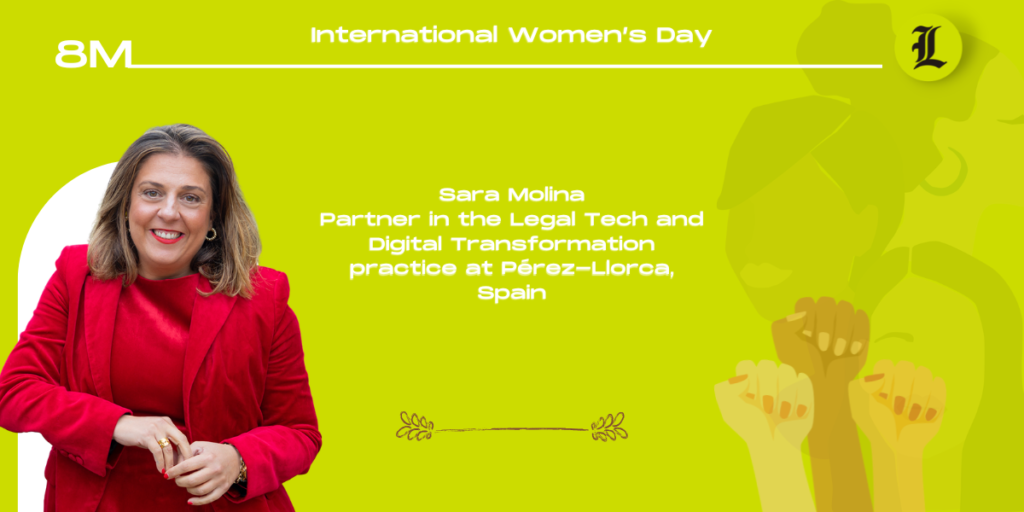
The first conversation is with Sara Molina, partner in the Legal Tech and Digital Transformation practice at Pérez-Llorca, one of the professionals most actively promoting the incorporation of technology and new operating models within the legal profession. From this vantage point, she observes how innovation is redefining not only the way legal services are delivered, but also the leadership dynamics within law firms.

Leading the technological transformation of Law
Innovation is a frequent topic of conversation in the legal sector. However, for Sara Molina, the real challenge lies not in technology, but in the cultural shift it demands. Throughout her career, she has observed that much of the resistance hindering the sector’s transformation stems not from a lack of tools or resources, but from deeply ingrained mindsets.
“The biggest challenge remains cultural,” he explains. For decades, prestige within the legal profession has been built around very specific metrics of value and a rather individualistic conception of professional performance. Technological transformation is forcing a re-evaluation of that logic. It’s not about replacing the traditional model of practicing law, but about expanding it to incorporate new ways of creating value for the client.
This change also implies a review of how work is organized within law firms. The legal profession has historically been very self-sufficient, not very open to collaboration with other disciplines. However, technological transformation demands precisely the opposite: working with technologists, data analysts, designers, and process specialists.
“Moving from closed specialization to collective intelligence is probably one of the biggest structural challenges in the sector,” Molina points out.
A new space for leadership in the legal sector
In this context of transformation, technological leadership is generating new opportunities within the legal sector, especially for female lawyers.
Legaltech has expanded the ways in which influence can be exerted within a legal organization. Today, a lawyer can lead the design of a digital legal product, an automation strategy, a knowledge management system, or a legal data architecture with a direct impact on clients’ businesses and the efficiency of organizations.
“We are seeing how legal leadership is beginning to be built also on the creation of solutions,” explains Molina. This represents a significant shift from traditional models in which professional influence was more closely linked to hierarchical position or very specific career paths within the firm.
In the field of innovation, leadership is built differently: from the ability to understand complex problems, translate them into operational solutions, and mobilize multidisciplinary teams to implement them.
Many female lawyers are finding in this space a way to exert real influence within organizations.
“Innovation leadership is based less on formal position and more on the ability to connect disciplines, build teams, and bring ideas to life.”
Innovating is also practicing law
Molina’s commitment to legal innovation also stems from a reflection on the very concept of legal practice. For a long time, professional excellence within the sector has been identified almost exclusively with traditional legal advice.
That paradigm remains very powerful, but the transformation of the sector is expanding its boundaries.
“The turning point comes when you understand that transforming how legal services are delivered is also a form of practicing law,” he explains. From this perspective, innovation doesn’t appear as an alternative to legal practice, but as a natural extension of it.
Working in innovation allows us to observe the impact of law from a different perspective. While traditional legal advice operates on a case-by-case basis, legal innovation can transform entire processes, improve decision-making, or make the law more accessible and efficient for entire organizations.
“The impact ceases to be individual and becomes systemic.”
The role of women in the transformation of the sector
In this transformation process, Molina observes that many women are playing a particularly important role as drivers of change.
She clarifies that there is no single model of female leadership, but she does perceive that the diversity of styles is broadening the way leadership is exercised within legal organizations. She explains that women working in transformative roles often act as bridges between different disciplines and levels of the organization.
“Innovation happens at the intersections,” he points out. “Between technology, business, operations, and law. And in those spaces, we are seeing leadership that connects different people, teams, and visions.”
This integrative approach is especially valuable in complex environments such as large firms, where transforming consolidated structures requires building consensus, aligning visions, and mobilizing diverse professional profiles.
Transforming from within firms
Leading innovation processes within large law firms involves working with already established structures. For Molina, the potential for internal transformation exists, but it depends on a key factor: that innovation is aligned with the firm’s overall strategy.
When innovation is limited to isolated initiatives or experimental laboratories, its impact is small. However, when it influences how legal services are designed, how teams are organized, or how the value generated for clients is measured, its transformative capacity is much greater.
“Many things can be changed from within,” he explains. “From introducing more collaborative work models to redesigning entire legal processes or integrating technology into daily practice.”
In this scenario, companies that are integrating innovation into their strategy are also placing those who lead these processes, many of them women, at the center of the conversation about the future of the sector.
Leadership in the future of law
Looking ahead to future generations, Molina insists that legal leadership of the future will continue to rest on a solid foundation of technical excellence. Technological transformation does not eliminate the need for legal rigor; on the contrary, it reinforces it.
However, leadership in the new context of the legal sector will also require other capabilities: understanding technology, designing useful legal solutions for complex organizations, and working in an interdisciplinary manner.
“The future of law will not consist only of interpreting rules or resolving cases, but of building effective legal systems: processes, tools, operating models and digital services.”
She also recommends that those starting their careers not go it alone. Professional networks, role models, and communities of practice—especially among female lawyers—can accelerate learning and open up opportunities.
And it leaves a final reflection that sums up well the moment the profession is experiencing: the sector is evolving and many of the most interesting career paths are precisely those that dare to explore new territories.
“Leadership, to a great extent, consists of daring to build paths before they are clearly laid out.”