
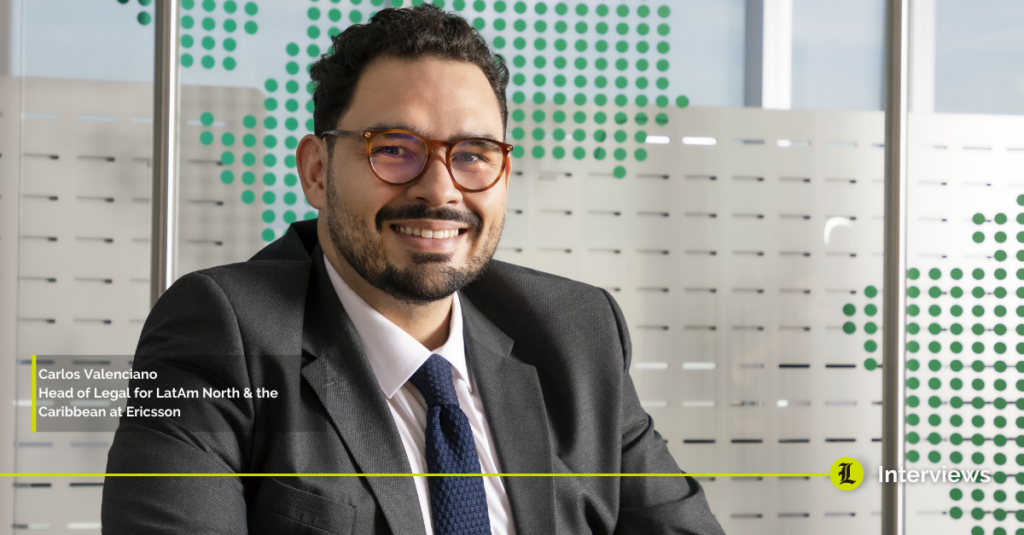
Some careers are explained by the positions held; others are better understood through the difficult decisions that shape them. Carlos Valenciano’s clearly belongs to the latter category. Leaving a solid law-firm career, relocating to another country, entering unfamiliar industries and operating across complex markets was not the result of a linear plan, but the natural consequence of a persistent concern: the need to understand the law from inside the business.
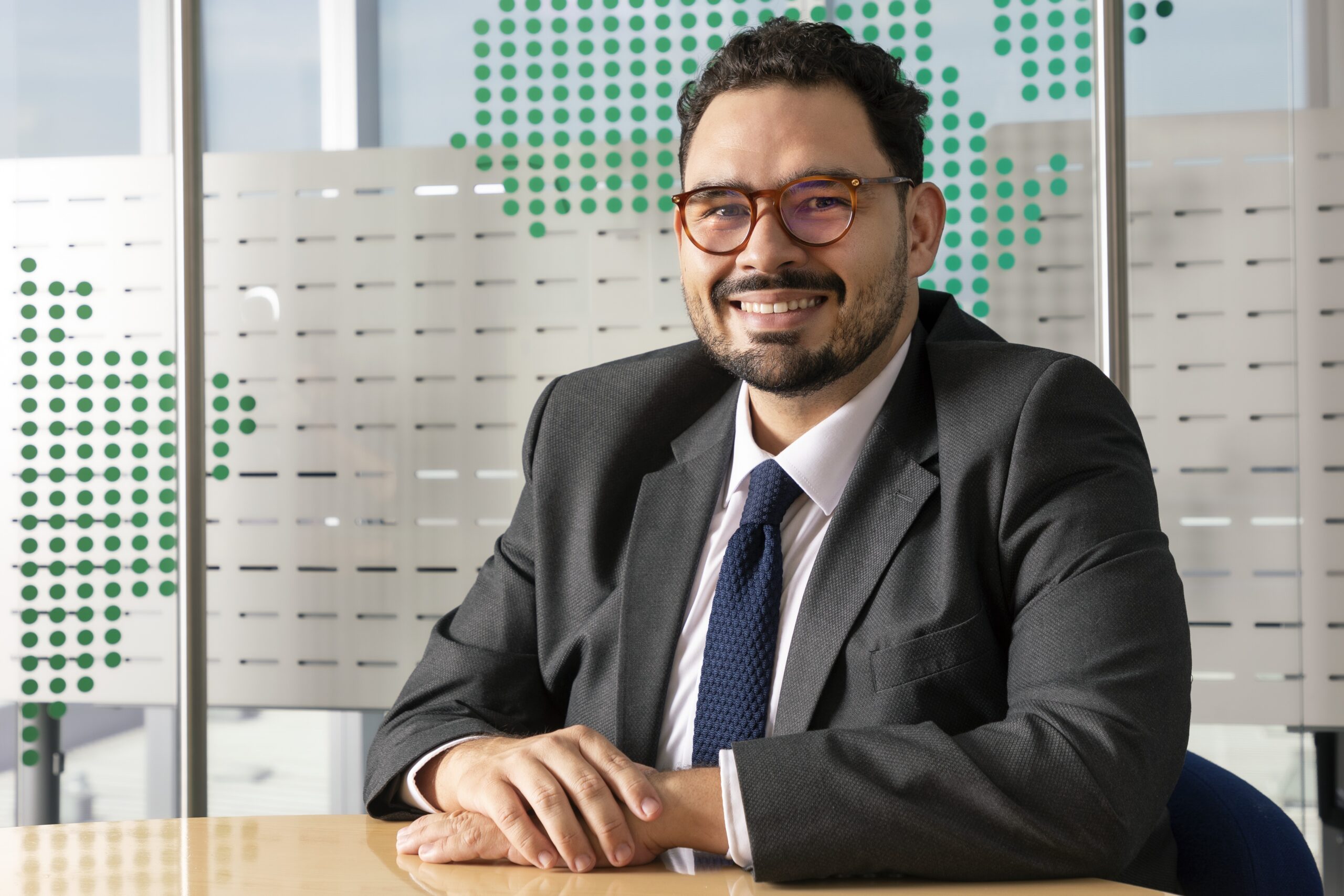
For Voices of Law: Dialogue with Partners and General Counsel from Latin America, we spoke with the Head of Legal for LatAm North & the Caribbean at Ericsson. Based in Mexico, Valenciano leads a regional legal function spanning more than 20 jurisdictions. His view of the profession is clear and uncompromising: in-house lawyers can no longer take refuge in technicalities or restrict themselves to risk containment. They must anticipate, understand technology and assume strategic responsibility. Ultimately, the law remains relevant only if it engages directly with operational realities.
Curiosity as a career driver
Looking back, Valenciano does not point to a single decisive moment, but rather to a recurring mindset. “More than a decision, curiosity has been a constant throughout my professional life,” he explains. A curiosity that operates on two levels: “on the one hand, sensing the opportunity hidden within uncertainty; on the other, being interested not only in how things work, but in how they can be improved”.
That attitude led him to leave a successful firm career to assume regional legal leadership in a completely new industry and, later, to relocate to Romania to execute a complex acquisition while overseeing legal matters across the Balkans. These experiences, accumulated through practice rather than theory, ultimately shaped his professional judgement. “As corporate lawyers, we have to leave behind the comfort of technical absolutism and adapt to the multidimensional complexity of business operations”, he says.
For Valenciano, understanding the legal framework is only the starting point. “It is not enough to internalise the company’s business model and ecosystem; you have to know in detail the goods and products it actually delivers,” he insists. This is why he defines the legal function as “a catalyst, not merely a controller, of the business”. In a highly technological environment, that approach has inevitably reshaped his professional identity.
“I believe, without embarrassment, that every day I am a little more of an engineer and a little less of a lawyer”.
The move into business and the idea of mission
The impulse to move beyond isolated mandates began even before his transition in-house. With a background in Financial Law, his firm work was largely transactional. “I intervened almost surgically to solve a specific problem, an acquisition, a financing, a restructuring, without truly understanding what would happen next”, he recalls.
That unanswered question gradually drew him deeper into his clients’ commercial and operational realities, until the move became inevitable. At Ericsson, he found something that fundamentally reshaped his understanding of the legal role. “Sharing, with thousands of colleagues around the world, a vision of unlimited connectivity as a driver of sustainable global digital transformation is extraordinary”, he says.
For a Latin American lawyer, he adds, that sense of purpose carries particular weight. “Seeing this technology applied to remote education, agricultural productivity or infrastructure management is genuinely exciting.” At that point, he concludes, “you stop seeing yourself simply as a lawyer or even as part of the business, and start to feel part of a global mission”.
Latin America: speed, complexity and judgement
Advising Ericsson across every Latin American jurisdiction has given Valenciano a perspective that is difficult to acquire elsewhere. While political, economic and regulatory volatility is not exclusive to the region, in Latin America change tends to occur at a distinctive pace. “The Latin American corporate lawyer cannot take refuge in the ivory tower of legal technicalities,” he insists.
Managing a regional legal function spanning more than 20 jurisdictions requires a careful equilibrium. “Superficial harmonisation leads to legal non-compliance, while an excessively rigid local approach can make business operations prohibitively costly,” he warns. In this context, the role of the regional legal director becomes strategic rather than merely coordinative: identifying common denominators, centralising their oversight, and prioritising risks according to “their imminence, recurrence and the severity of their potential impact”.
Anticipation, risk and value creation
For Valenciano, the value of the legal function can no longer be measured exclusively in terms of risk mitigation. “Risk management today begins ex ante, with strategic anticipation,” he argues. The legal department is not only responsible for identifying threats, but also for detecting opportunities, operational efficiencies and avenues for growth.
“The value of the legal function today lies not only in the courtroom or at the negotiating table, but also in the war room”.
Technology, and artificial intelligence in particular, has accelerated this shift. Automating contracts, due diligence processes and recurring queries allows teams to achieve in seconds what once required days of collective effort. Yet the impact goes beyond efficiency. “Artificial intelligence can be used predictively, to anticipate trends, detect patterns and generate scenarios,” he explains. This capability brings with it an unavoidable responsibility: “to act as the arbiter of its ethical use, even as regulation remains in its early stages”.
Leading teams and redefining legal talent
Leading geographically dispersed teams within matrix structures has been one of Valenciano’s most significant learning experiences as a manager. Sustaining cohesion, motivation and shared standards depends on fostering trust, open communication and genuine collaboration. The objective is not to homogenise approaches, but to integrate diverse skills and perspectives into a coherent whole.
The qualities he values most in legal talent, curiosity, critical thinking, strategic vision and the ability to synthesise information, are not new. However, in the context of expanding automation, they acquire renewed relevance. “It is not simply about being the ‘human in the loop’,” he notes, “but about exercising ethical, strategic and relational judgement.” In his view, technology will progressively liberate lawyers from transactional work, returning them to the core of their role: providing meaningful guidance and support.
Provoking the debate: Monterrey as a space for reflection
These reflections extend beyond individual practice. Valenciano’s participation in the Monterrey Legal Forum 2026, organised by Gericó Associates, responds to a deliberate intention: to open conversations that remain insufficiently developed among the region’s legal leadership.
“I want to bring to the table issues I care deeply about and that are still largely unregulated, despite being embedded in the daily operations of our companies,” he explains. Among them are mass automation and artificial intelligence, not merely as tools, but as forces reshaping the practice and purpose of law itself.
For Valenciano, the real value of such forums lies not only in the technical debate, “which is inherently very rich”, but in elevating the discussion to a collective plane. “It is worth asking ourselves, as a community, what impact these tools will have not only on the law, for example, on systems of user and consumer protection, but also on how they will redefine the role of the corporate lawyer”.
The Monterrey Forum thus becomes an almost ontological space: a setting in which to question where the in-house function is heading at a time when compliance, data protection, cybersecurity and the ethical use of advanced technologies are stretching the traditional boundaries of the legal role.
Carlos Valenciano’s career and discourse converge on a single idea. The legal leadership of the future will not be exercised through technical jargon or resistance to change, but through the capacity to ask the right questions at the right moment. From Ericsson, from Latin America, and from forums such as Monterrey, his message is consistent: a less formal, more strategic, and paradoxically more human, corporate lawyer.
In short
What’s the smartest thing anyone has ever said to you (and who said it)?
My grandmother, a German woman who will turn ninety this year and a remarkable visual artist, used to repeat this aphorism by Picasso when I was a child: “Learn the rules like a professional, so you can break them like an artist.” It applies to every aspect of life, because improvisation and spontaneity require not only technical mastery, but also deep empirical understanding. In professional terms, I’m grateful that chance shaped me early on through academic rigour and highly technical legal practice; it allows me today to operate with greater freedom and to adopt a more integrative, multidisciplinary approach.
A book?
As a Latin American, I’m naturally drawn to magical realism: The Kingdom of This World, by Alejo Carpentier, and The Left Wing (Blinding, I), by Mircea Cărtărescu.
A sport?
Fencing, which I practised in my youth. In my view, no other sport captures the essence of legal practice quite as well: a strong attack always begins with a solid defence.
A song?
Movimiento, by Jorge Drexler: “We are a species on a journey; we have no belongings, only luggage”.
If you weren’t a lawyer, what would you be?
A visual artist, or a storyteller.
Your favourite food?
Anything shared in good company.
What puts you in a bad mood?
Lack of punctuality.
A key to success?
Perseverance.