
Can international justice work when those who are supposed to apply it become targets of reprisals? US sanctions against members of the International Criminal Court, including its president , place this question at the heart of the debate. However distant The Hague may seem from Latin America, what happens there has consequences that transcend diplomacy: it affects the possibility of demanding accountability when political power closes off national avenues of justice.
First, it is important to clarify what the ICC does, or can do. It is a permanent court that tries individuals for genocide, crimes against humanity, war crimes, and, under specific conditions, the crime of aggression. However, its jurisdiction has clear limits: it cannot intervene in any atrocity, in any country, at any time, nor does it automatically replace national courts. Its operation rests on the principle of complementarity: States retain the primary responsibility for investigating and prosecuting, and international intervention is only warranted, among other requirements, when national actions are nonexistent or feigned.
There is also a structural problem that is often overlooked: as a criminal court, the ICC does not have its own police force. It needs states to arrest and extradite suspects, provide evidence, and protect those who cooperate with investigations. An arrest warrant can be legally valid and, at the same time, impossible to execute for years. This gap between decision and compliance explains why political support is indispensable, even though judicial decisions must remain independent of it.
Following the Court’s decision to issue arrest warrants for Israel’s prime minister and defense minister, as well as Hamas officials, several states decided to impose sanctions against the Court and, personally, against officials linked to the case. These measures add a new dimension to the conflict. In August 2026, the Court itself reported that nine of its eighteen judges were sanctioned by the United States, along with officials and staff from the Prosecutor’s Office. The institutional problem is clear: imposing personal costs on those involved in judicial proceedings can discourage their participation and paralyze the work of the institution. The controversy thus extends beyond whether a ruling is well-founded to encompass the very conditions that make it possible to adopt it independently.
Defending that independence does, however, require accepting scrutiny. The ICC must be accountable for the quality of its investigations, the length of its proceedings, respect for due process, and the clarity with which it sets its priorities. Criticisms of unequal justice always deserve verifiable responses. But there is a fundamental difference between appealing a decision, demanding institutional improvements, and pressuring judges to avoid an investigation. Confusing these three things allows the weakening of the justice system to be presented as reform.
Does the Court have a future? Yes, although its formal continuity offers an insufficient answer. It can continue to exist and, at the same time, lose all real capacity to investigate, protect witnesses, or make arrests. Its fate will depend on concrete decisions: sufficient funding, judicial cooperation, protection of its personnel, and sustained support against reprisals. Diplomatic statements have value, but their credibility is tested when fulfilling an obligation entails incurring a cost with an ally or a trading partner.
At the international level, the risk is consolidating a justice system whose application depends on each defendant’s ability to secure protection. No single court can eliminate power imbalances. However, accepting that these imbalances determine who can be investigated renders the aspiration for universal criminal responsibility meaningless. And it offers a worrying incentive: seeking a sufficiently powerful protector could prove more profitable than facing justice before a judge. For victims, the consequence would be a justice system conditioned by alliances over which they have no control.
Latin America is already part of this discussion. Venezuela notified its withdrawal from the Rome Statute on July 24, 2026, with an effective date registered by the United Nations of July 24, 2027. The distinction is important: announcing a withdrawal does not mean being immediately excluded from the system. The Statute itself establishes that denunciation does not extinguish certain prior obligations nor does it prevent the Court from continuing to examine issues already before it. Withdrawal does not constitute an automatic erasure of the past.
Colombia presents another possibility: the relationship between national and international justice can be geared toward strengthening domestic institutions. In 2021, the ICC Prosecutor’s Office concluded its preliminary examination of Colombia and signed a cooperation agreement with commitments to support national justice mechanisms. This precedent does not guarantee the resolution of all impunity problems, but it illustrates an important point: the Court’s relevance must also be measured by its contribution to the functioning of national processes.
And where does the Inter-American Court of Human Rights fit in? Its function is different. While the ICC determines individual criminal responsibility, the Inter-American Court establishes the international responsibility of States for human rights violations. It can order reparations and measures to prevent the recurrence of such acts, but it does not criminally convict an individual or send them to prison. Both courts can be relevant to the same events, even though they address different legal questions.
The Inter-American experience shows why this difference matters. In the case of Barrios Altos v. Peru , the Court declared the amnesty laws examined incompatible with the American Convention, as they hindered the investigation and punishment of serious violations. Its intervention sought to remove state barriers to justice, a function that remains especially relevant for those who find their own country’s institutions closed to them.
Weakening the ICC does not automatically alter the jurisdiction of the Inter-American Court; the connection is political and institutional. Normalizing reprisals against international judges can make it more acceptable for other governments to discredit or disobey the mechanisms that oversee them. This is a risk, not an inevitable consequence. Precisely for this reason, it is important to defend both institutions within their specific mandates: demanding rigor without turning every inconvenient decision into an excuse to dismantle them.
Latin American countries have a specific scope for action. They can fulfill their obligations, maintain cooperation, protect victims and witnesses, and strengthen the independence of their national courts. And they should apply consistent criteria when investigations involve politically aligned governments, because selectively upholding justice ultimately weakens the very principle it claims to invoke.
The time to decide is now
International justice is not defended within the walls of The Hague: it is defended in classrooms, in courts, at the ballot box, and in every public statement by political representatives. Whether the ICC remains capable of investigating, protecting witnesses, and carrying out arrests depends on what we do today, not on what we promise tomorrow.
We, as citizens, must inform ourselves about these cases, rigorously questioning both the Court and its detractors, and demand a consistent stance from our governments. We must demand that they speak out against sanctions against international judges, that they fund and cooperate with the system, and that they do so with the same firmness whether the accusation is against an ally or an adversary. If Latin America remains silent now, it will be saying that justice is a luxury only permitted when it is inconvenient. The victims of conflicts in Latin America cannot wait another decade to find out.
An imperfect institution needs reform and oversight; victims need it to remain capable of acting. Neither the Court nor the protection of victims will survive on its own: it is up to States to sustain them, and States are ultimately accountable to their citizens.
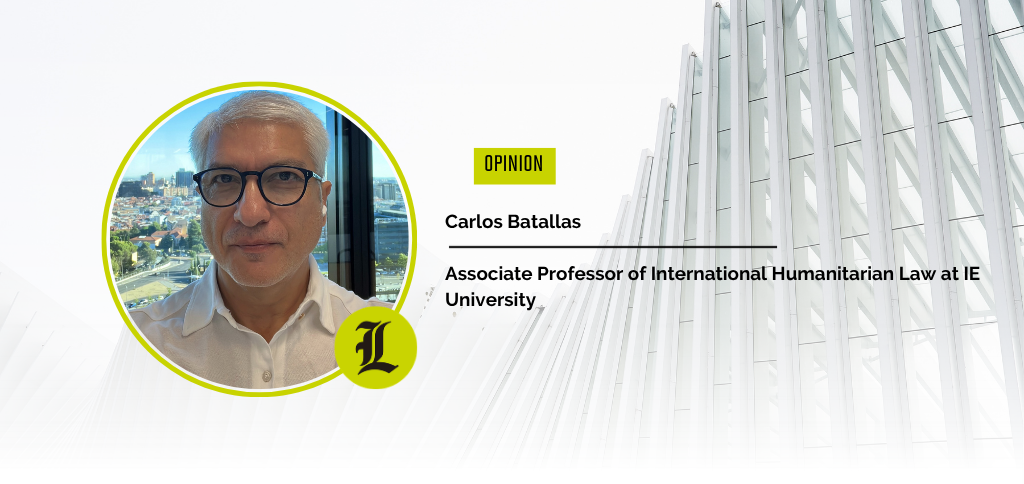
By Carlos Batallas, Associate Professor of International Humanitarian Law at IE University