

For those who structure B2B contracts and design dispute resolution strategies aimed at preserving contractual relationships, there is a question whose answer can define the future of business: Are your contractual models and your policy on the use of technology and ADR (Alternative Dispute Resolution) already prepared to take advantage of the new legislative and technological wave?
The combination of three movements can profoundly transform the way Brazilian companies contract and resolve disputes in international B2B transactions: the new General Law of Private International Law, the use of Contract Lifecycle Management (CLM) technologies, and the consolidation of appropriate methods of conflict resolution.
The draft of the General Law on Private International Law, led by Minister Luis Felipe Salomão, appears to have been designed, among other factors, precisely to provide greater security, stability, and freedom to companies and individuals when choosing the law applicable to their cross-border private relations. This aligns Brazil with the most modern legislation and strengthens the country’s attractiveness for international investment and contracting.
In the context of B2B commercial contracts and arbitration, this means:
- greater predictability and legal certainty in the choice of applicable law and in the interpretation of forum and arbitration choice clauses;
- greater coherence between what is discussed in arbitration and what is brought before the courts regarding urgent measures and enforcement;
- an approximation or equivalence of the Brazilian legal environment to the main international business centers, which reduces the “risk discount” in the valuation of international contracts with parties or execution in Brazil.
At the same time, CLM platforms already allow companies, through the application of technologies and the standardization of procedures, to centralize their contracts, automate approval workflows, control deadlines and obligations and accelerate negotiation cycles, with relevant benefits in terms of speed, reduction of administrative costs and greater contractual compliance.
In practice, a well-implemented CLM can make the contractual architecture more suitable for potential arbitrations: in addition to promoting the creation of a standardized business language, it allows for clear document traceability, active risk management, and organized evidence for potential disputes.
In the field of conflict resolution, business arbitration continues to expand, with a significant increase in the number of cases in recent years and a growing presence in diverse sectors, such as services, infrastructure and engineering, franchises or real estate leasing, among others.
The maturation of the dispute resolution system over the past few decades has solidified Brazil’s position among the most respected arbitration centers internationally, which has also driven the development of digital initiatives aimed at reducing the economic cost and average time required to resolve disputes. Arbitration has not only become established as a technically sound and efficient instrument for resolving disputes; mediation and dispute boards have also become ideal mechanisms for preserving value for both parties, thanks to their greater emphasis on collaboration and agreement.
This creates an ecosystem in which companies can negotiate and execute contracts more efficiently, with a reduction in litigation and, when the start of a contentious procedure is unavoidable, with solutions that are developed in a much more predictable environment and aligned with international best practices.
Brazil, therefore, can move towards consolidating this ecosystem, which focuses not only on resolving disputes but also on preserving relationships between private actors. The country and its economic agents appear to have the necessary mechanisms to replicate international best practices, reducing transaction costs and streamlining the processes of negotiation, signing, monitoring, and preservation of contracts.
This reality can be supported by three fundamental pillars: institutional advances, such as the approval of a modern framework of Private International Law; the adoption of CLM platforms for the negotiation, formalization and monitoring of contracts; and the intelligent design of arbitration, mediation and dispute board clauses for the resolution of disputes.
Given the convergence of a new framework of private international law, CLM technologies, and appropriate dispute resolution methods, the central question for global companies contracting in the B2B sector is no longer “if” they will adapt, but “when” and “how.” Those who update their contractual models, ADR policies, and contract management architecture now will be better positioned to reduce risks, costs, and dispute resolution times, as well as preserve strategic relationships and obtain better commercial terms. Ultimately, it’s about deciding whether the company will be a proactive force in building this new contractual ecosystem or simply react to changes, at a competitive disadvantage.
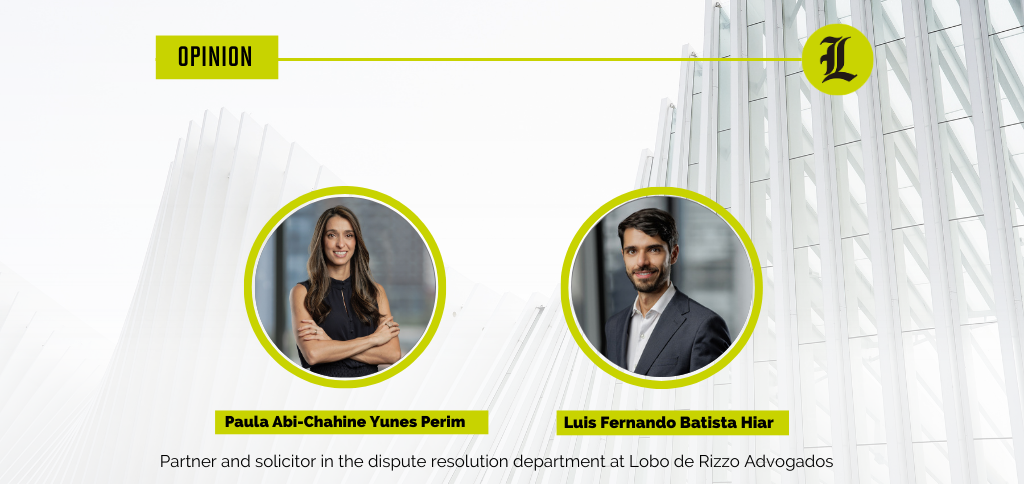
By Paula Abi-Chahine Yunes Perim and Luis Fernando Batista Hiar, partner and lawyer in the conflict resolution area of Lobo de Rizzo Advogados.